2021 · Duffner — Dechloromonas and close relatives prevail during hydrogenotrophic denitrification in stimulated microcosms with oxic aquifer material
Super-Abstract
When hydrogen gas was added to groundwater microcosms contaminated with nitrate, a specific genus of bacteria (Dechloromonas) dominated the resulting nitrate-removal community. This microbiology study examines H₂ as a fuel for environmental bioremediation of nitrate-polluted aquifers — it is entirely unrelated to therapeutic or biological H₂ use in medicine.
Commentary
Nitrate pollution in groundwater is a globally significant environmental and public health problem. One proposed remediation strategy is „hydrogenotrophic denitrification“ — injecting H₂ gas underground to stimulate bacteria that convert nitrate (NO₃⁻) to harmless nitrogen gas. This study identified which bacteria perform this task under realistic oligotrophic (nutrient-poor) oxic aquifer conditions. The finding that Dechloromonas species are the dominant performers — rather than the commonly assumed Hydrogenophaga or Sulfurimonas — is relevant to the design of groundwater remediation systems. The study has no bearing on H₂ as a biological or therapeutic agent for humans or animals.
Key quotes
- „After the microcosms were sparged with hydrogen gas, samples were taken regularly within 122 h for nitrate and nitrite measurements, community composition analysis via 16S rRNA gene amplicon sequencing and gene and transcript quantification via qPCR.“ — study design: H₂ is the electron donor for bacterial denitrification, not a therapeutic agent
- „The highest nitrate reduction rates and greatest increase in bacterial abundance coincided with a 15.3-fold increase in relative abundance of Rhodocyclaceae, specifically six ASVs that are closely related to the genus Dechloromonas.“ — core finding: Dechloromonas dominates H₂-driven nitrate removal in this aquifer type
- „We conclude that taxa of the genus Dechloromonas are the prevailing hydrogenotrophic denitrifiers in this nitrate polluted aquifer and the ability of hydrogenotrophic denitrification under the given conditions is species-specific.“ — conclusion: species identity matters for successful bioremediation design
Our assessment
This study is environmental microbiology — it uses H₂ gas as an electron donor for bacterial nitrate removal from polluted groundwater. It has no relevance to molecular H₂ as a health or therapeutic agent. Its inclusion in a medical H₂ database appears to be an indexing artefact based on the term „hydrogen.“ The research is methodologically sound within its domain (16S rRNA amplicon sequencing, qPCR of denitrification genes) and addresses a genuine environmental engineering challenge.
Study design
- Type: in-vitro microcosm experiment (environmental microbiology, not medical) · Model: nitrate-polluted oxic aquifer sediment + groundwater microcosms · H₂ role: electron donor for bacterial denitrification — not therapeutic
- Methods: 16S rRNA amplicon sequencing (community composition), qPCR of denitrification reductase genes (napA, nirS, nosZ), nitrate/nitrite measurement over 122 h
- Key finding: 15.3-fold enrichment of Dechloromonas (Rhodocyclaceae) under H₂ sparging; denitrification genes napA, nirS, clade I nosZ significantly increased — not relevant to H₂ medicine
Abstract
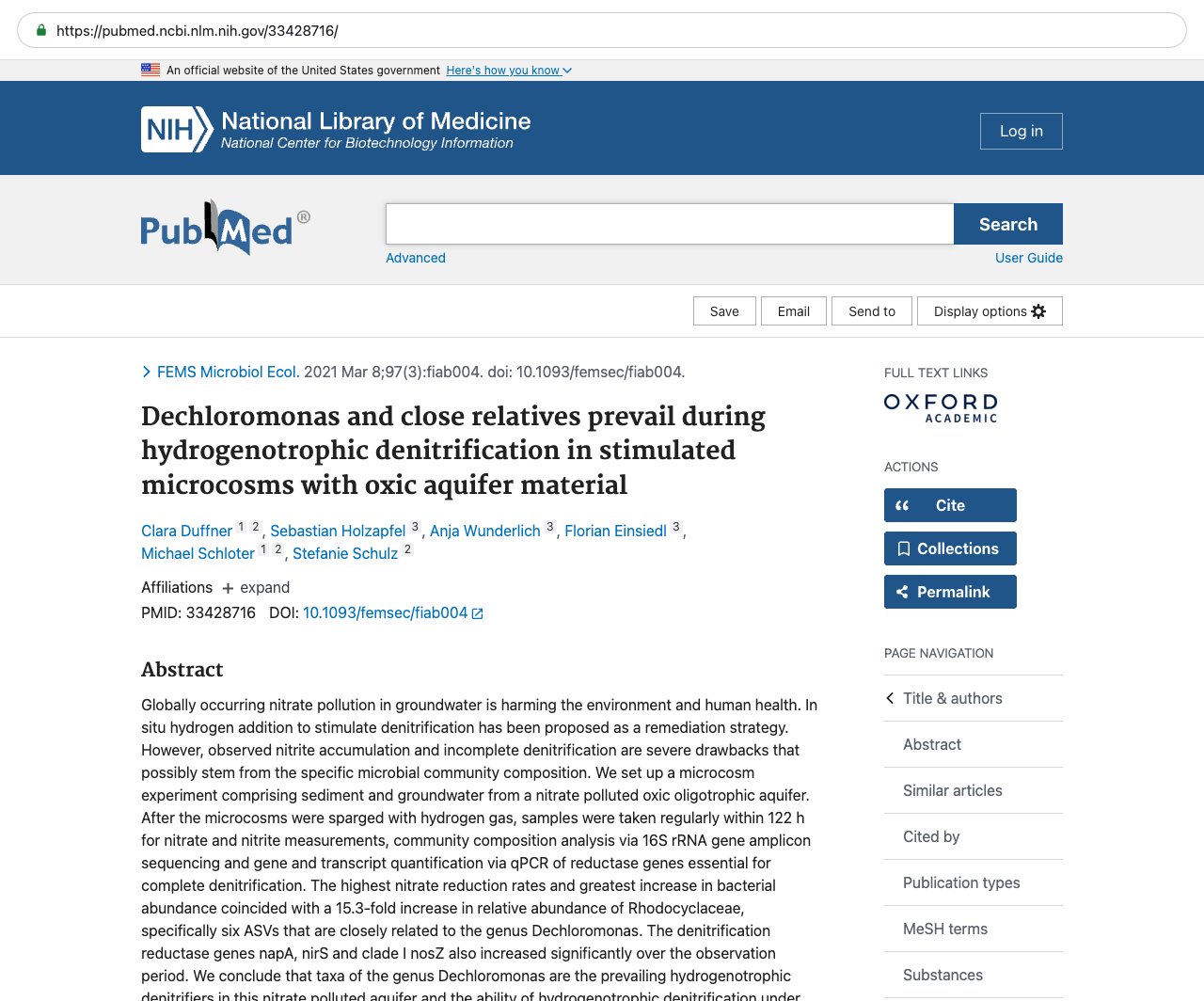
Globally occurring nitrate pollution in groundwater is harming the environment and human health. In situ hydrogen addition to stimulate denitrification has been proposed as a remediation strategy. However, observed nitrite accumulation and incomplete denitrification are severe drawbacks that possibly stem from the specific microbial community composition. We set up a microcosm experiment comprising sediment and groundwater from a nitrate polluted oxic oligotrophic aquifer. After the microcosms were sparged with hydrogen gas, samples were taken regularly within 122 h for nitrate and nitrite measurements, community composition analysis via 16S rRNA gene amplicon sequencing and gene and transcript quantification via qPCR of reductase genes essential for complete denitrification. The highest nitrate reduction rates and greatest increase in bacterial abundance coincided with a 15.3-fold increase in relative abundance of Rhodocyclaceae, specifically six ASVs that are closely related to the genus Dechloromonas. The denitrification reductase genes napA, nirS and clade I nosZ also increased significantly over the observation period. We conclude that taxa of the genus Dechloromonas are the prevailing hydrogenotrophic denitrifiers in this nitrate polluted aquifer and the ability of hydrogenotrophic denitrification under the given conditions is species-specific.
Source & links
Screenshot of the PubMed page
This page mirrors the published abstract (© the authors / publisher) for reference and citation. The canonical source is the PubMed record linked above. This is not medical advice.