2021 · Hartjen — Toward Tailoring the Degradation Rate of Magnesium-Based Biomaterials for Various Medical Applications: Assessing Corrosion, Cytocompatibility and Immunological Effects
Super-Abstract
This in-vitro materials science study tested a surface-treated magnesium alloy (WE43 with plasma electrolytic oxidation) as a degradable implant material. Molecular hydrogen appears here as a corrosion by-product generated when magnesium degrades in body fluids — not as a therapeutic agent. The surface treatment reduced H₂ gas evolution by ~41% and dramatically improved cell compatibility.
Commentary
Magnesium-based implants are an emerging class of biodegradable orthopaedic and cardiovascular devices. As magnesium corrodes in physiological fluids, it releases magnesium ions and hydrogen gas — both of which can be harmful in excess. This paper evaluates a plasma electrolytic oxidation (PEO) surface coating designed to slow corrosion. The H₂ gas evolution measurement serves as a proxy for corrosion rate, not as a therapeutic endpoint. Notably, untreated WE43 killed over 90% of human lymphocytes within 3 days — a stark cytotoxicity finding — while PEO-treated WE43 maintained >80% cell viability. The study contributes to biomaterial development, not to H₂ medicine.
Key quotes
- „Hydrogen gas evolution after two weeks was reduced by 40.7% through PEO treatment, indicating a significantly reduced corrosion rate.“ — H₂ here = unwanted corrosion by-product; PEO coating reduced it, improving safety
- „untreated WE43 killed over 90% of lymphocytes while more than 80% of the cells were still vital after incubation with the PEO-treated WE43.“ — dramatic improvement in cytocompatibility through surface treatment
- „PEO-treated WE43 slightly stimulated the activation, proliferation and toxin (perforin and granzyme B) expression of CD8+ T cells.“ — immunological side-effect to monitor in future implant applications
Our assessment
This study is not about molecular H₂ therapy. It is a biomaterials science paper evaluating a magnesium alloy coating for degradable implants. Hydrogen gas is measured as an unwanted corrosion by-product — its reduction is the goal, not its promotion. No evidence is presented for or against therapeutic H₂ use in humans. The study's relevance to H₂ medicine is indirect at most: it documents that corroding magnesium implants generate H₂, which may eventually inform discussions about local H₂ exposure in implant-bearing tissue — but this is speculative and not discussed in the paper.
Study design
- Type: in-vitro materials science (preclinical) · Model: primary human lymphocytes; immersion tests · H₂ role: corrosion by-product (H₂ gas evolution = corrosion rate proxy, not therapeutic)
- Material tested: WE43 magnesium alloy ± plasma electrolytic oxidation (PEO) surface coating
- Key finding: PEO reduced H₂ gas evolution by 40.7% (= lower corrosion); untreated WE43 killed >90% of lymphocytes; PEO-treated WE43 maintained >80% lymphocyte viability; mild CD8+ T-cell activation noted
Abstract
Magnesium (Mg)-based biomaterials hold considerable promise for applications in regenerative medicine. However, the degradation of Mg needs to be reduced to control toxicity caused by its rapid natural corrosion. In the process of developing new Mg alloys with various surface modifications, an efficient assessment of the relevant properties is essential. In the present study, a WE43 Mg alloy with a plasma electrolytic oxidation (PEO)-generated surface was investigated. Surface microstructure, hydrogen gas evolution in immersion tests and cytocompatibility were assessed. In addition, a novel in vitro immunological test using primary human lymphocytes was introduced. On PEO-treated WE43, a larger number of pores and microcracks, as well as increased roughness, were observed compared to untreated WE43. Hydrogen gas evolution after two weeks was reduced by 40.7% through PEO treatment, indicating a significantly reduced corrosion rate. In contrast to untreated WE43, PEO-treated WE43 exhibited excellent cytocompatibility. After incubation for three days, untreated WE43 killed over 90% of lymphocytes while more than 80% of the cells were still vital after incubation with the PEO-treated WE43. PEO-treated WE43 slightly stimulated the activation, proliferation and toxin (perforin and granzyme B) expression of CD8+ T cells. This study demonstrates that the combined assessment of corrosion, cytocompatibility and immunological effects on primary human lymphocytes provide a comprehensive and effective procedure for characterizing Mg variants with tailorable degradation and other features. PEO-treated WE43 is a promising candidate for further development as a degradable biomaterial.
Source & links
Screenshot of the PubMed page
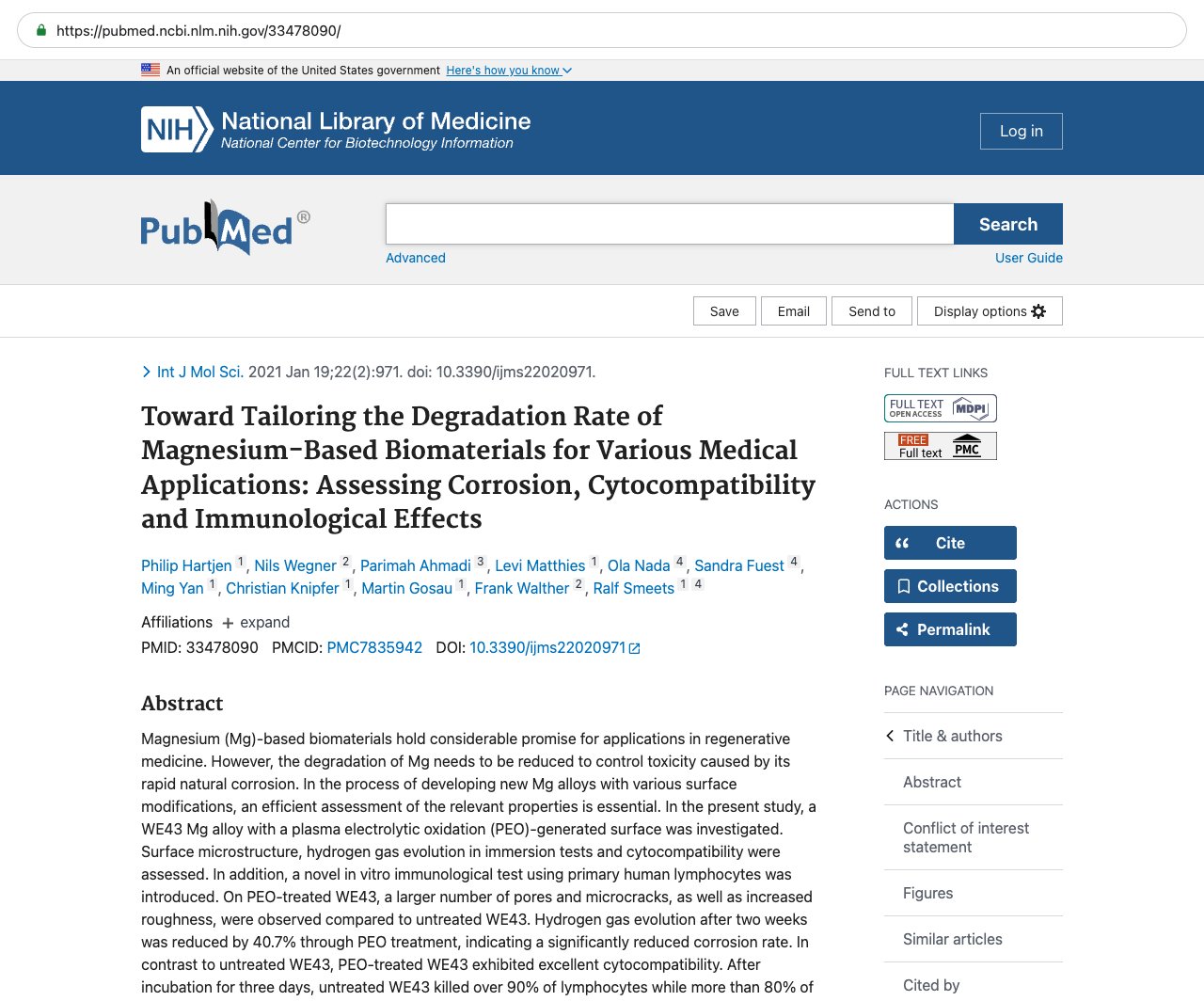
This page mirrors the published abstract (© the authors / publisher) for reference and citation. The canonical source is the PubMed record linked above. This is not medical advice.