2015 Burns : journal of the International Society for Burn Injuries Mechanism / Preclinical Inhalation
2015 · Keles et al. — Can an innocent toy become dangerous? The hydrogen gas balloon burn.
Super-Abstract
Hydrogen gas, used to fill balloons, can ignite and cause severe burns — a safety risk that is rarely discussed. This theoretical case report analyses how a seemingly harmless toy balloon can become a source of serious injury when the hydrogen gas it contains is accidentally ignited.
Commentary
This contribution sits outside the therapeutic hydrogen research mainstream. It does not investigate H₂ as a medicine but rather documents a safety hazard: hydrogen-filled balloons, when exposed to an ignition source, can detonate and cause burns. The paper serves as a cautionary note for clinicians treating burn patients and for the public. It underlines that H₂ is a flammable gas and that its use in consumer products carries physical risks entirely separate from its biomedical applications.
Key quotes
- „hydrogen gas balloon burn“ — the central subject: burns caused by igniting hydrogen balloons
Our assessment
No abstract is publicly available for this paper. This is a theoretical/case-based safety report, not a study of hydrogen's therapeutic effects. It addresses a physical injury risk (balloon combustion) rather than H₂ biology. No data on humans or animals in a biomedical sense are presented. The findings are not relevant to the evaluation of molecular hydrogen as a health intervention.
Study design
- Type: case/theory report · n: not specified · H₂ delivery: not applicable (hydrogen gas as a flammable fuel, not as therapy)
- Result: no abstract available; topic is burn injury from ignited hydrogen balloons — no biomedical H₂ endpoints
Source & links
Screenshot of the PubMed page
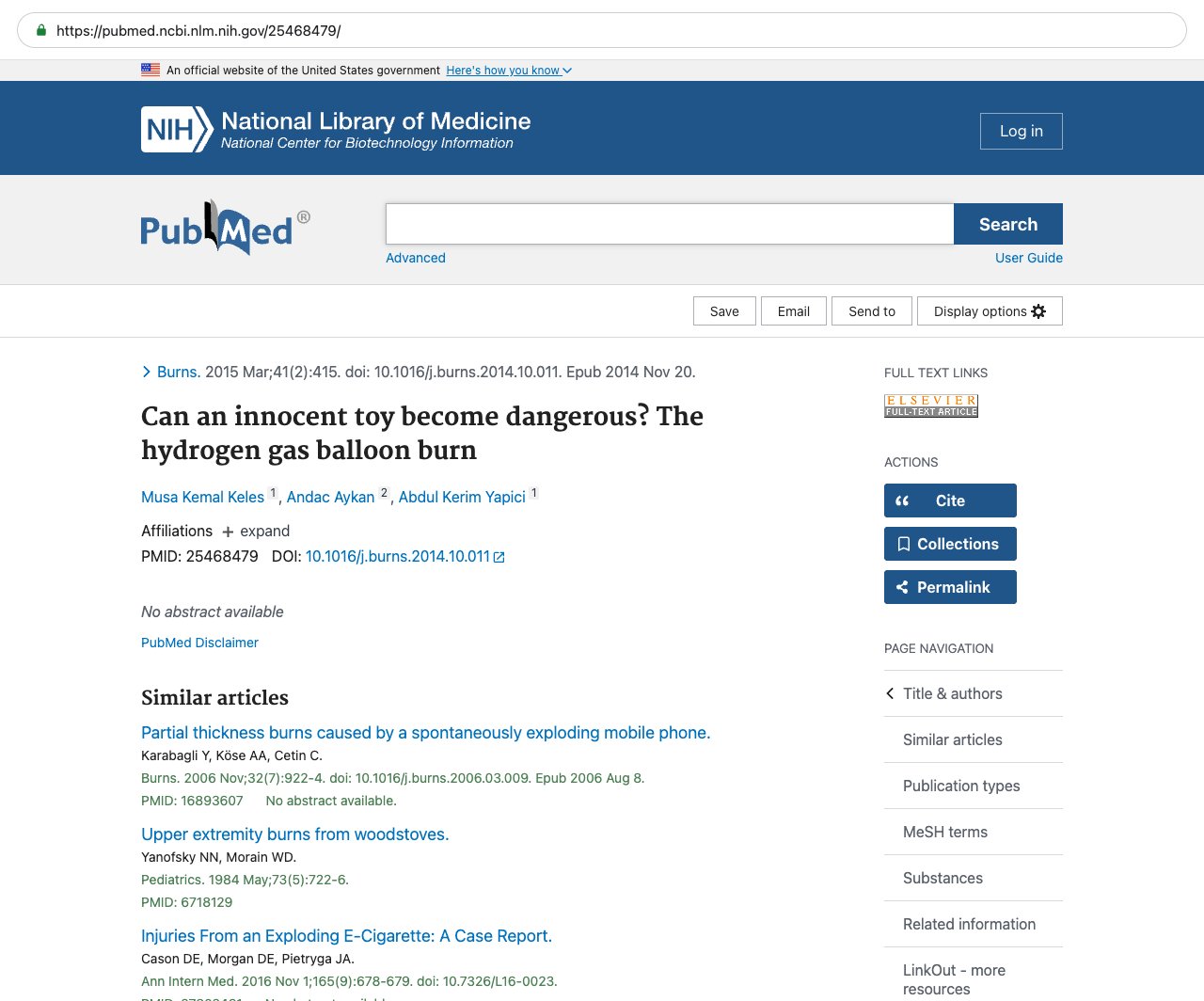
This page mirrors the published abstract (© the authors / publisher) for reference and citation. The canonical source is the PubMed record linked above. This is not medical advice.