2025 · Du — A partially degradable composite consisting of Ti-Zr-Cu-Pd-Sn metallic glass and Fe-Mg alloy for orthopedic applications.
Super-Abstract
Researchers combined a titanium-based metallic glass with an iron-magnesium alloy into a novel partially degradable bone implant. The Fe-Mg component gradually dissolves and is replaced by newly formed bone, while the metallic-glass skeleton remains. The design addresses two key problems: the slow degradation of iron and the rapid breakdown of magnesium — both of which had previously caused excessive hydrogen gas build-up that could fracture surrounding bone. (Acta Biomaterialia, 2025.)
Commentary
This is a materials-science and biomaterials study, not a molecular-hydrogen therapy study in the traditional sense. The hydrogen gas mentioned here is an unwanted by-product of magnesium degradation in implants — and a problem the authors specifically try to minimise, not a therapeutic agent. The spark-plasma-sintering method fuses otherwise immiscible iron and magnesium, yielding a composite that degrades at a controlled rate, promotes calcium-phosphate mineralisation, and avoids the brittle fracture typical of conventional bulk metallic glasses. All experiments are in vitro (cell culture and mechanical testing); no animal or human data are presented.
Key quotes
- „The mechanical alloying technique successfully enabled the fusion of immiscible Fe and Mg, addressing the issues of Fe's slow degradation and Mg's rapid breakdown, while also minimizing potential fractures in the metal framework due to hydrogen gas evolution.“ — core engineering achievement: controlled degradation and H₂ management
- „The controlled degradation of Mg(Fe) promotes the formation of Ca-P compounds, enhancing the bioactivity of the Fe-Mg composite.“ — mechanism by which the alloy supports new bone growth
- „This advancement holds promise for aligning with the natural growth rate of human bone, further augmenting the bioactive properties and practical applications of the MG/Fe-Mg composite material.“ — authors' forward-looking conclusion
Our assessment
This is an in-vitro materials-science study — not a hydrogen therapy study in the clinical sense. H₂ appears here as a degradation by-product to be controlled, not as a therapeutic molecule. Results on cell viability and mechanical properties come from laboratory models and cannot be directly transferred to clinical outcomes in humans. The work is technically solid and addresses a genuine problem in biodegradable implant design, but clinical validation in animals and humans is still required.
Study design
- Type: in-vitro / materials science · n: cell cultures + mechanical specimen testing · H₂ relevance: H₂ gas as by-product of Mg degradation (problem to minimise, not therapy)
- Method: spark plasma sintering (SPS) of Ti-Zr-Cu-Pd-Sn metallic glass with Fe-Mg alloy; mechanical-alloying pre-treatment · Outcome: controlled degradation rate, Ca-P compound formation, improved ductility under compression vs. conventional bulk metallic glass
Abstract
Partially-degradable biomaterials refers to smart implants where biodegradable metals can gradually be replaced by newly growing bone or living tissues, and leave behind a porous inert metal skeleton that stably binds with the new bone tissue. In this research, a partially degradable composite was designed by integrating Ti-Zr-Cu-Pd-Sn metallic glass (MG) with designed Fe-Mg alloy using spark plasma sintering (SPS). The mechanical alloying technique successfully enabled the fusion of immiscible Fe and Mg, addressing the issues of Fe's slow degradation and Mg's rapid breakdown, while also minimizing potential fractures in the metal framework due to hydrogen gas evolution. The controlled degradation of Mg(Fe) promotes the formation of Ca-P compounds, enhancing the bioactivity of the Fe-Mg composite. This design endows the composite with plastic and ductile deformation under compression, providing a viable solution to the brittle fracture behaviour commonly associated with conventional bulk metallic glasses (BMGs). This advancement holds promise for aligning with the natural growth rate of human bone, further augmenting the bioactive properties and practical applications of the MG/Fe-Mg composite material. STATEMENT OF SIGNIFICANCE: In this research, a partially degradable composite was designed by integrating Ti-Zr-Cu-Pd-Sn metallic glass (MG) with designed Fe-Mg alloy using SPS. The Fe-Mg alloy act as temporary space holders can gradually being replaced by newly formed bone, thus establishing a dynamic equilibrium between the biodegradation of the bio-metals and the inward growth of new bone. The degradation of Mg(Fe) promotes the formation of Ca-P compounds, enhancing the bioactivity of the composite. This design endows the composite with plastic deformation under compression, providing a viable solution to the brittle fracture behavior of conventional MGs. This advancement holds promise for aligning with the natural growth rate of human bone, further augmenting the practical applications of the MG/Fe-Mg composite.
Source & links
Screenshot of the PubMed page
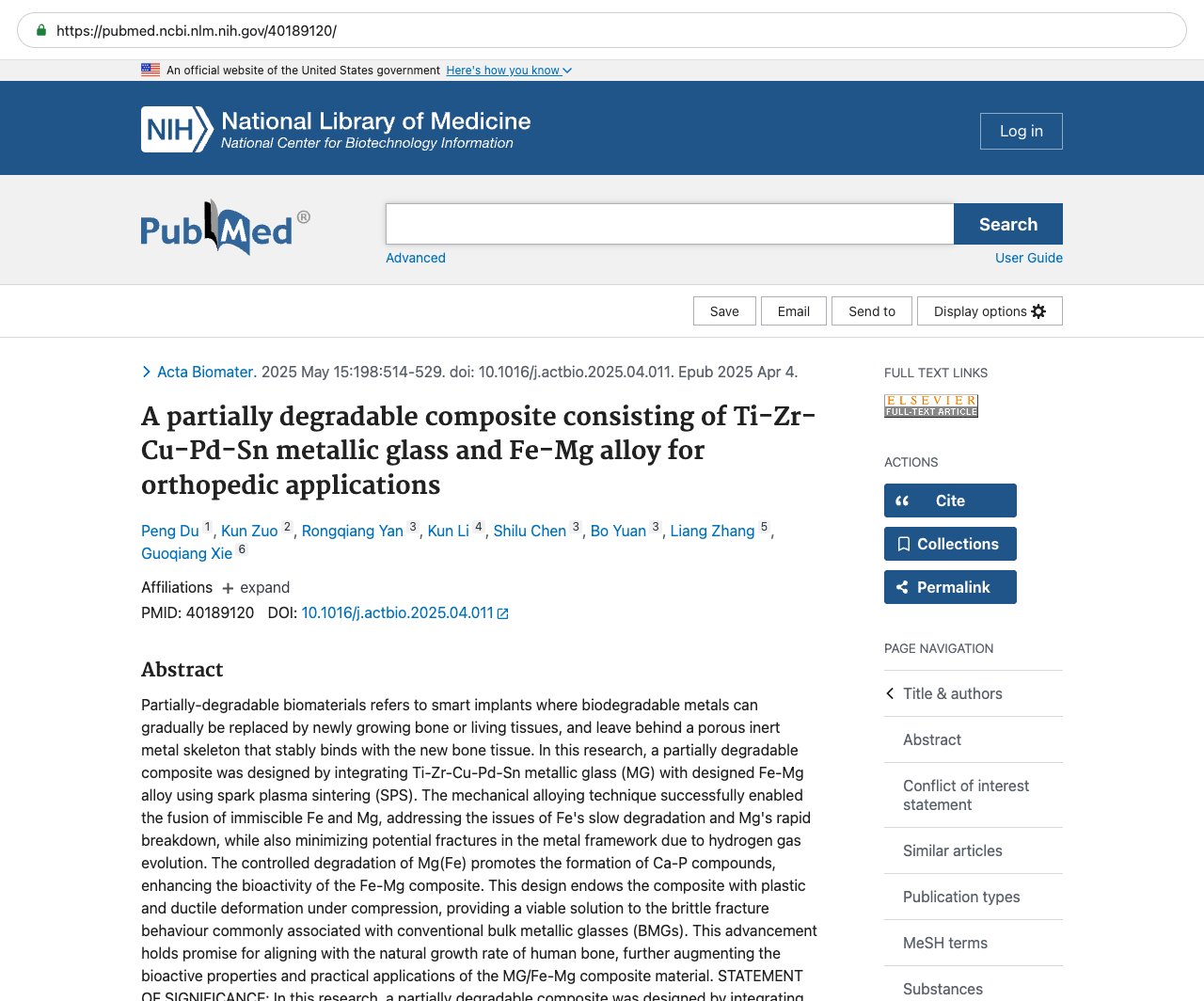
This page mirrors the published abstract (© the authors / publisher) for reference and citation. The canonical source is the PubMed record linked above. This is not medical advice.