2021 · Bai et al. — A PdMo Bimetallene with Precise Wavelength Adjustment and Catalysis for Synergistic Photothermal Ablation and Hydrogen Therapy of Cancer at Different Depths
Super-Abstract
This nanotechnology study synthesized a novel palladium-molybdenum (PdMo) bimetallene nanomaterial that simultaneously generates hydrogen gas and produces heat under near-infrared light, enabling combined anti-tumor therapy in mouse models. This is an in-vitro and in-vivo preclinical study — no human data. The approach represents advanced nanomaterial research, not a clinical therapy.
Commentary
PdMo bimetallenes are ultra-thin two-dimensional nanomaterials with tunable optical absorption across the near-infrared (NIR) biological window. This study demonstrates that by controlling synthesis time, the absorption peak can be precisely tuned from 700 to 1350 nm — enabling effective photothermal therapy at different tissue penetration depths (NIR-I at 808 nm for superficial tumors, NIR-II at 980/1064 nm for deeper tumors). The PdMo material also catalyzes hydrogen production from the hydrolysis of ammonia borane (AB) under acidic and photothermal conditions. The composite nanotherapeutic agent (PdMo@AB@HA, with hyaluronic acid surface coating for cancer cell targeting) showed effective tumor elimination in mouse tumor xenograft models at multiple NIR wavelengths. The H₂ generated acts as an anti-cancer agent within the tumor microenvironment, complementing the thermal ablation. This represents sophisticated materials chemistry; the cancer-killing effects of H₂ at this nano-delivery scale are mechanistically distinct from any consumer H₂ product.
Key quotes
- „The absorption peak of the PdMo bimetallene can be precisely adjusted in the NIR biological window (700-1350 nm) only by changing the synthesis time.“ — the key material innovation: tunable wavelength enabling therapy at different tumor depths
- „A PdMo bimetallene is an efficient catalyst, which can effectively promote hydrogen production from the hydrolysis of ammonia borane (AB) under acidic and photothermal conditions.“ — how H₂ is generated: catalytic hydrolysis triggered by tumor acidity and heat
- „The controlled release of hydrogen, targeted endocytosis, efficient eradication of tumors of different depths and high biosafety were systematically proved in vitro and in vivo.“ — the preclinical results: efficacy and safety in cell and mouse models — not in humans
Our assessment
This is an innovative preclinical materials science study demonstrating proof-of-concept for a dual photothermal/hydrogen nano-oncology platform. The NIR tunability and tumor-depth versatility are genuine technical advances. Critical limitations: all data is from cell cultures and mouse tumor models; clinical translation of injectable bimetallic nanomaterials involves extensive regulatory and safety evaluation that does not yet exist for this system. The H₂ is delivered via nanomaterial-mediated in-situ generation — entirely unrelated to hydrogen water, H₂ inhalation, or any current consumer product. This study does not constitute evidence for hydrogen therapy in humans.
Study design
- Type: preclinical in-vitro and in-vivo (mouse xenograft) nanomaterial study · n: cell assays + mouse tumor models · H₂ delivery: in-situ generation via PdMo-catalyzed ammonia borane hydrolysis
- Photothermal efficiency: 43.1% (808 nm), 51.7% (980 nm), 69.15% (1064 nm) · Targeting: hyaluronic acid coating for cancer cell uptake · Result: tumor eradication at multiple tissue depths in mouse models; no human data
Abstract
By delivering the idea of green and safe hydrogen energy and novel photothermal therapy to the biomedical field, engineering of therapeutic nanomaterials for treatment of major diseases (such as cancer) holds great significance. In this work, a novel PdMo bimetallene was synthesized by a solvothermal reduction method, and it was explored and applied in the field of anti-tumor therapy for the first time. The absorption peak of the PdMo bimetallene can be precisely adjusted in the NIR biological window (700-1350 nm) only by changing the synthesis time. At the same time, it also shows strong light absorption and high photothermal conversion efficiency. Specifically, the photothermal conversion efficiencies at 808 nm, 980 nm and 1064 nm are 43.1%, 51.7% and 69.15%, respectively. Surprisingly, a PdMo bimetallene is an efficient catalyst, which can effectively promote hydrogen production from the hydrolysis of ammonia borane (AB) under acidic and photothermal conditions. Benefitting from these excellent properties, a multifunctional composite nano therapeutic agent (PdMo@AB@HA) was developed via layer-by-layer surface modification with AB and hyaluronic acid (HA). In this way, the synergistic PTT/hydrogen therapy of PdMo@AB@HA composite nanosheets in the NIR-I and NIR-II windows (808 nm, 980 nm, and 1064 nm) on mouse tumor xenografts of different depths was realized. Furthermore, the controlled release of hydrogen, targeted endocytosis, efficient eradication of tumors of different depths and high biosafety were systematically proved in vitro and in vivo. This work not only provides a novel and efficient theranostic nanoplatform for efficient cancer theranostics, but also provides a new strategy for the development of safe and efficient new anti-tumor therapies.
Source & links
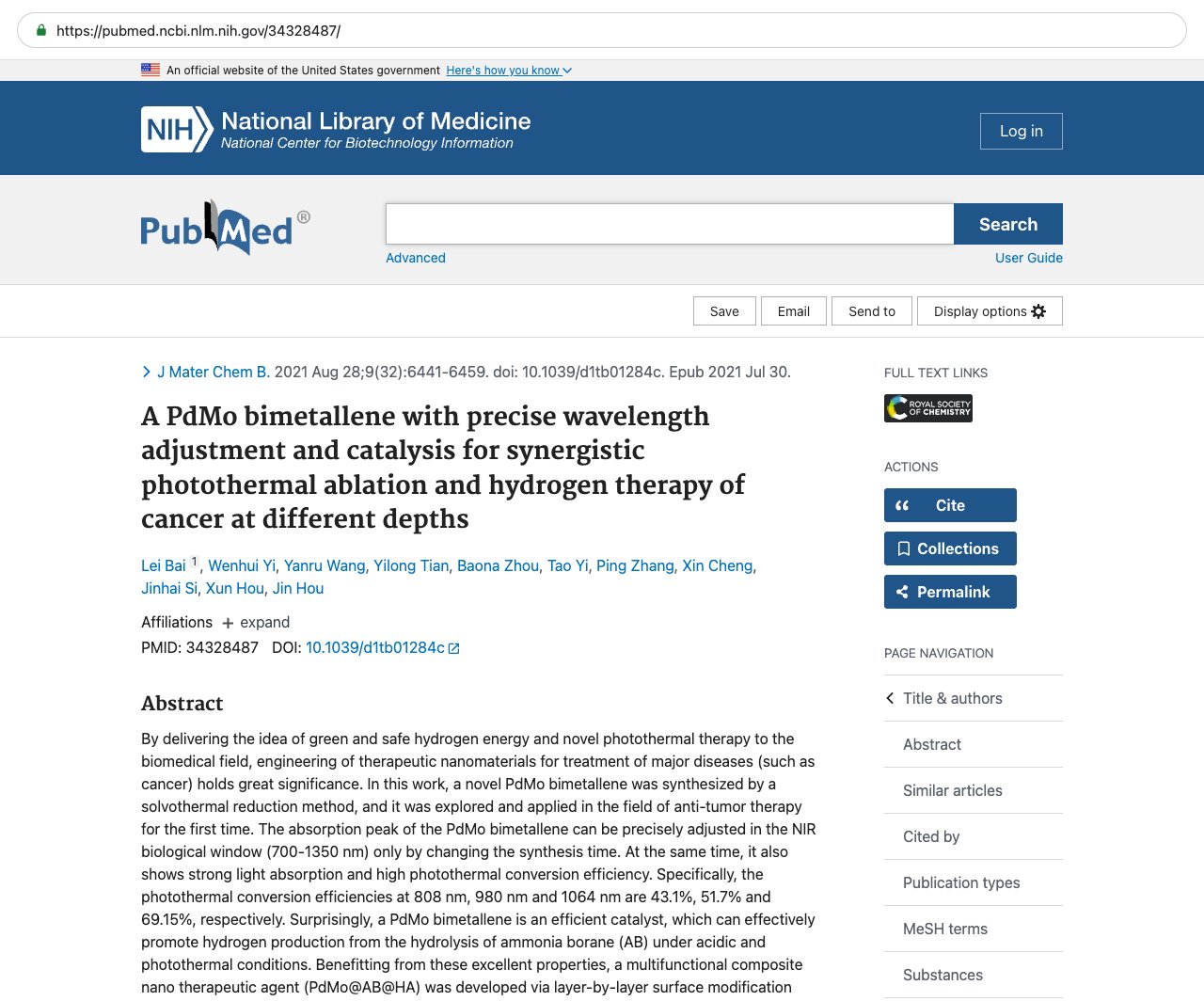
Screenshot of the PubMed page
This page mirrors the published abstract (© the authors / publisher) for reference and citation. The canonical source is the PubMed record linked above. This is not medical advice.