2024 · Li — Modulating the Electronic Structure of MnNi₂S₃ Nanoelectrodes to Activate Pyroptosis for Electrocatalytic Hydrogen-Immunotherapy.
Super-Abstract
Specially engineered nanoelectrodes deliver molecular hydrogen directly to tumor cells via electrolysis, triggering a cell-death pathway called pyroptosis that also activates the immune system to fight cancer. In this cell-culture study, the approach both killed tumor cells and turned immunologically „cold“ tumors into „hot“ ones capable of eliciting an immune response. (Advanced Materials, 2024.)
Commentary
This in-vitro study describes MnNi₂S₃ nanoelectrodes designed for electrocatalytic H₂ delivery to tumor sites. By doping nickel sulfide with manganese, the authors tuned the electronic structure to enhance the hydrogen evolution reaction (HER), enabling controlled H₂ release dependent on applied voltage. In cell models, this electrocatalytic hydrogen therapy (EHT) induced mitochondrial dysfunction and oxidative stress, activating the ROS/caspase-1/GSDMD pyroptosis pathway. Pyroptotic cell death further promoted infiltration of CD8+ T lymphocytes and reduced immune suppression in the tumor microenvironment. While mechanistically detailed and innovative, all data derive from cell cultures and animal tumor models — there is no human clinical evidence.
Key quotes
- „controllable delivery of H2 for electrocatalytic hydrogen therapy (EHT) is achieved in a voltage-dependent manner.“ — the key feature: H₂ delivery can be precisely controlled with applied voltage
- „MnNi2S3 NE-mediated EHT induces mitochondrial dysfunction and oxidative stress, which subsequently activates pyroptosis through the typical ROS/caspase-1/GSDMD signaling pathway.“ — the proposed mechanism linking H₂ delivery to immune-activating cell death
- „MnNi2S3 NE-mediated EHT enhances the infiltration of CD8+ T lymphocytes into tumors and reverses the immunosuppressive microenvironment.“ — the immunological downstream effect observed in preclinical models
Our assessment
This is an in-vitro/preclinical study — all results come from cell cultures and animal tumor models. The findings are mechanistically interesting and technically sophisticated, but cannot be transferred to humans without clinical trials. The concept of electrocatalytic H₂ delivery as a cancer therapy is at a very early stage. No safety, tolerability, or efficacy data in humans exist. The paper should be understood as exploratory materials science and cell biology, not as evidence for human cancer treatment.
Study design
- Type: in-vitro and preclinical in-vivo study · Model: cell lines (tumor) + mouse tumor implantation models (4T1, MC38) · H₂ delivery: electrocatalytic generation via MnNi₂S₃ nanoelectrodes (voltage-controlled)
- Result: H₂ delivery induced pyroptosis via ROS/caspase-1/GSDMD; increased CD8+ T cell tumor infiltration; reversed immunosuppressive microenvironment in bilateral mouse tumor models — no human data
Abstract
Hydrogen (H2) therapy has demonstrated antitumor effect, but the therapeutic efficacy is restricted by the low solubility and nontarget delivery of H2. Electrolysis of H2O by electrocatalysts sustainably releases enormous amounts of H2 and inspires the precise delivery of H2 for tumor therapy. Herein, manganese-doped Ni2S3 nanoelectrodes (MnNi2S3 NEs) are designed for the electrocatalytic delivery of H2 and the activation of antitumor immunity to effectively potentiate H2-immunotherapy. Ni atoms featuring empty 3d orbitals reduce the initial energy barrier of the hydrogen evolution reaction (HER) by promoting the adsorption of H2O. Moreover, Mn atoms with different electronegativity modulate the electronic structure of Ni atoms and facilitate the desorption of the generated H2, thus enhancing the HER activity of the MnNi2S3 NEs. Based on the high HER activity, controllable delivery of H2 for electrocatalytic hydrogen therapy (EHT) is achieved in a voltage-dependent manner. Mechanistically, MnNi2S3 NE-mediated EHT induces mitochondrial dysfunction and oxidative stress, which subsequently activates pyroptosis through the typical ROS/caspase-1/GSDMD signaling pathway. Furthermore, MnNi2S3 NE-mediated EHT enhances the infiltration of CD8+ T lymphocytes into tumors and reverses the immunosuppressive microenvironment. This work demonstrates an electrocatalyst with high HER activity for synergistic gas-immunotherapy, which may spark electrocatalyst-based tumor therapy strategies.
Source & links
Screenshot of the PubMed page
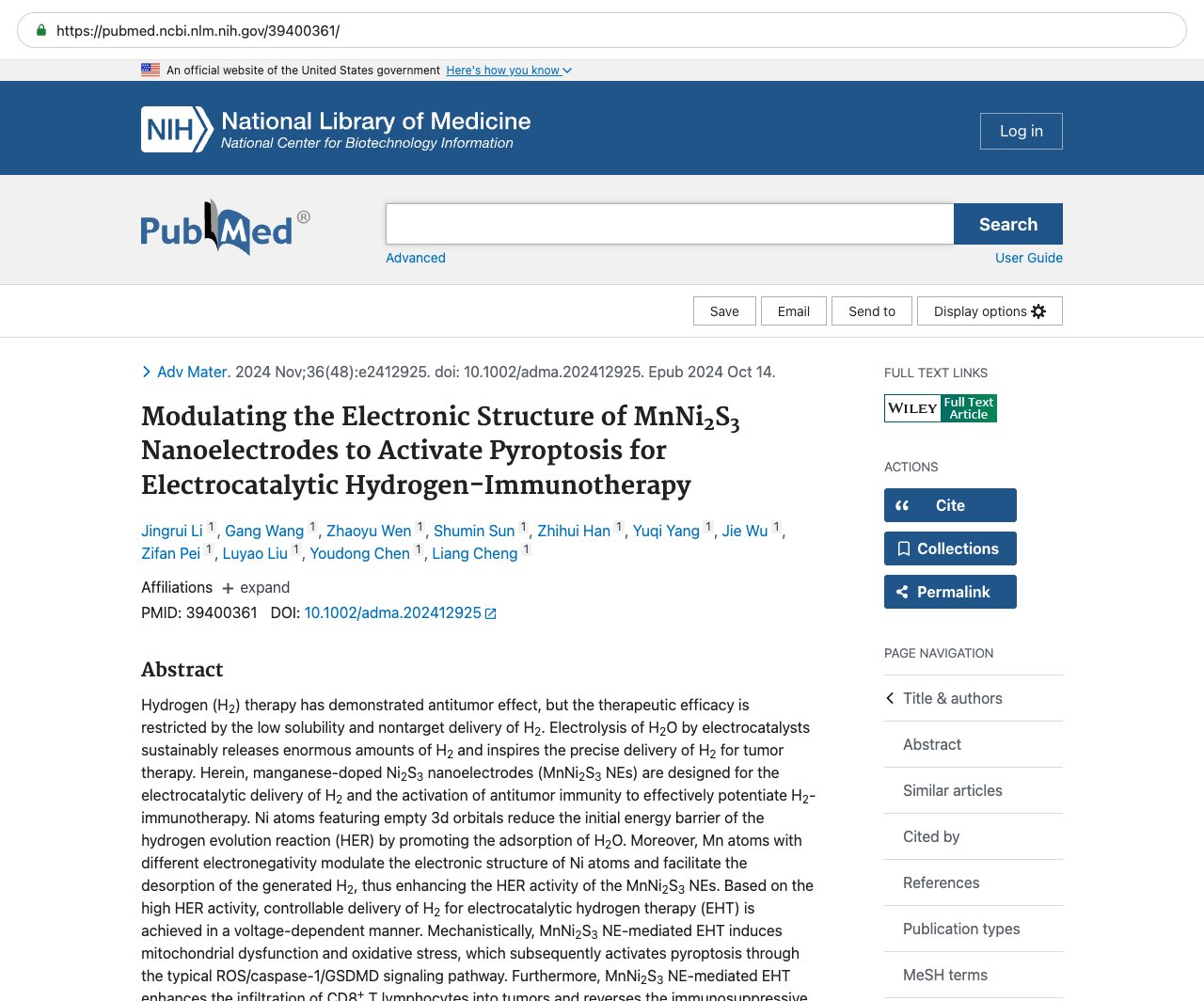
This page mirrors the published abstract (© the authors / publisher) for reference and citation. The canonical source is the PubMed record linked above. This is not medical advice.