2025 · Liu — Local Delivery of Molecular Hydrogen by Fluorinated Zeolitic Imidazole Framework Nanosheets Boosts Cancer Immunotherapy.
Super-Abstract
A newly engineered nanomaterial can carry and locally release large amounts of molecular hydrogen (H₂) inside a tumour, while also amplifying the effect of immune checkpoint therapy. The fluorinated zeolitic imidazolate framework releases H₂ and zinc ions in the tumour microenvironment, killing cells and — surprisingly — increasing the expression of a surface signal that makes tumour cells better targets for anti-CD47 antibody therapy. In mouse melanoma models, tumour inhibition rates of 83–90 % were achieved — but this is entirely animal research. (ACS Applied Materials & Interfaces, 2025.)
Commentary
Immune checkpoint blockade (ICB) — therapies like anti-PD-L1 or anti-CD47 — have revolutionised cancer treatment but still fail many patients due to resistance and an immunosuppressive tumour microenvironment. This paper takes a creative approach: H₂ released locally from a porous nanomaterial (F7-ZIF) triggers mitochondrial damage and cell apoptosis, but also upregulates CD47 on tumour cells — the „do not eat me“ signal. This counterintuitive finding actually helps: by increasing CD47, the anti-CD47 antibody has more binding targets, and combined with Fc-receptor-mediated macrophage activation, achieves stronger phagocytosis. The further combination with anti-PD-L1 activated systemic T-cell immunity. The RNA-seq mechanistic data add depth. All of this is melanoma mouse models — translation to human cancer is the critical unknown. F7-ZIF nanoparticle safety, biodistribution, and manufacturability remain open questions.
Key quotes
- „F7-ZIF/H2 considerably upregulated the expression of CD47 ('do not eat me' signal) on tumor cells, which increases target accessibility for anti-CD47 antibody, thereby enhancing their binding efficiency.“ — the unexpected finding: H₂ upregulates CD47 — which then amplifies anti-CD47 immunotherapy
- „In melanoma tumor models with small (∼50 mm3) and large sized established tumors (∼200 mm3), the combination of F7-ZIF/H2 and anti-CD47 reaches 90% and 83% of tumor inhibition rate.“ — strong mouse tumour inhibition across two tumour sizes
- „When further combined with anti-PD-L1, the therapeutic system triggers systemic T cell immunity that rejects the progression of both primary and distal tumors.“ — triple combination activates systemic anti-tumour immunity including distant lesions
Our assessment
An imaginative and mechanistically well-characterised preclinical study that identifies an unexpected synergy between local H₂ delivery and immune checkpoint therapy. The CD47-upregulation finding is novel and the triple-combination (H₂ + anti-CD47 + anti-PD-L1) data are impressive in the mouse model. However, this is entirely animal research — no human data exist, and results cannot be directly extrapolated to patients. The clinical gap is large: nanoparticle safety and tumour-specific delivery must be proven in humans, the CD47 upregulation effect may differ in human tumour biology, and melanoma mouse models are known to be poor predictors of human immunotherapy response. A compelling concept requiring substantial further development before any clinical relevance.
Study design
- Type: animal study (preclinical) · Model: mouse melanoma xenograft (small ~50 mm³ and large ~200 mm³ tumours) · H₂ delivery: hepta-fluorinated zeolitic imidazolate framework nanosheet (F7-ZIF) — acid-responsive H₂ release in the tumour microenvironment
- Combination therapy: F7-ZIF/H₂ + anti-CD47 antibody ± anti-PD-L1 antibody · RNA-seq mechanistic profiling
- Result: 90 % (small) / 83 % (large tumour) inhibition rate with F7-ZIF/H₂ + anti-CD47; triple combination triggered systemic T-cell immunity against primary and distal tumours
Abstract
Identifying strategies to improve the efficacy of the immune checkpoint blockade (ICB) remains a major clinical need. Based on the high tissue penetration capability of hydrogen molecules (H2) and their immunomodulatory effects, this work proposes a local gas delivery strategy targeting the tumor microenvironment for high-efficacy hydrogen immunotherapy. We synthesized hepta-fluorinated zeolitic imidazolate frameworks nanosheet (F7-ZIF) with high H2 payload, sustained acid-responsive gas release property, and biodegradation. H2-loaded F7-ZIF (F7-ZIF/H2) effectively released H2 and Zn2+ to induce significant mitochondrial damage and cell apoptosis. More importantly, F7-ZIF/H2 considerably upregulated the expression of CD47 ("do not eat me" signal) on tumor cells, which increases target accessibility for anti-CD47 antibody, thereby enhancing their binding efficiency. RNA-seq suggests that the CD47 antibody not only blocks the "do not eat me" signal (mediated by CD47-SIRPα interactions) but also engages Fc receptors on macrophages through its Fc region to trigger antibody-dependent cellular phagocytosis. In melanoma tumor models with small (∼50 mm3) and large sized established tumors (∼200 mm3), the combination of F7-ZIF/H2 and anti-CD47 reaches 90% and 83% of tumor inhibition rate, respectively, compared to free anti-CD47. When further combined with anti-PD-L1, the therapeutic system triggers systemic T cell immunity that rejects the progression of both primary and distal tumors. This work provides insights into gas-assisted cancer immunotherapy.
Source & links
Screenshot of the PubMed page
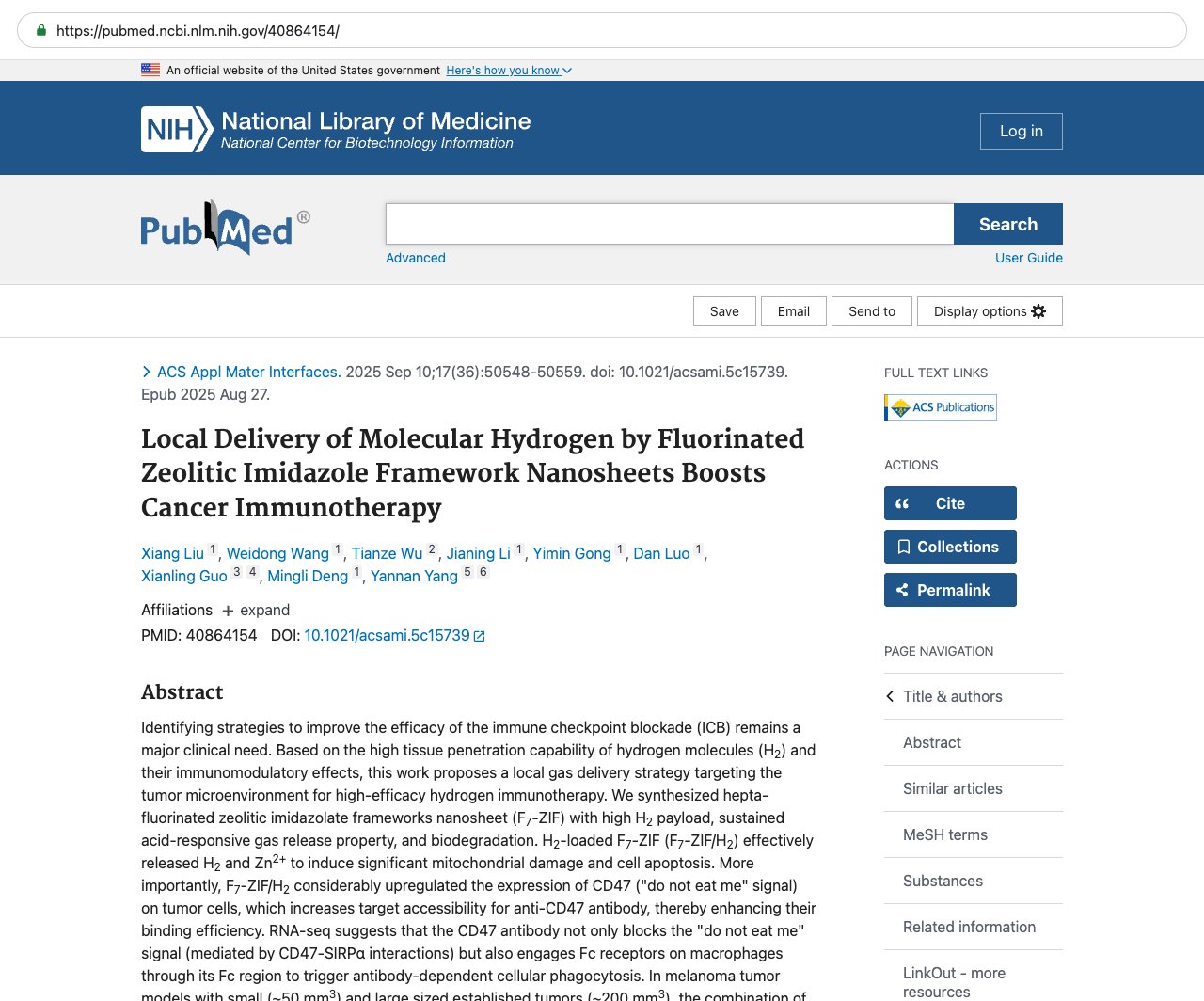
This page mirrors the published abstract (© the authors / publisher) for reference and citation. The canonical source is the PubMed record linked above. This is not medical advice.