2015 · Barbu et al. — The use of hydrogen gas clearance for blood flow measurements in single endogenous and transplanted pancreatic islets.
Super-Abstract
Researchers used hydrogen gas as a tracer — not as therapy — to precisely measure blood flow in individual pancreatic islets in rats and mice. This animal study revealed that blood perfusion within a single pancreas varies enormously (by a factor of 6–10) between islets, and that transplanted human and mouse islets receive about 30 % less blood flow than the surrounding kidney tissue.
Commentary
This paper uses H₂ in a purely methodological role: as a washout tracer detected by platinum micro-electrodes to quantify blood flow at the single-islet level. It is not a study of H₂ as a therapeutic agent. The findings are relevant to islet transplantation research — a vascular deficit of ~30 % in grafted islets compared to native renal parenchyma may partly explain the limited long-term success of islet transplants. The technique offers a tool to investigate how genetic or environmental factors alter islet perfusion in vivo. Clinically, this is purely preclinical rodent and athymic-mouse work; no human therapeutic conclusions can be drawn.
Key quotes
- „The blood flow of human and mouse islet grafts transplanted in athymic mice was approximately 30% lower than that in the surrounding renal parenchyma.“ — key quantitative finding: transplanted islets are underperfused
- „vascular conductance and blood flow values displayed a highly heterogeneous distribution, varying by factors 6-10 within the same pancreas.“ — within-organ heterogeneity of islet perfusion
- „The present technique provides unique opportunities to study the islet vascular dysfunction seen after transplantation.“ — the methodological contribution: a tool for studying transplant vasculature
Our assessment
This is a methodological animal study — H₂ is used as a physiological tracer, not as a therapeutic intervention. The findings are relevant to pancreatic islet biology and transplantation science. Important limitations: all experiments were conducted in rats and athymic mice; results cannot be directly transferred to human physiology. The study does not evaluate any health benefit of molecular hydrogen as a consumed substance.
Study design
- Type: animal study (preclinical) · Model: male Lewis rats (endogenous/transplanted islets) + athymic mice (human and mouse islet grafts under renal capsule) · H₂ delivery: hydrogen gas washout via microelectrodes (measurement tool, not therapy)
- Result: highly heterogeneous islet blood flow within single pancreas (6–10× variation); transplanted human/mouse islet grafts ~30 % lower blood flow than surrounding renal parenchyma; technique validated for in-vivo single-islet perfusion studies
Abstract
The blood perfusion of pancreatic islets is regulated independently from that of the exocrine pancreas, and is of importance for multiple aspects of normal islet function, and probably also during impaired glucose tolerance. Single islet blood flow has been difficult to evaluate due to technical limitations. We therefore adapted a hydrogen gas washout technique using microelectrodes to allow such measurements. Platinum micro-electrodes monitored hydrogen gas clearance from individual endogenous and transplanted islets in the pancreas of male Lewis rats and in human and mouse islets implanted under the renal capsule of male athymic mice. Both in the rat endogenous pancreatic islets as well as in the intra-pancreatically transplanted islets, the vascular conductance and blood flow values displayed a highly heterogeneous distribution, varying by factors 6-10 within the same pancreas. The blood flow of human and mouse islet grafts transplanted in athymic mice was approximately 30% lower than that in the surrounding renal parenchyma. The present technique provides unique opportunities to study the islet vascular dysfunction seen after transplantation, but also allows for investigating the effects of genetic and environmental perturbations on islet blood flow at the single islet level in vivo.
Source & links
Screenshot of the PubMed page
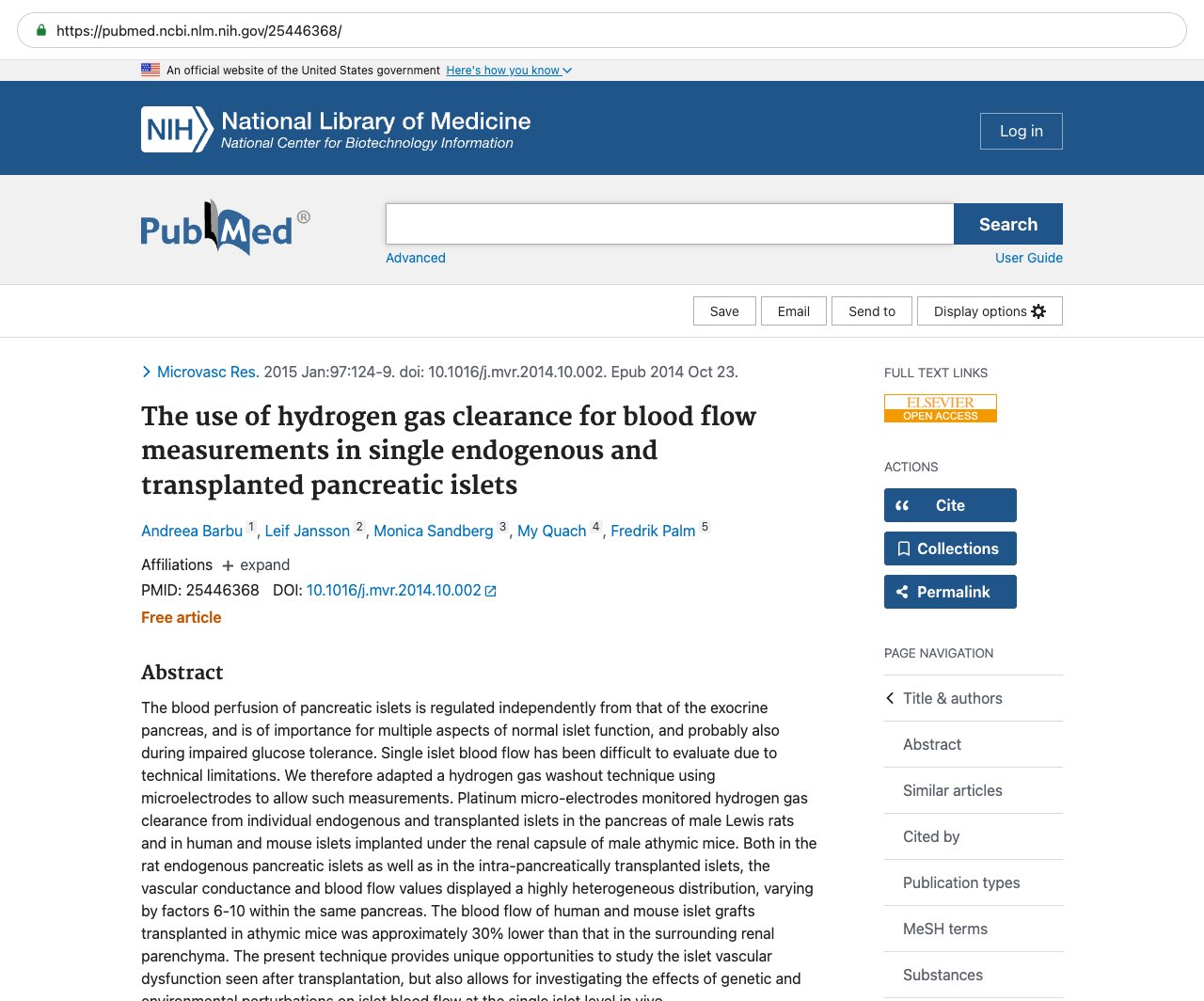
This page mirrors the published abstract (© the authors / publisher) for reference and citation. The canonical source is the PubMed record linked above. This is not medical advice.