1983 · Homer — Transient solutions of equations for countercurrent capillary exchange.
Super-Abstract
A mathematical model of countercurrent capillary exchange was developed and applied to the analysis of hydrogen gas exchange in the renal medulla, yielding new estimates of medullary blood flow and revealing how tracer exchange between adjacent capillaries can mimic or distort countercurrent effects. This is a theoretical/modelling study with no therapeutic relevance. (The American Journal of Physiology, 1983.)
Commentary
This paper develops mathematical transient solutions for a passive countercurrent capillary exchange model and specifically applies it to hydrogen gas clearance measurements in the renal medulla as a case study. Hydrogen gas here functions as an inert diffusible tracer used in classic indicator-dilution physiology — the clearance of inhaled H₂ from tissues is measured to estimate regional blood flow. The paper's contribution is purely theoretical: it shows that standard semilogarithmic washout analysis of H₂ clearance curves will overestimate or underestimate medullary blood flow depending on the efficiency of countercurrent exchange. This is a mathematical physiology paper with no connection to H₂ therapy.
Key quotes
- „The model is applied to an analysis of hydrogen gas exchange in the renal medulla.“ — H₂ used as inert tracer to model renal medullary blood flow — not therapeutic
- „Semilog plots of tissue washout curves appear nearly linear but will overestimate flow if the countercurrent process is inefficient and will underestimate flow if the countercurrent exchange is efficient.“ — key methodological insight: standard analysis can systematically mis-estimate blood flow
- „Capillaries in other vascular beds that are close enough together to permit considerable exchange of inert gas tracers may simulate countercurrent effects if some of the adjacent capillaries are in countercurrent or staggered cocurrent arrangements.“ — broader implication for all inert-gas tracer blood flow measurements
Our assessment
This is a theoretical modelling study in mathematical physiology. Hydrogen gas appears here solely as an inert tracer for blood flow measurement in a physiological model — there is no therapeutic application whatsoever. The paper is of interest to physiologists and bioengineers working with tracer methods for regional blood flow estimation, but has no bearing on molecular hydrogen therapy.
Study design
- Type: theoretical/mathematical modelling study · n: n/a (mathematical analysis) · H₂ role: inert diffusible tracer in countercurrent capillary exchange model for renal medullary blood flow estimation (not therapeutic)
- Result: transient solutions derived for passive countercurrent exchange model; medullary flow estimates consistent with vascular tracer data; semilog washout analysis shown to systematically over- or underestimate flow depending on countercurrent efficiency
Abstract
A model for passive countercurrent capillary exchange is presented, and solutions for transient responses are obtained. The model is applied to an analysis of hydrogen gas exchange in the renal medulla. Estimates of medullary flow per gram tissue are in reasonable agreement with estimates obtained with vascular tracers and similar to the values for whole kidney. Semilog plots of tissue washout curves appear nearly linear but will overestimate flow if the countercurrent process is inefficient and will underestimate flow if the countercurrent exchange is efficient. Analysis of the countercurrent process also provides some insights into the importance of tracer exchange between capillaries in vascular beds not arranged in orderly countercurrent networks. Capillaries in other vascular beds that are close enough together to permit considerable exchange of inert gas tracers may simulate countercurrent effects if some of the adjacent capillaries are in countercurrent or staggered cocurrent arrangements.
Source & links
Screenshot of the PubMed page
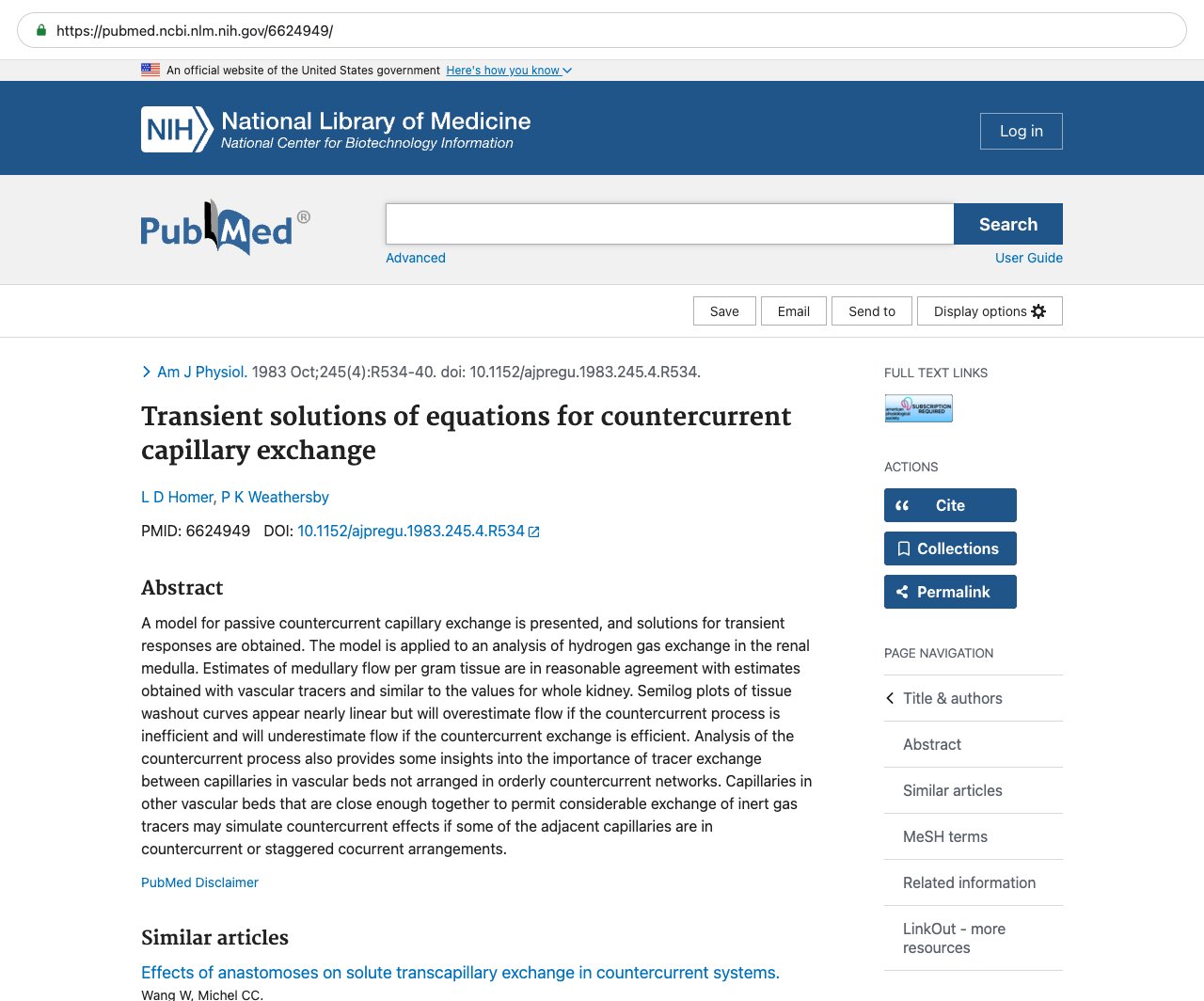
This page mirrors the published abstract (© the authors / publisher) for reference and citation. The canonical source is the PubMed record linked above. This is not medical advice.