2019 · Guan — Hydrogen gas reduces chronic intermittent hypoxia-induced hypertension by inhibiting sympathetic nerve activity and increasing vasodilator responses via antioxidation.
Super-Abstract
In rats subjected to chronic intermittent hypoxia (CIH) — a model of sleep-apnoea-related hypertension — daily H₂ gas inhalation significantly attenuated the rise in blood pressure. H₂ reduced sympathetic nervous system overactivity and improved vascular relaxation responses, with the antioxidant effect of H₂ (reducing 8-OHdG and increasing superoxide dismutase activity) identified as the likely mechanism. (Journal of Cellular Biochemistry, 2019.)
Commentary
Obstructive sleep apnoea is closely linked to hypertension, and chronic intermittent hypoxia is the primary experimental model used to study this relationship. Oxidative stress from repeated hypoxia-reoxygenation cycles drives sympathetic activation and vascular dysfunction. This study tests whether H₂'s antioxidant properties can interrupt that chain. The results are positive: H₂ inhalation (2 h/day for 5 weeks) prevented the blood pressure rise seen in CIH rats and normalized sympathetic activity, vascular relaxation responses, and oxidative stress markers. Importantly, H₂ inhalation alone (without CIH) had no effect on blood pressure in healthy rats — a useful specificity finding. Limitations: this is a rat study with a specific and artificial hypoxia protocol, no human sleep-apnoea patients were involved, and the 5-week CIH model does not fully capture the complexity of human sleep apnoea with its comorbidities and individual variability.
Key quotes
- „The systolic and diastolic blood pressure (BP) increased significantly in rats exposed to intermittent hypoxia, both of which were markedly attenuated after H treatment.“ — primary result: H₂ reduced CIH-induced blood pressure elevation
- „H2 gas significantly improved CIH-induced abnormal vascular relaxation.“ — vascular function finding: H₂ restored normal vasodilation responses
- „Inhalation of H2 gas alone did not cause such changes.“ — important control: H₂ had no effect on blood pressure in healthy (non-hypoxic) rats
Our assessment
An informative preclinical rat study — not clinical evidence for human hypertension or sleep apnoea management. The finding that H₂ did not lower blood pressure in healthy rats (only in CIH-hypertensive ones) is an important specificity signal that reduces concern about overcorrection. The antioxidant mechanism (8-OHdG reduction, SOD increase) is consistent with H₂'s known properties. However, this is a rodent model of a specific hypertension subtype; no human patients were studied, and the H₂ inhalation protocol differs substantially from any practicable clinical delivery.
Study design
- Type: preclinical randomized animal study · Model: adult male rats, chronic intermittent hypoxia (CIH) 8 h/day for 5 weeks ± H₂ inhalation 2 h/day · H₂ delivery: H₂ gas inhalation (2 h/day for 5 weeks, concentration not specified in abstract)
- Result: CIH-induced systolic/diastolic BP elevation markedly attenuated by H₂; renal sympathetic nerve activity and plasma norepinephrine normalized; vascular relaxation responses restored; 8-OHdG reduced and SOD activity increased (oxidative stress improvement); H₂ alone had no effect on BP in healthy controls
Abstract
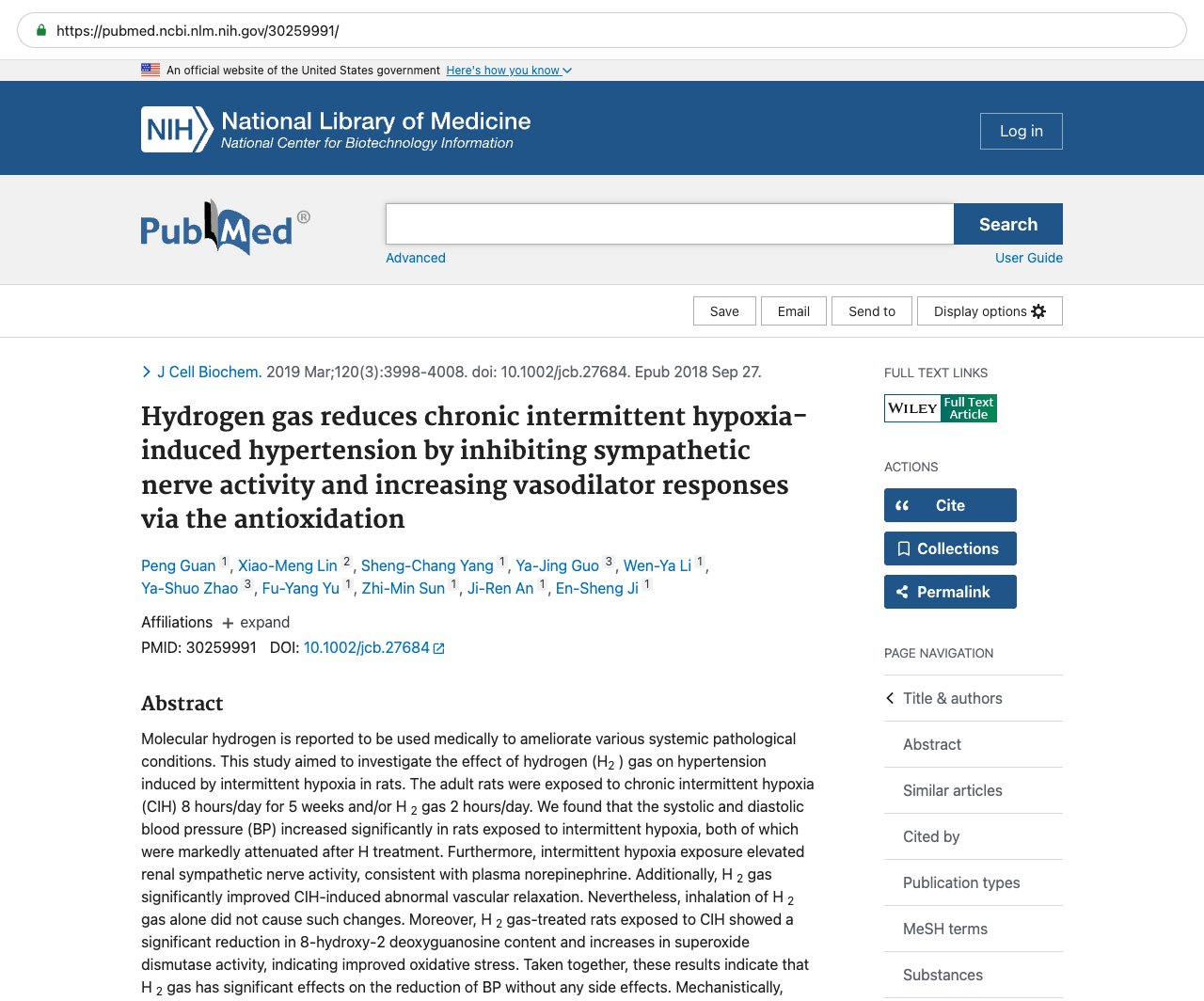
Molecular hydrogen is reported to be used medically to ameliorate various systemic pathological conditions. This study aimed to investigate the effect of hydrogen (H2 ) gas on hypertension induced by intermittent hypoxia in rats. The adult rats were exposed to chronic intermittent hypoxia (CIH) 8 hours/day for 5 weeks and/or H 2 gas 2 hours/day. We found that the systolic and diastolic blood pressure (BP) increased significantly in rats exposed to intermittent hypoxia, both of which were markedly attenuated after H treatment. Furthermore, intermittent hypoxia exposure elevated renal sympathetic nerve activity, consistent with plasma norepinephrine. Additionally, H 2 gas significantly improved CIH-induced abnormal vascular relaxation. Nevertheless, inhalation of H 2 gas alone did not cause such changes. Moreover, H 2 gas-treated rats exposed to CIH showed a significant reduction in 8-hydroxy-2 deoxyguanosine content and increases in superoxide dismutase activity, indicating improved oxidative stress. Taken together, these results indicate that H 2 gas has significant effects on the reduction of BP without any side effects. Mechanistically, inhibition of sympathetic activity and reduction of systemic vascular resistance may participate in this process via the antioxidant activity of H 2 .
Source & links
Screenshot of the PubMed page
This page mirrors the published abstract (© the authors / publisher) for reference and citation. The canonical source is the PubMed record linked above. This is not medical advice.