2026 · Zhang — Pearl-Like Bioinspired Coating Enables Regulation of Mg Degradation for Osteoporotic Bone Repair
Super-Abstract
A pearl-inspired multilayer coating for magnesium alloy bone implants was developed to precisely control the rate at which magnesium degrades in osteoporotic bone — specifically preventing premature hydrogen gas release, which can cause local tissue problems. In osteoporotic rat models, the coated implant improved bone integration, vascularization, and immune regulation compared to uncoated implants. (Advanced Science, 2026.)
Commentary
Magnesium alloys are biodegradable metals that are promising for bone implants because they gradually dissolve in the body, eliminating the need for a second surgery to remove hardware. Their main clinical problem is uncontrolled degradation: too-fast dissolving releases hydrogen gas and raises local pH, both of which can damage surrounding tissue. This study uses a biomimetic coating inspired by the „brick-and-mortar“ structure of pearl — alternating layers of calcium phosphate (corrosion barrier) and fibronectin-mimetic peptides (promoting cell adhesion and immune modulation). The coating slows Mg degradation and specifically prevents uncontrolled H₂ release. The role of H₂ in this paper is therefore primarily as a by-product to be controlled, not as a therapeutic agent — the peptide and Ca-P layers do the therapeutic work. Evidence comes from in-vitro materials testing and an osteoporotic rat model.
Key quotes
- „The CaP layer reduces rapid degradation and prevents hydrogen gas release and local alkalinization, whereas Fn-mimetic peptides enhance early bone integration and vascularization.“ — the two-layer function: CaP blocks H₂ release; peptides drive bone healing
- „this study develops a bionic magnesium alloy internal fixation coating inspired by the 'brick-and-mortar' structure of pearl, aiming to improve bone-implant integration and vascularization in osteoporotic conditions.“ — the engineering rationale: biomimicry for osteoporotic bone repair
- „The synergistic effect of the magnesium alloy implant and bionic coating significantly improved bone implant stability, regeneration, and vascularization, as demonstrated in osteoporotic rat models.“ — summary of the animal model outcome
Our assessment
This paper is primarily an implant engineering and materials science study. H₂ appears here as an unwanted side-product of magnesium degradation that the coating is designed to suppress — not as a therapeutic tool. The biomimetic coating concept is scientifically interesting and the osteoporotic rat data are encouraging. However, all evidence is preclinical (animal model); human bone implant performance, immune responses, and long-term biodegradation behaviour would need independent clinical evaluation. No human data are presented.
Study design
- Type: preclinical animal + materials study · Model: osteoporotic rat model · H₂ relevance: H₂ as controlled by-product of Mg alloy degradation; coating designed to prevent uncontrolled H₂ release
- Result: improved bone implant stability, vascularization, and immune regulation vs. uncoated Mg implant in osteoporotic rats; controlled degradation rate demonstrated
Abstract
In osteoporotic bones, the stability of orthopedic implants is compromised, and excessive M1 macrophage polarization at the bone-implant interface disrupts bone-immune homeostasis, leading to implant loosening or failure. To address this, this study develops a bionic magnesium alloy internal fixation coating inspired by the "brick-and-mortar" structure of pearl, aiming to improve bone-implant integration and vascularization in osteoporotic conditions. The multifunctional coating consists of a calcium phosphate (Ca-P) "brick" layer, which serves as a mineralization template and corrosion barrier, and fibronectin-mimetic peptides (Fn-mimetic peptides) as the "mortar" to promote cell adhesion, regulate immune responses, and stimulate angiogenesis. This bionic multilayer structure not only alleviates oxidative stress in the osteoporotic microenvironment but also fosters immune regulation-osteogenesis coupling and improves the bone-vascular-immune microenvironment. It precisely controls the degradation rate of Mg alloys and enhances tissue repair. The CaP layer reduces rapid degradation and prevents hydrogen gas release and local alkalinization, whereas Fn-mimetic peptides enhance early bone integration and vascularization. The synergistic effect of the magnesium alloy implant and bionic coating significantly improved bone implant stability, regeneration, and vascularization, as demonstrated in osteoporotic rat models, offering a promising strategy for the design of bone repair materials under pathological conditions.
Source & links
Screenshot of the PubMed page
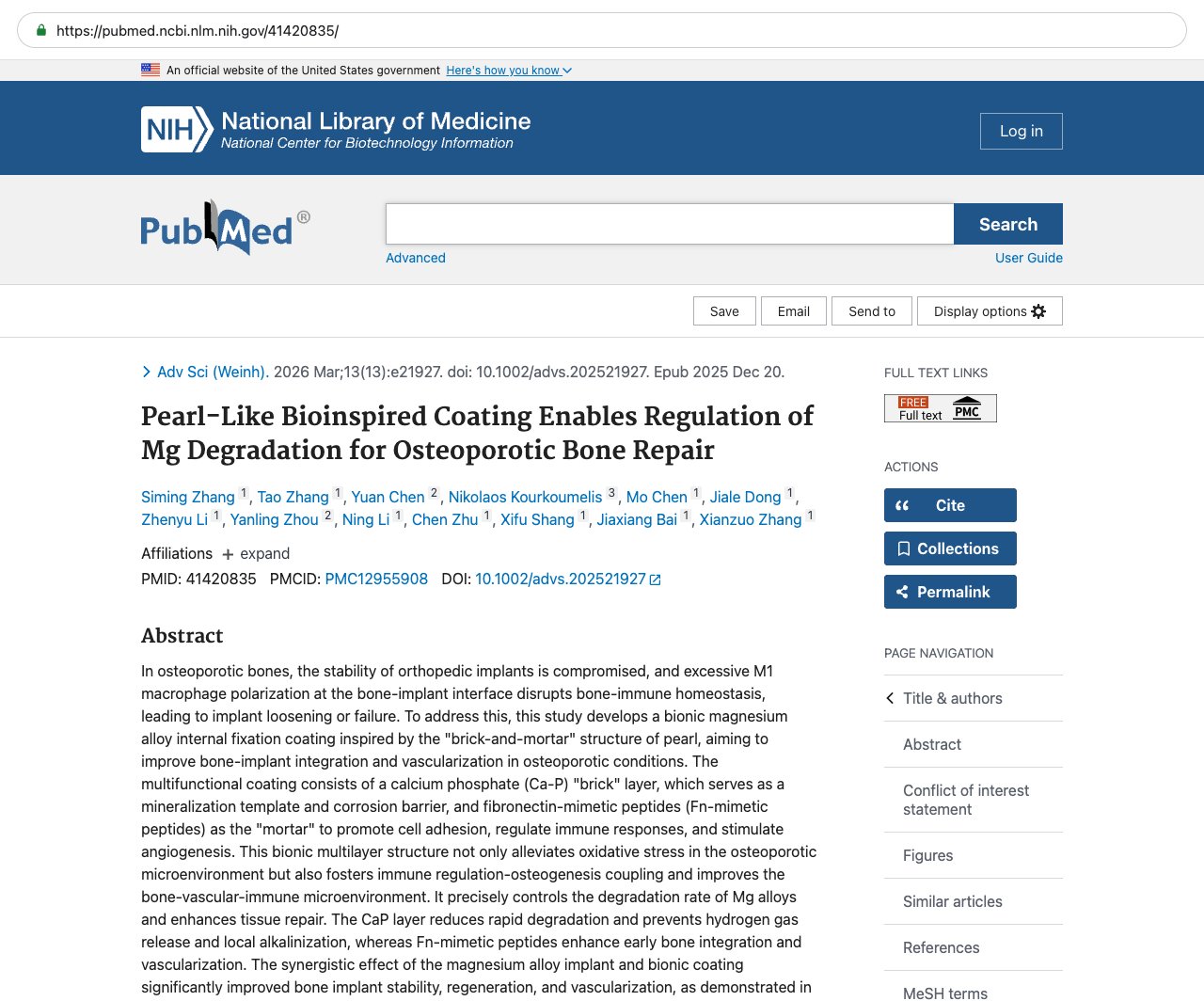
This page mirrors the published abstract (© the authors / publisher) for reference and citation. The canonical source is the PubMed record linked above. This is not medical advice.