2026 · Li — Adjunctive Molecular Hydrogen Capsule Therapy in Empyema Complicated by Chronic Inflammatory Demyelinating Polyneuropathy: A Case Report
Super-Abstract
A 76-year-old man with a rare combination of chest infection (Stage II empyema) and an autoimmune nerve disorder (CIDP) recovered after surgery plus adjuvant oral molecular hydrogen therapy. Detailed immune monitoring showed that H₂ appeared to selectively promote the death of overactivated inflammatory immune cells while preserving protective regulatory cells — a pattern consistent with immune homeostasis rather than broad immunosuppression. (In Vivo, 2026.)
Commentary
This is a single case report — the lowest level of clinical evidence — but an immunologically detailed one. The patient's situation was genuinely complex: Stage II empyema requiring thoracoscopic surgery, overlaid on pre-existing CIDP (an autoimmune nerve disease), with systemic hyperinflammation and immune exhaustion during recovery. Oral hydrogen capsules were added during the critical post-operative phase. The authors performed longitudinal immunophenotyping, which is unusual and valuable for a case report. The immunological observations — selective Fas upregulation on hyperactivated cytotoxic T cells (suggesting apoptotic clearance of pro-inflammatory cells), preserved helper T cells, restored memory B cells, and expanded regulatory T and B cells (Tregs, Bregs) — form a coherent biological narrative. However, this is one patient with no control: it is impossible to know whether the recovery would have occurred without H₂ capsules. The concurrent post-operative care, standard CIDP management, and natural disease trajectory cannot be excluded as explanations.
Key quotes
- „We observed a cell-specific up-regulation of fas cell surface death receptor (Fas) expression in hyper-activated naïve and effector cytotoxic T cells (Tc), suggesting a H2-facilitated apoptotic clearance of pro-inflammatory lineages. Conversely, the helper T-cell (Th) reservoir was preserved.“ — the key immunological observation: H₂ may selectively promote clearance of hyperactive inflammatory cells without depleting protective helper cells
- „Recovery was further characterized by the consistent restoration of intermediate and post-germinal center memory B-cell populations, coupled with a substantial augmentation of suppressive T and B-cell subsets (Tregs and Bregs).“ — the broader immune rebalancing pattern observed during the patient's recovery
- „Molecular hydrogen may act as a systemic bioregulator that fosters immune homeostasis by selectively targeting hyper-activated effector cells while promoting regulatory cell recovery.“ — the authors' mechanistic hypothesis — framed cautiously as 'may act'
Our assessment
A case report provides the lowest level of clinical evidence. No causal inference about H₂ is possible from a single uncontrolled case. The patient recovered — but the simultaneous surgical treatment (VATS decortication), post-operative care, and the natural course of CIDP management all contributed. The immunophenotyping data is genuinely interesting and generates testable hypotheses about H₂'s immunomodulatory mechanism. The honest assessment: this report is valuable as a detailed clinical observation that informs future controlled studies — it does not prove that H₂ caused the recovery. The authors themselves use appropriately cautious language ('may act').
Study design
- Type: case report (single patient, no control) · n: 1 (76-year-old male) · H₂ delivery: oral molecular hydrogen capsules (adjunctive, during post-operative critical phase)
- Clinical context: Stage II empyema treated with VATS decortication + standard care; pre-existing CIDP; systemic hyperinflammation during recovery
- Result: clinical recovery achieved; immunophenotyping showed Fas upregulation in hyperactivated cytotoxic T cells, preserved Th cells, restored memory B cells, expanded Tregs and Bregs — consistent with immune homeostasis; causal role of H₂ cannot be established from a single case
Abstract
BACKGROUND/AIM: The management of Stage II empyema complicated by chronic inflammatory demyelinating polyneuropathy (CIDP) presents a formidable clinical challenge due to the precarious balance required between aggressive infection control and the modulation of immune-mediated neurological frailty. We report a complex case of comorbid empyema and CIDP successfully managed with a multidisciplinary approach and adjuvant molecular hydrogen (H2) therapy. CASE REPORT: A 76-year-old male with CIDP presented with acute respiratory failure secondary to Stage II empyema. Following video-assisted thoracoscopic surgery (VATS) decortication, the patient exhibited systemic hyperinflammation and immune exhaustion. Adjuvant oral molecular hydrogen therapy was initiated during the critical phase. Longitudinal immunophenotyping was performed to monitor the therapeutic response. Clinical recovery coincided with profound immunological remodeling. We observed a cell-specific up-regulation of fas cell surface death receptor (Fas) expression in hyper-activated naïve and effector cytotoxic T cells (Tc), suggesting a H2-facilitated apoptotic clearance of pro-inflammatory lineages. Conversely, the helper T-cell (Th) reservoir was preserved. Recovery was further characterized by the consistent restoration of intermediate and post-germinal center memory B-cell populations, coupled with a substantial augmentation of suppressive T and B-cell subsets (Tregs and Bregs). This shift toward immune homeostasis prevented secondary autoimmune flares and facilitated successful discharge. CONCLUSION: Molecular hydrogen may act as a systemic bioregulator that fosters immune homeostasis by selectively targeting hyper-activated effector cells while promoting regulatory cell recovery. This dual antioxidant and immunomodulatory capacity positions H2 as a promising adjuvant therapy for complex infectious and neuroinflammatory conditions.
Source & links
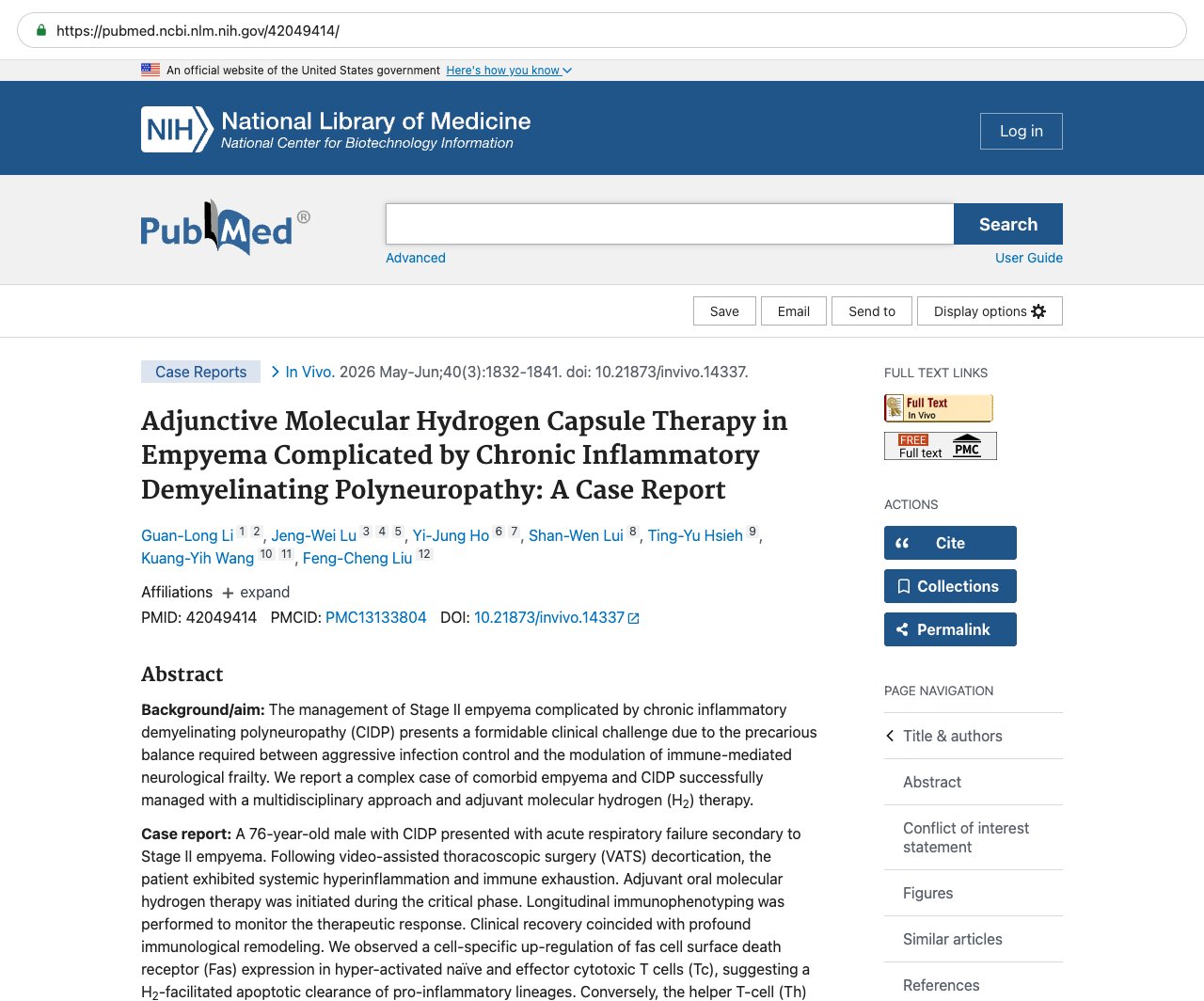
Screenshot of the PubMed page
This page mirrors the published abstract (© the authors / publisher) for reference and citation. The canonical source is the PubMed record linked above. This is not medical advice.