2025 APMIS : acta pathologica, microbiologica, et immunologica Scandinavica Pilot / Observational Human H₂ therapy Drinking (HRW)
2025 · Lui et al. — Predicting Therapeutic Response to Molecular Hydrogen in Autoimmune Diseases via Immunophenotyping
Super-Abstract
Can we predict in advance which autoimmune patients will benefit from H₂ therapy? This prospective study in 25 patients (rheumatoid arthritis, lupus, and others) developed a novel prediction index — the HRPI — based on immune cell profiles. An HRPI below −0.3 reliably predicted favorable clinical response (ROC = 0.94). The study also showed that H₂ significantly shifted 15 out of 108 immune cell subsets. (APMIS, 2025.)
Commentary
Personalized medicine for H₂ therapy is what this paper is attempting. Rather than simply reporting that hydrogen helped some patients, Lui and colleagues went one step further: they profiled 108 immune subsets before and after three months of oral H₂ therapy (170 mg hydrogen-enriched coral calcium daily) and correlated the baseline immune landscape with treatment response — measured via the Brief Fatigue Inventory. The result is the Hydrogen-assisted Treatment Response Prediction Index (HRPI), a composite score with impressive ROC performance. Notably, disease-specific patterns emerged: RA patients showed a distinct immunological fingerprint compared to SLE patients, with increased PD-1+ T cells, Fas+ B cells, and a marked reduction in Tr1 (type 1 regulatory T) cells. This suggests H₂ does not act as a blunt immunosuppressant but engages the immune system in condition-specific ways. The study is methodologically more sophisticated than many single case reports in this field and represents a meaningful step toward stratified H₂ therapy.
Key quotes
- „Based on baseline immune profiles and the percent change in fatigue scores, a Hydrogen-assisted Treatment Response Prediction Index (HRPI) was developed, demonstrating strong predictive performance (ROC = 0.9375, p = 0.0118).“ — the HRPI: a biomarker-based prediction tool for H₂ treatment response
- „Disease-specific immune modulation was observed in RA patients, particularly characterized by increased proportions of programmed cell death protein 1 (PD-1+) T cells and Fas+ B cells, and a marked reduction in Tr1 cells compared to patients with SLE or other autoimmune diseases.“ — H₂ acts differently in RA vs. SLE — disease-specific immune signatures
- „HRPI values below -0.3 predicted favorable clinical responses, whereas values near zero were associated with poor outcomes.“ — the practical decision threshold for the prediction index
Our assessment
This study is one of the more ambitious H₂ clinical papers to date in autoimmunology, introducing a biomarker-based prediction framework. The HRPI's ROC of 0.94 is striking, but must be interpreted cautiously: the sample is very small (n = 25, with subgroups as small as n = 4–7), there is no placebo control group, and the H₂ delivery used coral calcium capsules — a compound that may introduce confounders (calcium, mineral content). Fatigue as an outcome measure, while patient-relevant, is subjective. Flow cytometry was used rigorously with 108 subsets, which is a methodological strength. The HRPI requires independent validation in larger cohorts before clinical adoption. Overall: a genuinely interesting step forward, but preliminary.
Study design
- Type: prospective observational cohort · n: 25 (RA n=14, SLE n=7, other n=4) + 15 untreated RA controls · H₂ delivery: oral hydrogen-enriched coral calcium, 170 mg/day for 3 months
- Endpoints: flow cytometry of 108 immune subsets; Brief Fatigue Inventory (BFI-T); HRPI development
- Result: 15/108 immune subsets significantly changed; HRPI (ROC=0.94) predicts favorable response when below −0.3; disease-specific immune patterns in RA vs. SLE
Abstract
Autoimmune diseases, such as rheumatoid arthritis (RA) and systemic lupus erythematosus (SLE), are characterized by immune dysregulation that leads to chronic inflammation and organ damage. Current therapeutic strategies-including corticosteroids, immunosuppressants, and biologics-often exhibit variable efficacy and are associated with potential adverse effects. Molecular hydrogen, recognized for its ability to scavenge mitochondrial reactive oxygen species and inhibit the NLRP3 inflammasome, has emerged as a promising adjunctive treatment. However, its immunomodulatory effects remain insufficiently defined. This study aimed to evaluate the immunological effects of molecular hydrogen-assisted therapy (MHAT) on immune cell subsets and to identify potential predictive biomarkers of treatment efficacy. A total of 25 patients with autoimmune diseases who received MHAT were included (RA: n = 14; SLE: n = 7; others: n = 4, including one each with psoriatic arthritis, primary Sjögren's syndrome, immune-related interstitial lung disease, and diffuse idiopathic skeletal hyperostosis). An additional 15 untreated RA patients served as controls for the assessment of MHAT-induced changes in lymphocyte profiles and type 1 regulatory T (Tr1) cells. MHAT was administered orally at a daily dose of 170 mg hydrogen-enriched coral calcium for three months. Immune phenotyping of T cells, B cells, and regulatory T cells was performed using flow cytometry before and after treatment. Among the 108 immune subsets analyzed, 15 exhibited significant changes, including 11 T cell and 4 B cell subsets. Disease-specific immune modulation was observed in RA patients, particularly characterized by increased proportions of programmed cell death protein 1 (PD-1+) T cells and Fas+ B cells, and a marked reduction in Tr1 cells compared to patients with SLE or other autoimmune diseases. Based on baseline immune profiles and the percent change in fatigue scores (assessed by the Brief Fatigue Inventory, BFI-T), a Hydrogen-assisted Treatment Response Prediction Index (HRPI) was developed, demonstrating strong predictive performance (ROC = 0.9375, p = 0.0118). HRPI values below -0.3 predicted favorable clinical responses, whereas values near zero were associated with poor outcomes. HRPI shows potential as a predictive biomarker for MHAT efficacy and guides personalized autoimmune treatment.
Source & links
Screenshot of the PubMed page
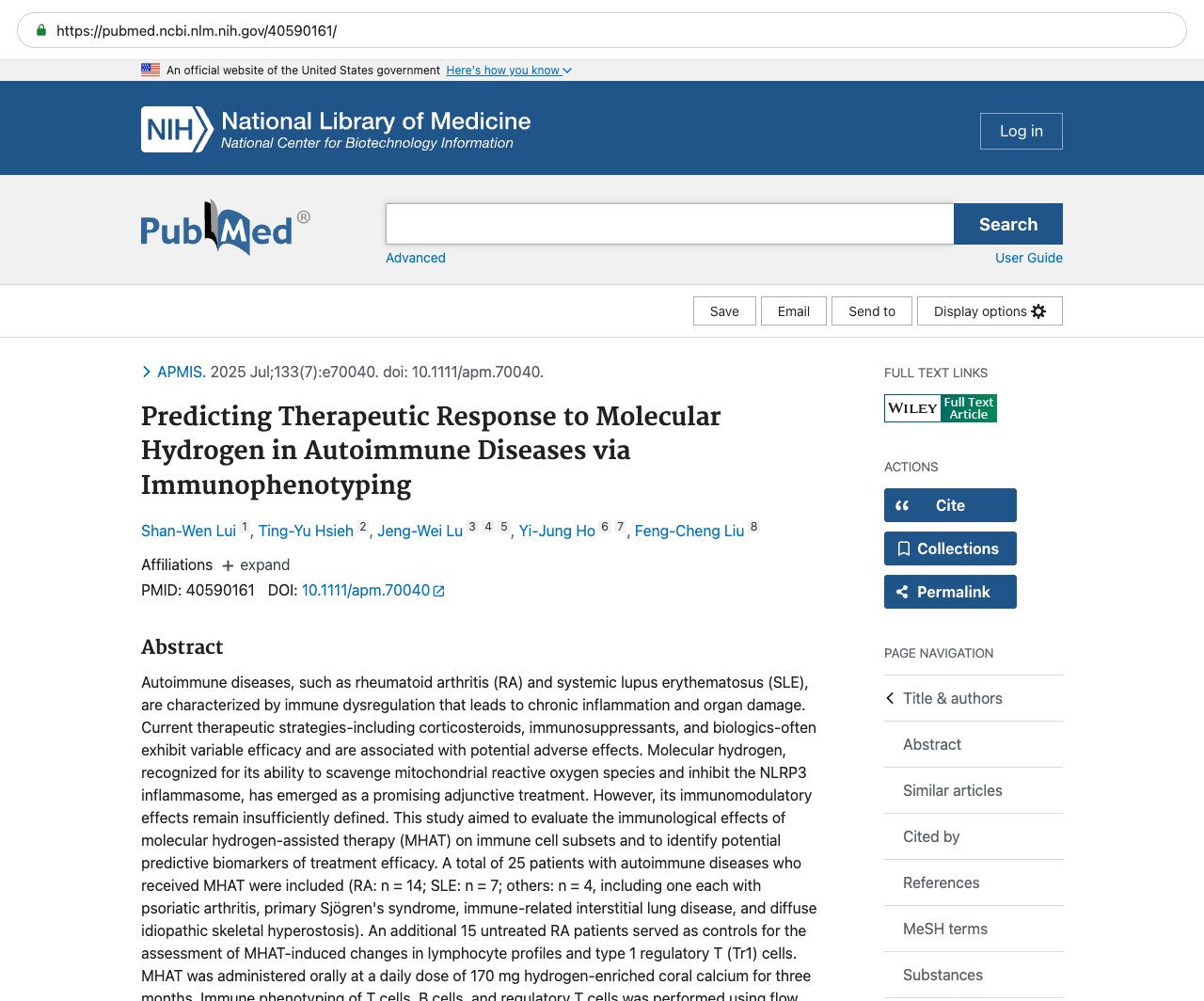
This page mirrors the published abstract (© the authors / publisher) for reference and citation. The canonical source is the PubMed record linked above. This is not medical advice.