2024 · Slezák — New Possibilities of the Prevention and Treatment of Cardiovascular Pathologies: The Potential of Molecular Hydrogen in the Reduction of Oxidative Stress
Super-Abstract
This review examines molecular hydrogen (H₂) as a selective antioxidant with particular promise for cardiovascular disease, where oxidative stress plays a defining role. Unlike conventional antioxidants — which have largely failed in clinical trials — H₂ neutralises only the most damaging reactive oxygen species (·OH) while leaving beneficial ROS for normal cell signalling intact. The authors summarise the current mechanistic and clinical evidence base. This is a literature review, not a new experimental study.
Commentary
Oxidative stress is one of medicine's most discussed topics — and also one of its most disappointing: countless antioxidant trials (vitamin E, vitamin C, beta-carotene, NAC) have failed to deliver the promised benefits in humans. This review by Slezák and colleagues asks why H₂ might succeed where conventional antioxidants have not. Their answer centres on selectivity: H₂ preferentially scavenges hydroxyl radicals (·OH) and peroxynitrite (ONOO⁻) — the most reactive and destructive species — without blunting superoxide or H₂O₂, which cells use for signalling. The coverage is broad, spanning cardiovascular disease, aging, neurological conditions, metabolic disorders, skin aging, immune function, and sports performance. The review is thorough in scope but, as with most narrative reviews, does not perform meta-analytic quantification of effect sizes.
Key quotes
- „H2 is superior to conventional antioxidants as it can selectively reduce (.)OH radicals while preserving important ROS that are otherwise used for normal cell signaling.“ — the central claim distinguishing H₂ from conventional antioxidants
- „Disproportion between reactive oxygen species (ROS) production and the body's antioxidant system can cause oxidative stress, which is considered a common denominator in various pathological conditions, including cardiovascular diseases, aging, and cognitive disorders.“ — why oxidative stress is a transdiagnostic target
- „their use in human medicine did not bring the expected effect“ — honest assessment of why classical antioxidants have failed
Our assessment
This is a narrative review — it synthesises existing literature rather than generating new experimental data. The selective-antioxidant hypothesis for H₂ is well-supported mechanistically and aligns with a broad body of preclinical work. However, the review does not provide pooled effect sizes or a systematic quality assessment of the included studies, which limits the strength of its conclusions. The field still needs large, well-powered randomised controlled trials, especially in cardiovascular populations. The authors' enthusiasm for H₂ should be read in the context of these limitations.
Study design
- Type: narrative review · n: n/a (literature synthesis) · H₂ delivery: multiple modalities discussed (inhalation, drinking water, etc.)
- Result: no pooled effect sizes; narrative conclusion that H₂'s selective ROS scavenging (·OH, ONOO⁻) makes it mechanistically superior to non-selective antioxidants for cardiovascular and systemic oxidative-stress conditions
Abstract
Disproportion between reactive oxygen species (ROS) production and the body's antioxidant system can cause oxidative stress, which is considered a common denominator in various pathological conditions, including cardiovascular diseases, aging, and cognitive disorders. The generation of free radicals, which occurs through partial reduction of oxygen, can quickly overwhelm the endogenous antioxidant system capacity of the cell. This causes lipid, protein, DNA and RNA damage, inflammation, and overall cell degeneration, which can be mitigated by various antioxidants. However, their use in human medicine did not bring the expected effect. Molecular hydrogen (H2), due to its unique physical and chemical properties, provides a number of benefits for alleviating oxidative stress. H2 is superior to conventional antioxidants as it can selectively reduce (.)OH radicals while preserving important ROS that are otherwise used for normal cell signaling. Key words Oxidative stress, Cardiovascular diseases, Molecular hydrogen, ROS, Inflammation.
Source & links
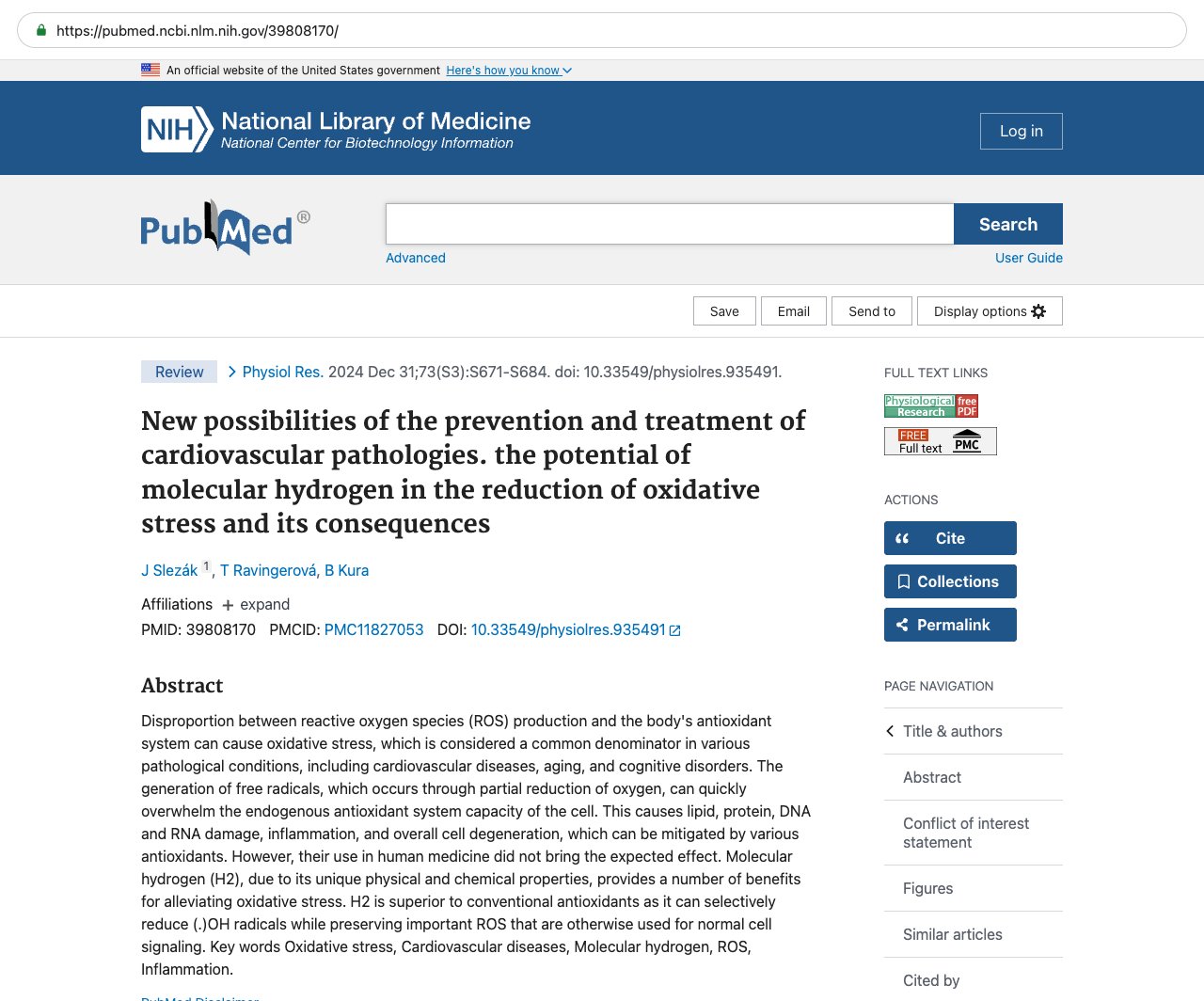
Screenshot of the PubMed page
This page mirrors the published abstract (© the authors / publisher) for reference and citation. The canonical source is the PubMed record linked above. This is not medical advice.