2025 · Hsu et al. — Molecular Hydrogen Therapy Enhances Immune Markers in Treg, Plasma, Tr1 Cells, and KLRG1 Expression on Tc Cells: A Case of Acute SDH With Midline Shift and Uncal Herniation Post-decompressive Craniectomy
Super-Abstract
Acute subdural hematoma with brain herniation carries high mortality and poor neurological outcomes. This case report describes a 24-year-old man who survived a severe traumatic SDH — with midline shift, uncal herniation, and dilated pupil — and received hydrogen capsules as an add-on to conventional neurocritical care. The primary recovery was attributed to standard interventions, but H₂ therapy appeared to favorably modulate immune markers, particularly regulatory T cells and plasma cells, without adverse effects. (In Vivo, 2025.)
Commentary
This case sits at the intersection of neurotrauma and immunology. Subdural hematomas trigger a robust neuroinflammatory cascade — microglial activation, oxidative burst, blood-brain barrier disruption — and the management challenge goes beyond simple surgical decompression. The patient received an impressive array of conventional interventions: craniectomy, hyperbaric oxygen, therapeutic hypothermia, and stem cell therapy — before hydrogen capsules were added. The immune monitoring (Treg and plasma cell enrichment) suggests H₂ may have engaged anti-inflammatory immune circuits, consistent with its known mechanism as a selective antioxidant that modulates the NLRP3 inflammasome and reduces mitochondrial ROS. However, the authors themselves are candid: conventional therapies were vital to survival, and H₂ was an adjunct whose specific contribution cannot be separated. The extreme rarity of such a case and the multiple simultaneous interventions make it very difficult to draw conclusions about H₂.
Key quotes
- „Hydrogen therapy appeared to enhance immune markers, particularly Treg and plasma cells, with no adverse effects.“ — the claimed H₂ contribution — immune modulation without toxicity
- „Conventional treatments-craniectomy, hyperbaric oxygen, therapeutic hypothermia, and stem cell therapy-were essential for stabilizing his condition.“ — authors explicitly prioritize standard care — honest framing
- „This case indicates that hydrogen therapy may serve as a beneficial addition to established SDH management methods.“ — cautious conclusion: potential add-on, not replacement
Our assessment
Single case report with four simultaneous major interventions — any attribution to H₂ is speculative. The patient received craniectomy, hyperbaric oxygen (itself a strong anti-inflammatory), therapeutic hypothermia, and stem cell therapy concurrently. These are each individually capable of modulating the immune profile described. The H₂ contribution cannot be isolated. The authors are appropriately cautious. The clinical value of this report is primarily in demonstrating safety (no adverse effects) and in providing an immunological snapshot of a neurotrauma patient during H₂ therapy — a niche that is essentially unexplored. This does not constitute efficacy evidence for H₂ in neurotrauma.
Study design
- Type: single case report · n: 1 (24-year-old male, acute SDH with midline shift, uncal herniation) · H₂ delivery: hydrogen capsules, daily from admission; concurrent craniectomy, hyperbaric O₂, therapeutic hypothermia, stem cells
- Endpoints: immune phenotyping (Treg, plasma cells, Tr1 cells, KLRG1+ Tc cells); clinical recovery narrative
- Result: increased Treg and plasma cell markers observed; KLRG1 expression on Tc cells enhanced; patient survived and recovered; H₂-specific contribution cannot be isolated from concurrent interventions
Abstract
BACKGROUND/AIM: Subdural hematomas (SDH), often caused by head trauma, are serious with high mortality and long-term complications. Studies show that molecular hydrogen has neuroprotective effects, such as reducing oxidative stress, inflammation, and cell death. It may also protect mitochondria, support cell function, and regulate immune responses, making it a promising new treatment option for SDH. However, more research is needed to confirm its effectiveness and create treatment guidelines. CASE REPORT: We present a 24-year-old man with SDH, along with a right-sided midline shift, uncal herniation, and dilated left pupil. Conventional treatments-craniectomy, hyperbaric oxygen, therapeutic hypothermia, and stem cell therapy-were essential for stabilizing his condition. In addition, we administered hydrogen capsules as a novel adjunct therapy, beginning daily treatment immediately upon admission. While recovery was primarily due to standard interventions, hydrogen therapy appeared to enhance immune markers, particularly Treg and plasma cells, with no adverse effects. This case indicates that hydrogen therapy may serve as a beneficial addition to established SDH management methods. CONCLUSION: This case suggests that molecular hydrogen therapy may be a helpful adjunct treatment for SDH with midline shift. Conventional therapies, including craniectomy, hyperbaric oxygen, therapeutic hypothermia, and stem cell therapy, were vital to the patient's recovery, but hydrogen therapy may have contributed by modulating immune responses, particularly Treg and plasma cell activity. While these findings are encouraging, further research is necessary to confirm hydrogen therapy's benefits and its role alongside traditional neurocritical care treatments.
Source & links
Screenshot of the PubMed page
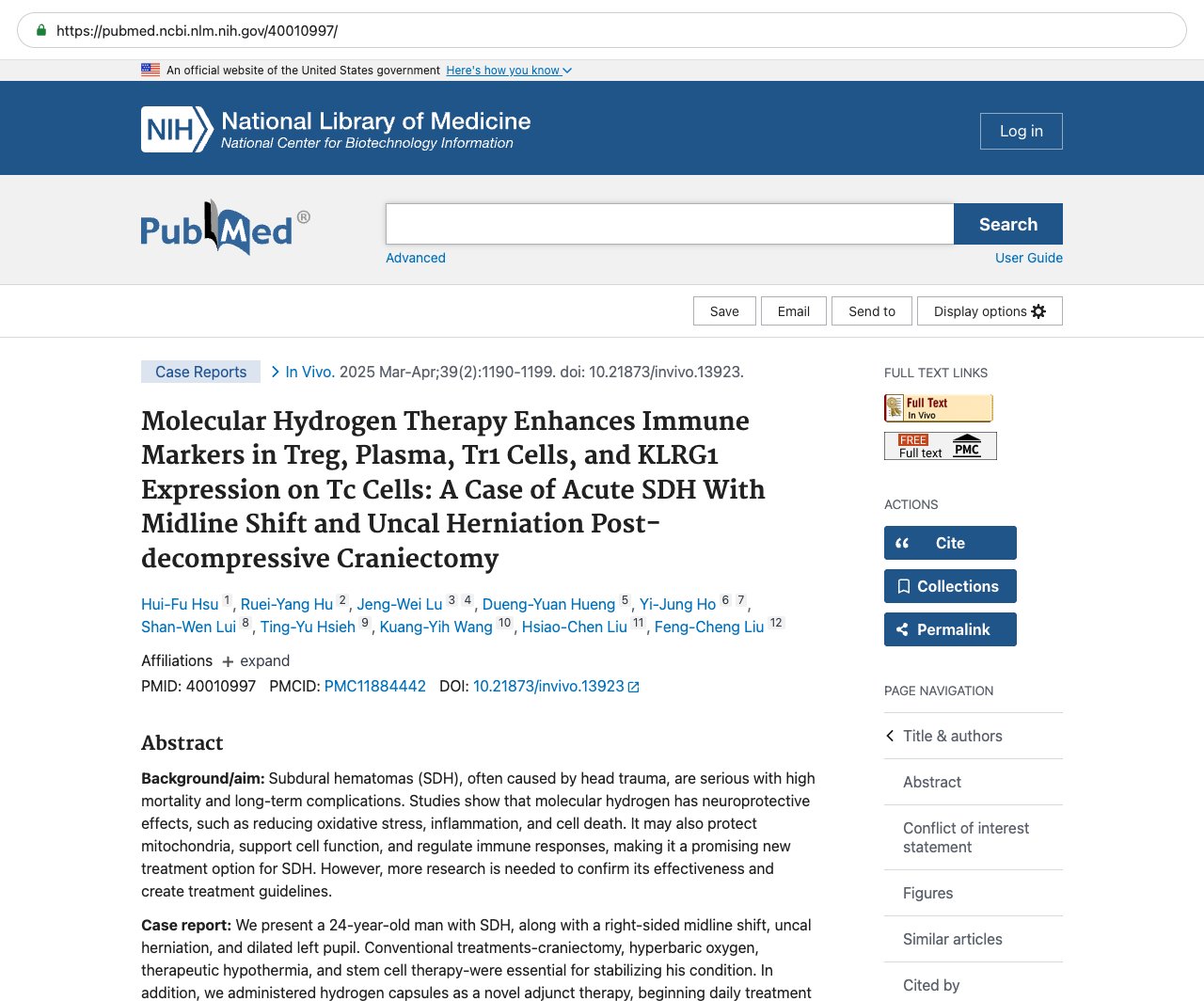
This page mirrors the published abstract (© the authors / publisher) for reference and citation. The canonical source is the PubMed record linked above. This is not medical advice.