2021 · Lucas — Molecular hydrogen (H₂) as a potential treatment for acute and chronic fatigue
Super-Abstract
This review paper argues that molecular H₂ is well-suited for treating both acute and chronic fatigue, based on the premise that oxidative stress and mitochondrial dysfunction underlie many forms of fatigue. The authors synthesise existing evidence on reactive oxygen/nitrogen species in fatigue and H₂'s antioxidant properties. This is a literature review, not a clinical trial — no new patient data are presented.
Commentary
Fatigue spans a wide spectrum: from post-exercise recovery to chronic conditions such as Parkinson's disease, multiple sclerosis, COVID-19 sequelae, and alcohol hangover. The authors identify oxidative stress — particularly the production of reactive oxygen and nitrogen species (ROS/RNS) — and resulting mitochondrial dysfunction as common mechanistic denominators. They then review H₂'s documented antioxidant profile and propose it as a rationally targeted intervention. The review covers both acute (exercise, hangover) and chronic (neurological disease, viral infection) fatigue contexts. The logic is mechanistically coherent but the evidence chain has important gaps: while H₂ has antioxidant properties, direct clinical evidence for H₂ reducing fatigue in the specific disease contexts reviewed (Parkinson's, MS, COVID-19) is limited. The review acknowledges this by framing its conclusion as a „proposal.“
Key quotes
- „Oxidative stress and a resulting disturbance of mitochondrial function are likely to be common denominators for many forms of fatigue, and antioxidant treatments have been shown to be effective in alleviating the symptoms of fatigue.“ — the mechanistic rationale linking oxidative stress, mitochondria, and fatigue
- „we review the role of reactive oxygen and nitrogen species in fatigue and the antioxidant effects of the intake of molecular hydrogen.“ — scope of the review: ROS/RNS biology + H₂ antioxidant evidence
- „We propose that molecular hydrogen is well suited for the treatment of temporary and chronic forms of oxidative stress-associated fatigue.“ — conclusion framed as a proposal — not yet a clinical recommendation
Our assessment
A plausible but still largely theoretical review. The mechanistic basis — oxidative stress drives fatigue, H₂ reduces oxidative stress — is supported by existing biology. However, this is a review paper, not a clinical trial, and the leap from antioxidant mechanism to effective fatigue treatment requires human trial evidence that remains incomplete. The authors' choice of the word „proposal“ is honest and appropriate. The review usefully collects the biological rationale across multiple fatigue contexts but should not be read as clinical proof of efficacy. A specific limitation: the heterogeneity of „fatigue“ across the diseases covered means that a single intervention may have very different effects depending on aetiology.
Study design
- Type: narrative review · n: n/a — literature synthesis, no primary data · H₂ delivery: various forms discussed (inhalation, hydrogen-rich water, etc.) — not experimentally compared
- Scope: covers acute fatigue (exercise, hangover) and chronic fatigue (Parkinson's, MS, COVID-19, influenza); reviews ROS/RNS biology and H₂ antioxidant literature
- Key conclusion: H₂ proposed as a rational treatment for oxidative-stress-associated fatigue based on mechanistic argument — clinical validation still required
Abstract
Many diseases as well as acute conditions can lead to fatigue, which can be either temporary or chronic in nature. Acute fatigue develops frequently after physical exercise or after alcohol hangover, whereas microbial infections such as influenza or COVID-19 and chronic diseases like Parkinson's disease or multiple sclerosis are often associated with chronic fatigue. Oxidative stress and a resulting disturbance of mitochondrial function are likely to be common denominators for many forms of fatigue, and antioxidant treatments have been shown to be effective in alleviating the symptoms of fatigue. In this study, we review the role of reactive oxygen and nitrogen species in fatigue and the antioxidant effects of the intake of molecular hydrogen. We propose that molecular hydrogen is well suited for the treatment of temporary and chronic forms of oxidative stress-associated fatigue.
Source & links
Screenshot of the PubMed page
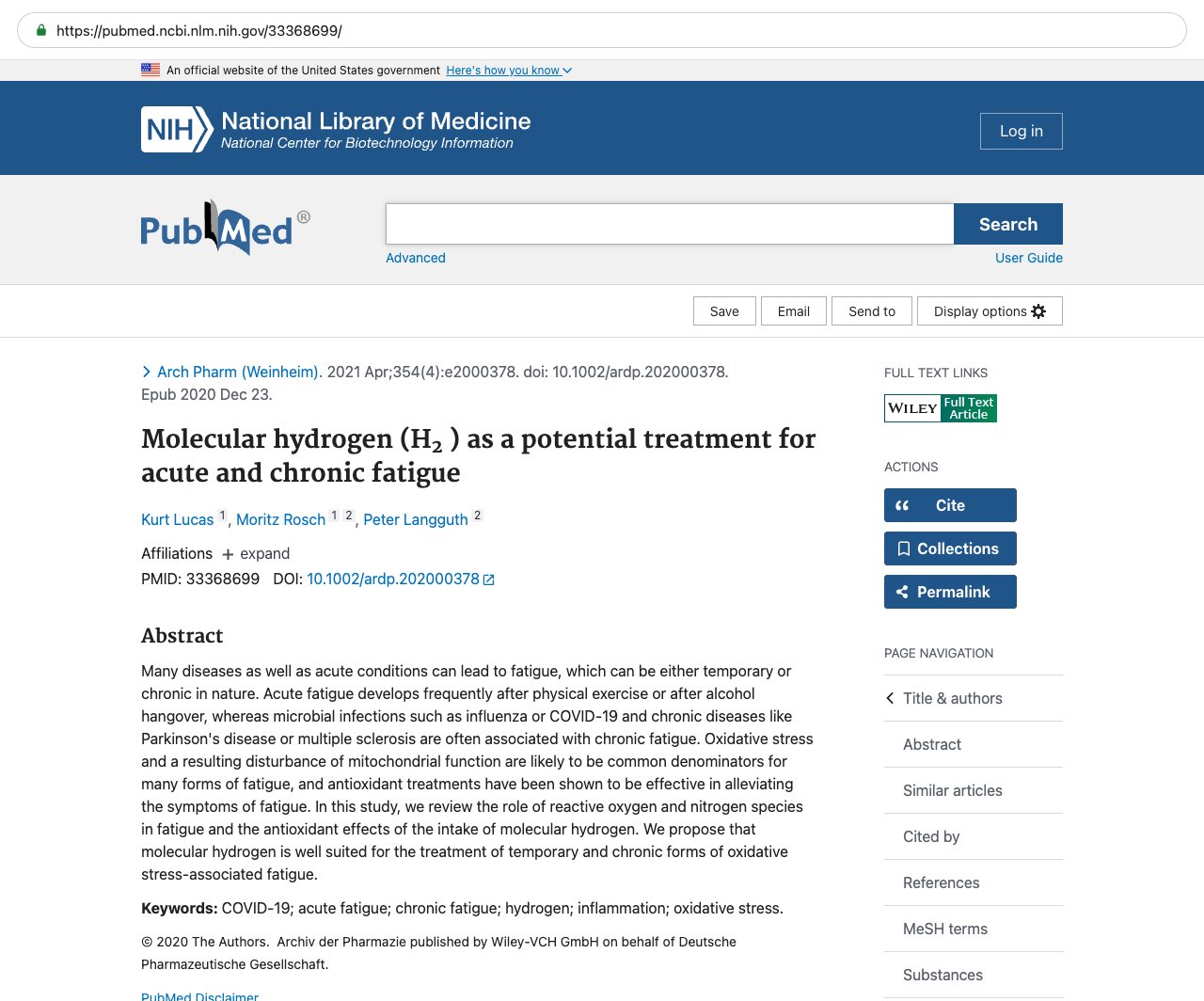
This page mirrors the published abstract (© the authors / publisher) for reference and citation. The canonical source is the PubMed record linked above. This is not medical advice.