2015 · Chikan et al. — Atomic Insight into the Altered O6-Methylguanine-DNA Methyltransferase Protein Architecture in Gastric Cancer.
Super-Abstract
A missense mutation at codon 151 of the DNA-repair protein MGMT — found in nearly 40 % of tested gastric-cancer tissue samples — causes major structural disruption of the protein's active site, as shown by molecular dynamics simulation. The mutation (Serine → Isoleucine) destabilises key salt bridges and alters the DNA-binding domain. This is a computational and clinical-sequencing study; no molecular hydrogen (H₂) is involved.
Commentary
O6-methylguanine-DNA methyltransferase (MGMT) repairs alkylating-agent-induced DNA damage by removing mutagenic O6-methylguanine lesions. Mutations that impair MGMT function may promote cancer by allowing DNA damage to accumulate. The study screened gastric-cancer patients from a population with high alkylating-agent exposure (dietary context) and found a Ser151Ile mutation in ~40 % of samples. Molecular dynamics simulation then showed that this variant structurally destabilises the protein through disrupted hydrogen-bond patterns and loss of stabilising salt bridges in several residue clusters. Note: this paper is unrelated to molecular hydrogen (H₂) biology. The term „hydrogen“ refers solely to conventional hydrogen bonds in standard protein chemistry. Its appearance in H₂ research databases reflects keyword overlap, not scientific relevance to H₂ medicine.
Key quotes
- „nearly 40% of the studied neoplastic samples harbored missense mutation at codon151 resulting into Serine to Isoleucine variation.“ — prevalence of the mutation in the patient cohort
- „The atomic insight into MGMT protein by computational approach showed a significant change in the intra molecular hydrogen bond pattern, thus leading to the observed structural anomalies.“ — how the mutation disrupts protein architecture at the atomic level
- „the identified mutation in the vicinity of the active site of MGMT protein causes the local and global destabilization of a protein by either eliminating the stabilizing salt bridges in cluster C3, C4, and C5 or by locally destabilizing the "protein stabilizing hing" mapped on C3-C4 cluster.“ — specific structural mechanism of destabilisation
Our assessment
This is a computational in-silico study combined with mutational screening of clinical samples — no interventional experiments were performed. The findings are hypothesis-generating: the identified mutation plausibly impairs MGMT function and could contribute to gastric carcinogenesis, but functional validation in cell or animal models is still needed. The study has no relevance to molecular hydrogen (H₂) therapy or biology; it deals with hydrogen bonds as a standard biochemical concept. It belongs to structural oncology and DNA-repair research.
Study design
- Type: in-silico molecular dynamics study + clinical mutational screening · Samples: gastric cancer patient tissue (neoplastic samples, ~40 % mutation prevalence) · H₂ relevance: none
- Method: Sanger sequencing of MGMT codon 151 region + MD simulation of wild-type vs. Ser151Ile variant · Result: mutation disrupts hydrogen-bond network, destabilises salt bridges in clusters C3–C5, distorts active site and DNA-binding domain
Abstract
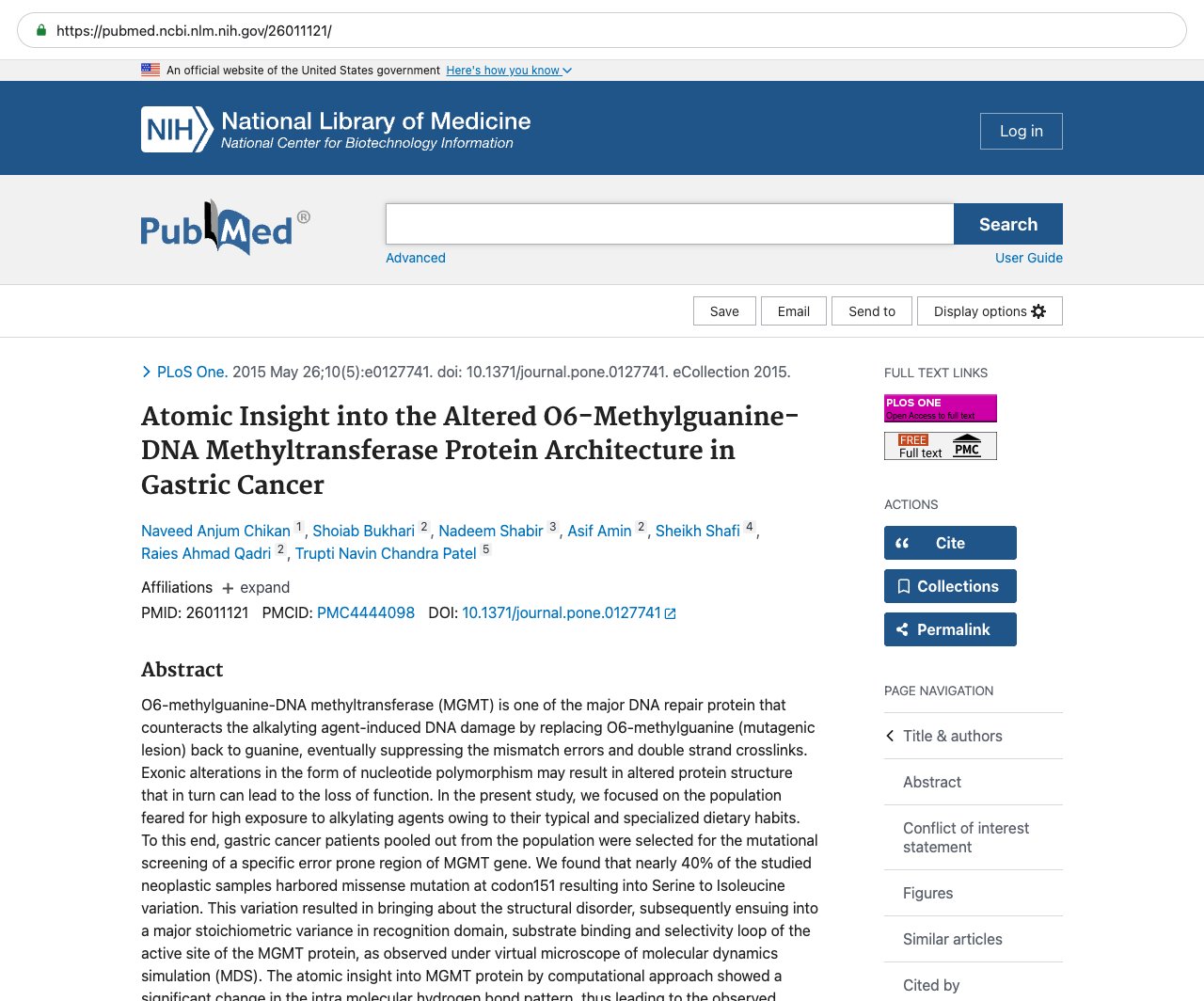
O6-methylguanine-DNA methyltransferase (MGMT) is one of the major DNA repair protein that counteracts the alkalyting agent-induced DNA damage by replacing O6-methylguanine (mutagenic lesion) back to guanine, eventually suppressing the mismatch errors and double strand crosslinks. Exonic alterations in the form of nucleotide polymorphism may result in altered protein structure that in turn can lead to the loss of function. In the present study, we focused on the population feared for high exposure to alkylating agents owing to their typical and specialized dietary habits. To this end, gastric cancer patients pooled out from the population were selected for the mutational screening of a specific error prone region of MGMT gene. We found that nearly 40% of the studied neoplastic samples harbored missense mutation at codon151 resulting into Serine to Isoleucine variation. This variation resulted in bringing about the structural disorder, subsequently ensuing into a major stoichiometric variance in recognition domain, substrate binding and selectivity loop of the active site of the MGMT protein, as observed under virtual microscope of molecular dynamics simulation (MDS). The atomic insight into MGMT protein by computational approach showed a significant change in the intra molecular hydrogen bond pattern, thus leading to the observed structural anomalies. To further examine the mutational implications on regulatory plugs of MGMT that holds the protein in a DNA-Binding position, a MDS based analysis was carried out on, all known physically interacting amino acids essentially clustered into groups based on their position and function. The results generated by physical-functional clustering of protein indicated that the identified mutation in the vicinity of the active site of MGMT protein causes the local and global destabilization of a protein by either eliminating the stabilizing salt bridges in cluster C3, C4, and C5 or by locally destabilizing the "protein stabilizing hing" mapped on C3-C4 cluster, preceding the active site.
Source & links
Screenshot of the PubMed page
This page mirrors the published abstract (© the authors / publisher) for reference and citation. The canonical source is the PubMed record linked above. This is not medical advice.