2020 · Bhattacharya — Effect of aggrecan degradation on the nanomechanics of hyaluronan in extra-fibrillar matrix of annulus fibrosus: A molecular dynamics investigation.
Super-Abstract
This computational study uses molecular dynamics simulations to examine how hydration — linked to aggrecan degradation — affects the nanoscale mechanical behaviour of hyaluronan in the outer ring of intervertebral discs. Results show that increasing hydration significantly shifts both tensile and compressive stiffness of hyaluronan, helping to explain why water loss in disc degeneration alters spinal mechanics. This is a theoretical in-vitro simulation study with no direct H₂ medicine relevance.
Commentary
This paper falls outside the core domain of hydrogen medicine. It models hyaluronan — a polysaccharide abundant in connective tissue and intervertebral discs — under varying hydration conditions using atomistic molecular dynamics. The connection to H₂ is indirect at best: water molecule behaviour and hydrogen bonding are central to the simulation, but the study does not investigate molecular hydrogen (H₂) as a therapeutic or biological agent. The findings are relevant for understanding disc degeneration biomechanics and could inform tissue-engineering approaches, but they do not support any claims about ingested or inhaled H₂.
Key quotes
- „an increase in the hydration levels decreases the elastic modulus of hyaluronan in tension from ~4.6 GPa to ~2.1 GPa.“ — hydration dramatically softens hyaluronan under tension
- „Compressive loading, on the other hand, causes intensive coiling of hyaluronan molecule, which traps more water through hydrogen bonding and aids in bearing compressive loads.“ — hydrogen bonds within hyaluronan contribute to compressive load-bearing
- „study shows that hydration level has a strong influence on the atomistic level interactions between hyaluronan molecules and hyaluronan and water molecules in the EFM which influences the nanoscale mechanics of the Annulus Fibrosus.“ — main conclusion: hydration governs nanomechanics of the disc's outer ring
Our assessment
This is a computational biomechanics study, not an H₂ medicine study. It provides mechanistic insight into how water content affects intervertebral disc behaviour at the nanoscale — relevant for spinal degeneration research, not for evaluating therapeutic hydrogen. Limitations: molecular dynamics simulations are model-dependent and cannot substitute for experimental tissue studies or clinical data. No H₂ therapeutic conclusions can be drawn from this paper.
Study design
- Type: in-silico molecular dynamics simulation · Model: atomistic hyaluronan model in extra-fibrillar matrix of annulus fibrosus · H₂ delivery: not applicable — H₂ is not studied as a therapeutic agent
- Variables: hydration levels 0–75% by weight of water · Outcome: elastic modulus in tension decreased from ~4.6 GPa to ~2.1 GPa with increasing hydration; compressive modulus peaked at 50% hydration (~6 GPa) then declined at 75%
Abstract
Intervertebral Disc (IVD) Degeneration is one of the primary causes of low back pain among the adult population - the most significant cause being the degradation of aggrecan present in the extra-fibrillar matrix (EFM). Aggrecan degradation is closely associated with loss of water content leading to an alteration in the mechanical behaviour of the IVD. The loss in water content has a significant impact on the chemo-mechanical interplay of IVD biochemical constituents at the fundamental level. This work presents a mechanistic understanding of the effect of hydration, closely associated with aggrecan degradation, on the nanoscale mechanical behaviour of the hyaluronan present in the EFM of the Annulus Fibrosus. For this purpose, explicit three-dimensional molecular dynamics analyses of tensile and compressive tests are performed on a representative atomistic model of the hyaluronan present in the EFM. To account for the degradation of aggrecan, hydration levels are varied from 0 to 75% by weight of water. Analyses show that an increase in the hydration levels decreases the elastic modulus of hyaluronan in tension from ~4.6 GPa to ~2.1 GPa. On the other hand, the increase in hydration level increases the elastic moduli in axial compression from ~1.6 GPa in un-hydrated condition to ~6 GPa in 50% hydrated condition. But as the hydration levels increase to 75%, the elastic modulus reduces to ~3.5 GPa signifying a shift in load-bearing characteristic, from the solid hyaluronan component to the fluid component. Furthermore, analyses show a reduction in the intermolecular energy between hyaluronan and water, under axial tensile loading, indicating a nanoscale intermolecular debonding between hyaluronan and water molecules. This is attributed to the ability of hyaluronan to form stabilizing intra-molecular hydrogen bonds between adjacent residues. Compressive loading, on the other hand, causes intensive coiling of hyaluronan molecule, which traps more water through hydrogen bonding and aids in bearing compressive loads. Overall, study shows that hydration level has a strong influence on the atomistic level interactions between hyaluronan molecules and hyaluronan and water molecules in the EFM which influences the nanoscale mechanics of the Annulus Fibrosus.
Source & links
Screenshot of the PubMed page
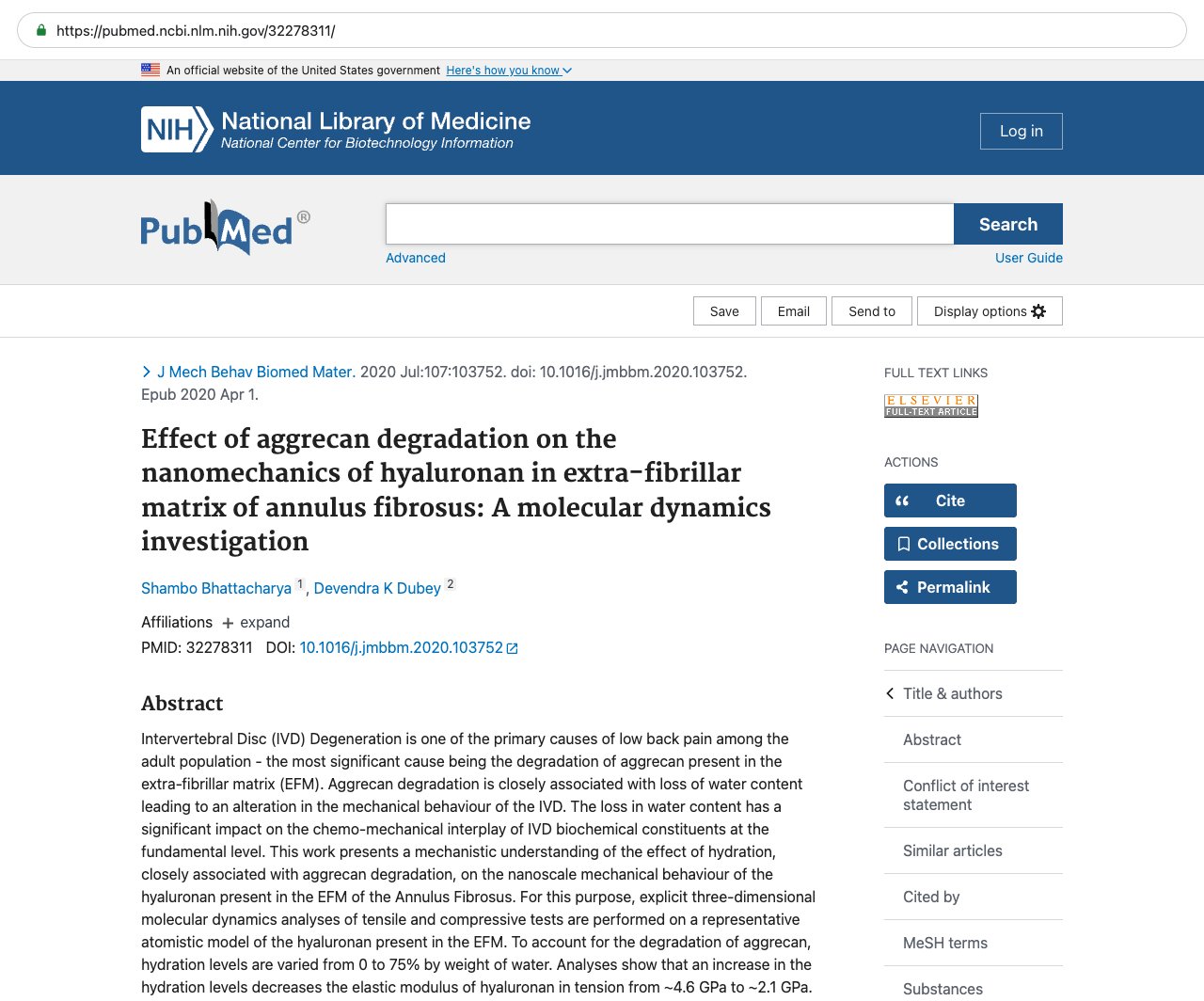
This page mirrors the published abstract (© the authors / publisher) for reference and citation. The canonical source is the PubMed record linked above. This is not medical advice.