2017 · Biswas — A Comprehensive Computational Study on Pathogenic Missense Mutations Spanning the RING2 and REP Domains of Parkin Protein
Super-Abstract
This purely computational (in silico) study analysed how genetic mutations in the Parkin protein — linked to early-onset Parkinson's disease — affect the protein's structure and function. Hydrogen appears in this work only as part of standard molecular modelling (intramolecular hydrogen bonds), not as a therapeutic agent. This is a theoretical bioinformatics study with no H₂ therapy relevance.
Commentary
Parkin is an E3 ubiquitin ligase whose loss-of-function mutations are a major cause of autosomal recessive juvenile Parkinson's disease (ARJP). This study used a range of computational tools (SIFT, PolyPhen2, MutationAccessor, I-Mutant, Discovery Studio) to predict the pathogenicity of missense mutations in the RING2 and REP domains of Parkin. The work is a standard bioinformatics analysis of protein structural impacts — solvent accessibility, hydrophobicity, hydrogen bonding profiles, and interaction energies were compared between mutant and wild-type Parkin. The inclusion of this study in an H₂ database is likely because the word „hydrogen“ appears in the context of intramolecular hydrogen bonds — a standard feature of all protein folding analyses, not a reference to molecular hydrogen therapy. The study has no direct connection to hydrogen (H₂) as a therapeutic or bioactive molecule.
Key quotes
- „By comparing the various analyses it could be safely concluded that except P437L and A379V mutations, all other mutations were potentially deleterious affecting various structural aspects of RING2 domain architecture.“ — main finding: most tested mutations are structurally damaging
- „This study is based purely on computational approach which has the potential to identify disease mutations and the information could further be used in treatment of diseases and prognosis.“ — scope and limitation: in silico only, no wet-lab or clinical data
- „To study the structural and functional implications of these mutations on RING2-REP domain of Parkin, we studied the solvent accessibility (SASA/RSA), hydrophobicity, intra-molecular hydrogen bonding profile and domain analysis by various computational tools.“ — the role of „hydrogen“ here: intramolecular hydrogen bonds in protein structure, not H₂ therapy
Our assessment
This is a purely theoretical/computational study with no direct relevance to molecular hydrogen therapy. „Hydrogen“ in this paper refers to intramolecular hydrogen bonds in protein structure — a ubiquitous feature of all biological molecules — not to dissolved H₂ gas or hydrogen-rich water. The Parkin mutation analysis may be scientifically valuable for Parkinson's disease research, but it provides no evidence for or against H₂ as a therapeutic agent. Users researching H₂ therapy should be aware that this study's inclusion in the H₂ literature database appears to reflect a keyword-matching artefact.
Study design
- Type: computational/in silico study · Model: bioinformatics analysis of Parkin protein mutants · H₂ relevance: none — „hydrogen“ refers to intramolecular hydrogen bonds in protein modelling, not molecular H₂
- Outcome: most RING2/REP missense mutations predicted as structurally deleterious; P437L and A379V identified as potentially non-deleterious exceptions
Abstract
Various mutations in PARK2 gene, which encodes the protein parkin, are significantly associated with the onset of autosomal recessive juvenile Parkinson (ARJP) in neuronal cells. Parkin is a multi domain protein, the N-terminal part contains the Ubl and the C-terminal part consists of four zinc coordinating domains, viz., RING0, RING1, in between ring (IBR) and RING2. Disease mutations are spread over all the domains of Parkin, although mutations in some regions may affect the functionality of Parkin more adversely. The mutations in the RING2 domain are seen to abolish the neuroprotective E3 ligase activity of Parkin. In this current work, we carried out detailed in silico analysis to study the extent of pathogenicity of mutations spanning the Parkin RING2 domain and the adjoining REP region by SIFT, Mutation Accessor, PolyPhen2, SNPs and GO, GV/GD and I-mutant. To study the structural and functional implications of these mutations on RING2-REP domain of Parkin, we studied the solvent accessibility (SASA/RSA), hydrophobicity, intra-molecular hydrogen bonding profile and domain analysis by various computational tools. Finally, we analysed the interaction energy profiles of the mutants and compared them to the wild type protein using Discovery studio 2.5. By comparing the various analyses it could be safely concluded that except P437L and A379V mutations, all other mutations were potentially deleterious affecting various structural aspects of RING2 domain architecture. This study is based purely on computational approach which has the potential to identify disease mutations and the information could further be used in treatment of diseases and prognosis.
Source & links
Screenshot of the PubMed page
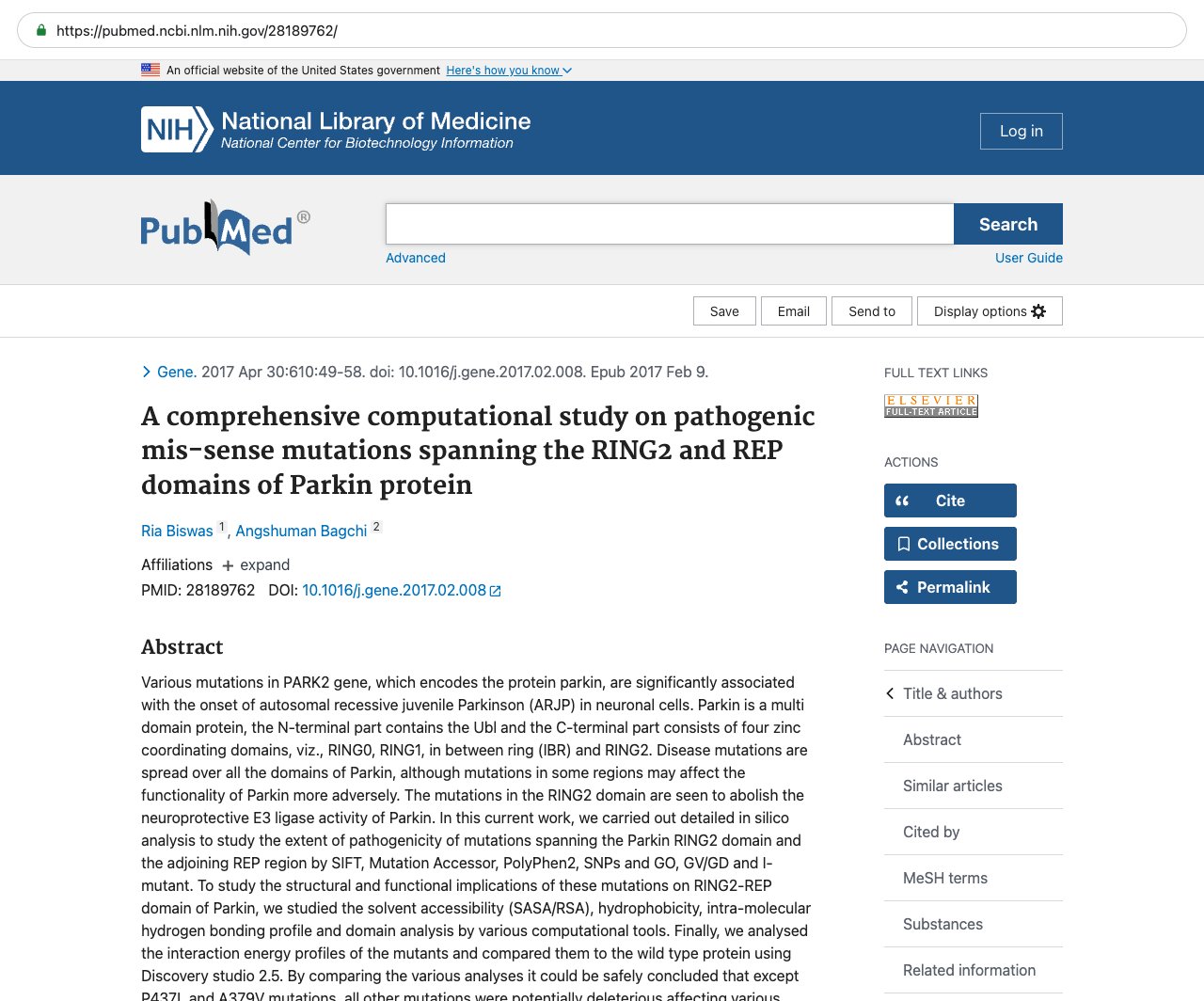
This page mirrors the published abstract (© the authors / publisher) for reference and citation. The canonical source is the PubMed record linked above. This is not medical advice.