2025 · Li — Hydrogen promoted mitochondrial autophagy and alleviated CIH-induced vascular endothelial cell senescence by regulating oxidative stress.
Super-Abstract
Obstructive sleep apnoea (OSA) causes repeated oxygen deficits that accelerate ageing of the blood vessel lining — and molecular hydrogen (H₂) can protect vascular endothelial cells against this premature ageing by activating cellular clean-up processes (autophagy) and reducing oxidative stress. In mice with experimentally induced chronic intermittent hypoxia, H₂ treatment improved aortic function and reduced senescence markers. This is an animal and cell study — no human data are available. (European Journal of Pharmacology, 2025.)
Commentary
Obstructive sleep apnoea is highly prevalent and its cardiovascular complications — including hypertension, atherosclerosis, and endothelial dysfunction — are a significant clinical burden. The model used here (chronic intermittent hypoxia, CIH) is an established murine model for OSA-associated vascular injury. The paper reports that H₂ activates mitophagy (selective autophagy of damaged mitochondria) via the Nrf2 transcription factor pathway, and that silencing Nrf2 in cell culture abolishes H₂'s protective effect — providing pathway-level causal evidence. The echocardiography and aortic ring vasodilation data provide functional (not just molecular) evidence of vascular benefit. These are well-designed animal experiments, but the clinical application question — does H₂ supplementation in OSA patients reduce vascular ageing? — remains entirely unanswered. OSA treatment (CPAP) and H₂ would need to be compared or combined in human trials.
Key quotes
- „H2 alleviated CIH-induced vascular endothelial aging by improving the pathological injury of the aorta, alleviating vasodilation dysfunction, decreasing the expression of oxidative stress and aging markers, and increasing the expression of autophagy-related proteins.“ — summary of the functional and molecular benefits observed in the mouse model
- „H2 could inhibit oxidative stress and activate autophagy pathways, but silencing Nuclear factor-erythroid 2 related factor 2 (Nrf2) impaired the ability of H2 to ameliorate endothelial senescence.“ — causal evidence: Nrf2 is the essential mediator — without it, H₂ loses its effect
- „H2 can activate mitochondrial autophagy, reduce oxidative stress, and improve the senescence of endothelial cells induced by CIH, providing evidence for the clinical application of H2 in OSA-related vascular endothelial senescence diseases.“ — cautious clinical implication stated — but human proof is still absent
Our assessment
A solid mechanistic animal study demonstrating that H₂ protects vascular endothelial cells from OSA-induced senescence via Nrf2-mediated mitophagy. The functional vascular readouts (echocardiography, aortic ring vasodilation) strengthen the findings beyond molecular markers alone. The Nrf2-silencing experiment provides causal depth. Decisive limitation: entirely animal and cell research — no human evidence exists. The translation from a murine CIH model to human OSA with vascular complications requires clinical trials. The paper correctly notes this as „providing evidence for clinical application“ — which is aspirational, not demonstrative. A meaningful mechanistic contribution, not a therapeutic proof.
Study design
- Type: animal study + in-vitro (preclinical) · Model: mouse chronic intermittent hypoxia (CIH) model for OSA + vascular endothelial cell culture · H₂ delivery: method unspecified (hydrogen gas exposure)
- Endpoints: echocardiography, aortic ring vasodilation response, SA-β-gal staining (senescence), DHE staining (oxidative stress), transmission electron microscopy, immunofluorescence (autophagy proteins); Nrf2-silencing experiment in CIH cell model
- Result: H₂ improved aortic function, reduced senescence and oxidative stress markers, increased autophagy proteins; Nrf2 silencing abolished protective effects (causal pathway evidence)
Abstract
Obstructive sleep apnea (OSA), characterized by recurrent upper airway collapse during sleep, has been linked to systemic physiological impairment and accelerated vascular senescence through chronic intermittent hypoxia (CIH). Currently, there is no approved medication to treat the complications of OSA. Molecular hydrogen (H2), an anti-oxidative therapeutic agent, plays an important role in regulating cardiovascular and anti-aging. In this study, we aimed to investigate the therapeutic effect of H2 on OSA-associated vascular endothelial aging by establishing a mouse model induced by CIH and explore the mechanism of H2 from the perspective of oxidative stress and autophagy. Echocardiography and aortic ring vasodilatory response were employed to assess the impact of H2 on the aortic function in CIH mice. Haematoxylin and eosin staining, transmission electron microscopy, SA-β-gal staining, DHE staining, and immunofluorescence staining were utilized to observe the changes in histopathology and protein expression. The results demonstrated that H2 alleviated CIH-induced vascular endothelial aging by improving the pathological injury of the aorta, alleviating vasodilation dysfunction, decreasing the expression of oxidative stress and aging markers, and increasing the expression of autophagy-related proteins. Mechanism investigations revealed that H2 could inhibit oxidative stress and activate autophagy pathways, but silencing Nuclear factor-erythroid 2 related factor 2 (Nrf2) impaired the ability of H2 to ameliorate endothelial senescence in the CIH cell model. These suggest that H2 can activate mitochondrial autophagy, reduce oxidative stress, and improve the senescence of endothelial cells induced by CIH, providing evidence for the clinical application of H2 in OSA-related vascular endothelial senescence diseases.
Source & links
Screenshot of the PubMed page
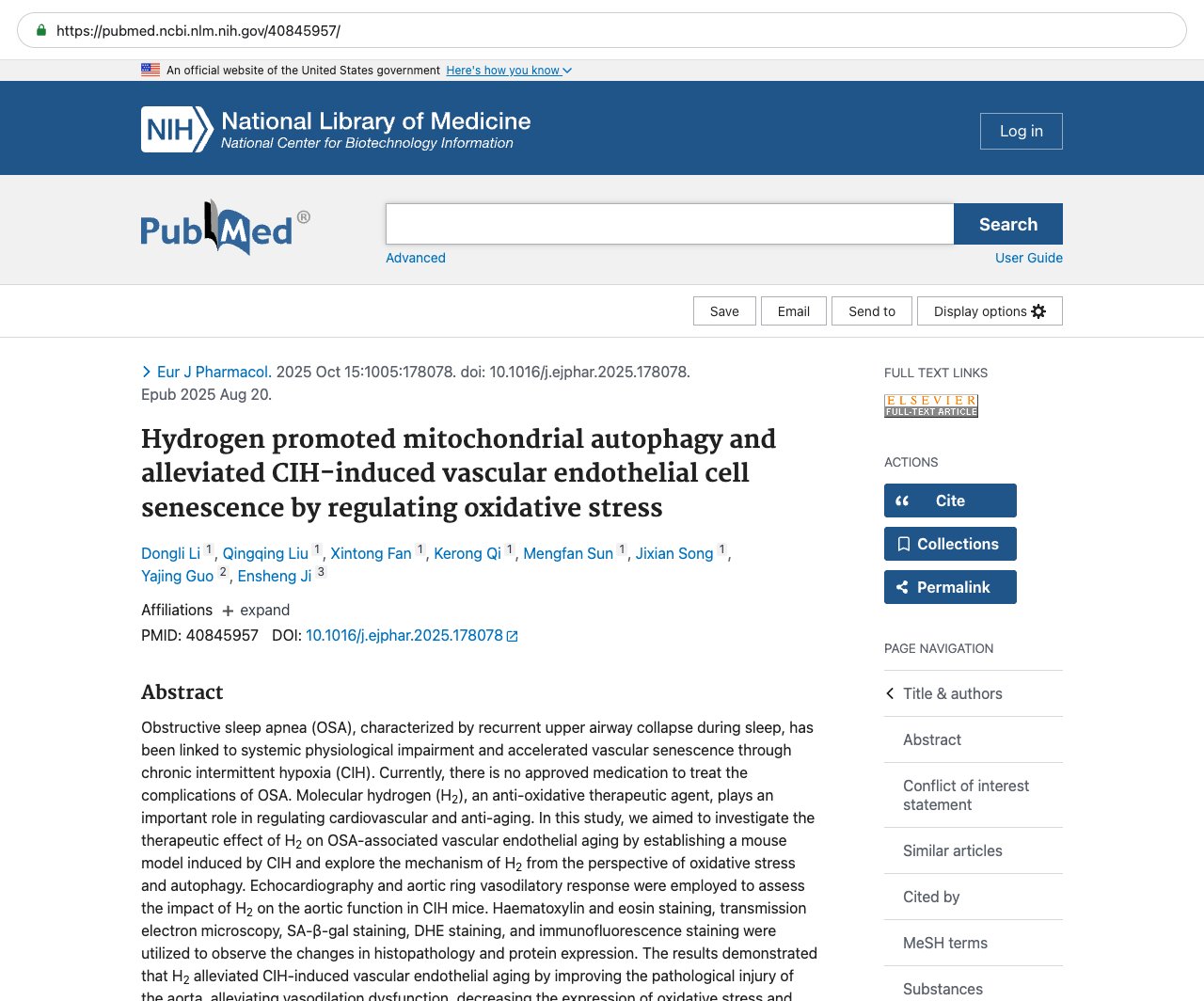
This page mirrors the published abstract (© the authors / publisher) for reference and citation. The canonical source is the PubMed record linked above. This is not medical advice.