2020 · Wang — Hydrogen exerts neuroprotection by activation of the miR-21/PI3K/AKT/GSK-3β pathway in an in vitro model of traumatic brain injury.
Super-Abstract
Using scratched PC12 cells as an in-vitro model of traumatic brain injury, this study shows that hydrogen-rich medium activates the miR-21/PI3K/AKT/GSK-3β signalling pathway, reduces neuronal apoptosis, and promotes neurite regeneration. Both a miR-21 inhibitor and a PI3K blocker reversed the protective effect, confirming pathway specificity. This is a cell-culture study; results cannot be directly transferred to humans.
Commentary
This is a mechanistic cell study focusing on one important question: through which molecular pathway does hydrogen protect neurons after injury? Using the scratch-wound model on PC12 cells (a rat adrenal pheochromocytoma line commonly used to model neurons), the authors show that hydrogen-rich medium activates miR-21 — a microRNA known to promote cell survival — which in turn activates the PI3K/AKT/GSK-3β cascade, suppressing pro-apoptotic factors (Bax) and upregulating anti-apoptotic ones (Bcl-2). The pathway logic is sound and the controls (antagomir and PI3K blocker) confirm specificity. However, PC12 cells are an imperfect neuronal proxy, scratch injury is a crude trauma model, and — critically — no animal or human data are provided. These results identify a plausible mechanism, not a clinical therapy.
Key quotes
- „hydrogen-rich medium improved neurite regeneration and inhibited apoptosis in the injured cells.“ — core finding: H₂-rich medium protected PC12 cells after scratch injury
- „Scratch injury was accompanied by up-regulation of miR-21, p-PI3K, p-Akt and p-GSK-3β.“ — the pathway is activated by injury and further boosted by H₂
- „hydrogen exerted a neuroprotective effect against neuronal apoptosis and impaired nerve regeneration through activation of miR-21/PI3K/AKT/GSK-3β signalling in this in vitro model of traumatic brain injury.“ — main conclusion — mechanism identified in cell culture only
Our assessment
This is a cell-culture (in-vitro) study — not a human study. The miR-21/PI3K/AKT/GSK-3β pathway identified here is a plausible neuroprotective mechanism for H₂, adding to a growing body of mechanistic evidence. However, PC12 cells are a surrogate, the scratch model is simplified, and the jump from cultured cells to traumatic brain injury therapy in humans is substantial. No clinical conclusions can be drawn. The study is hypothesis-generating, not evidence of efficacy in patients.
Study design
- Type: in-vitro mechanistic study · Model: PC12 cells with manual scratch injury · H₂ delivery: hydrogen-rich culture medium, 48 h incubation
- Outcome: H₂-rich medium reduced apoptosis (TUNEL staining), improved neurite regeneration (immunofluorescence), upregulated miR-21/p-PI3K/p-Akt/p-GSK-3β, and increased Bcl-2/Bax ratio; effects reversed by miR-21 antagomir or PI3K blocker
Abstract
Few studies have explored the effect of hydrogen on neuronal apoptosis or impaired nerve regeneration after traumatic brain injury, and the mechanisms involved in these processes are unclear. In this study, we explored neuroprotection of hydrogen-rich medium through activation of the miR-21/PI3K/AKT/GSK-3β pathway in an in vitro model of traumatic brain injury. Such model adopted PC12 cells with manual scratching. Then, injured cells were cultured in hydrogen-rich medium for 48 hours. Expression of miR-21, p-PI3K, p-Akt, p-GSK-3β, Bax and Bcl-2 was measured using RT-qPCR, Western blot analysis and immunofluorescence staining. Rate of apoptosis was determined using TUNEL staining. Neuronal regeneration was assessed using immunofluorescence staining. The results showed that hydrogen-rich medium improved neurite regeneration and inhibited apoptosis in the injured cells. Scratch injury was accompanied by up-regulation of miR-21, p-PI3K, p-Akt and p-GSK-3β. A miR-21 antagomir inhibited the expression of these four molecules, while a PI3K blocker only affected the three proteins and not miR-21. Both the miR-21 antagomir and PI3K blocker reversed the protective effect of hydrogen. In conclusion, hydrogen exerted a neuroprotective effect against neuronal apoptosis and impaired nerve regeneration through activation of miR-21/PI3K/AKT/GSK-3β signalling in this in vitro model of traumatic brain injury.
Source & links
Screenshot of the PubMed page
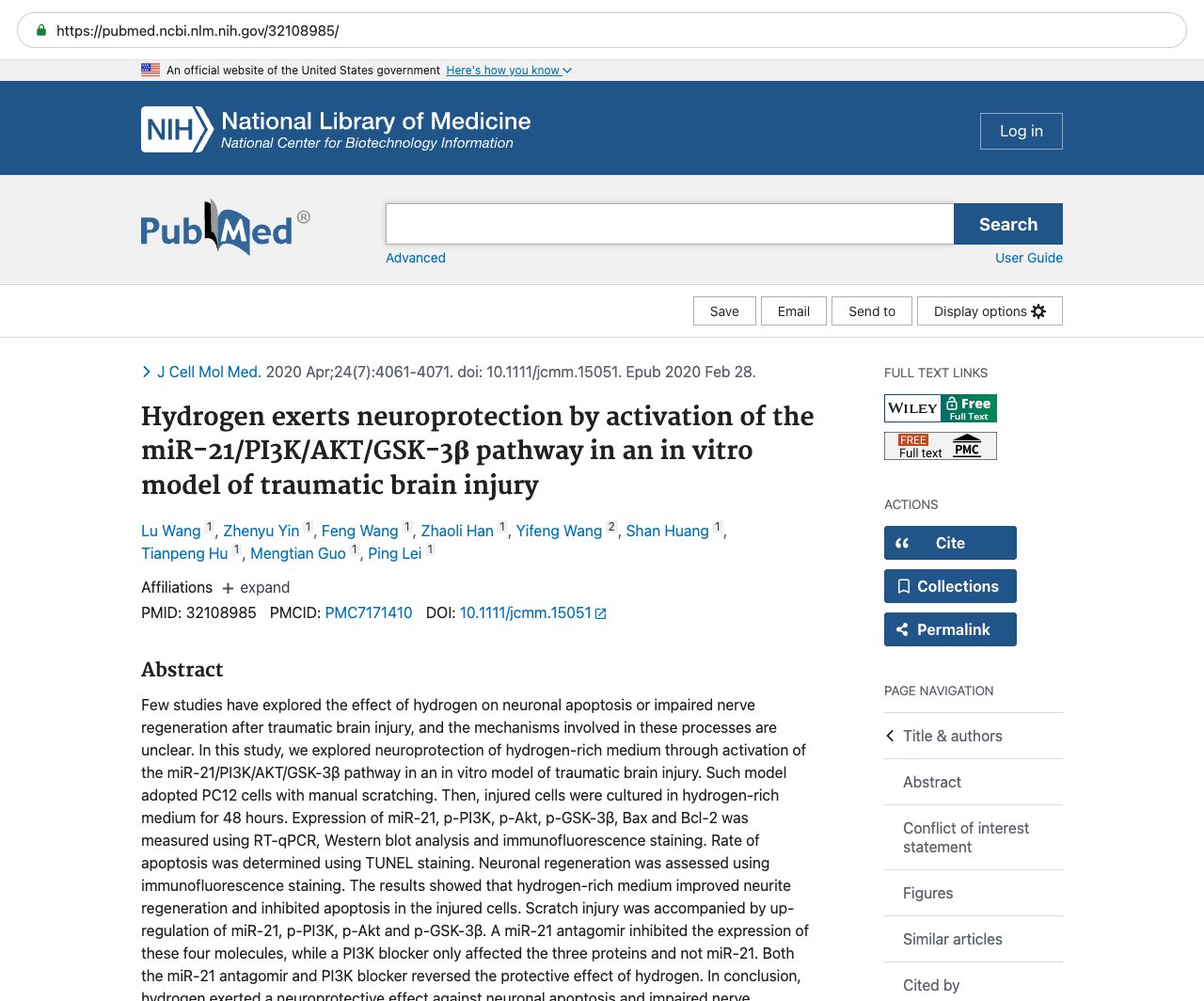
This page mirrors the published abstract (© the authors / publisher) for reference and citation. The canonical source is the PubMed record linked above. This is not medical advice.