1988 · Scrimshaw — The acceptability of milk and milk products in populations with a high prevalence of lactose intolerance.
Super-Abstract
Most humans lose the ability to digest lactose after infancy — and a standard lactose tolerance test is a poor predictor of whether an individual can actually consume moderate amounts of milk without symptoms. This review explains the global prevalence of lactose maldigestion, the role of hydrogen gas in breath testing for diagnosis, and why fermented dairy products are often better tolerated. (The American Journal of Clinical Nutrition, 1988.)
Commentary
This review uses breath hydrogen measurement as a standard diagnostic tool for lactose maldigestion — hydrogen gas produced by colonic bacteria fermenting unabsorbed lactose diffuses into the bloodstream and is exhaled, providing a non-invasive measure. The H₂ breath test described here is a widely accepted clinical method, not related to molecular hydrogen therapy. The paper's central message is public health-oriented: globally, the majority of adult humans are lactose maldigesters, yet many can consume moderate amounts of dairy without symptoms due to adaptations in gut microbiota, food matrix effects, and learning to tolerate small doses. This is a classic review with no direct relevance to H₂ therapy.
Key quotes
- „Measurement is made of either the subsequent rise in blood glucose or the appearance of additional hydrogen in the breath.“ — breath H₂ testing described as a standard lactose maldigestion diagnostic
- „A positive standard lactose test is not a reliable predictor of the ability of an individual to consume moderate amounts of milk and milk products without symptoms.“ — key practical finding: lab test ≠ real-world tolerance
- „it passes undigested to the large intestine. There it is fermented by the colonic flora, with short-chain fatty acids and hydrogen gas as major products.“ — mechanistic explanation of how H₂ is generated during lactose fermentation
Our assessment
This is a narrative review on lactose intolerance, using H₂ breath testing as a diagnostic tool — there is no therapeutic H₂ application. The paper is a high-quality public health overview that established important principles about the gap between laboratory lactose testing and real-world dairy tolerance. Its connection to molecular hydrogen research is purely methodological: breath H₂ here is a marker of malabsorption, not a therapeutic molecule.
Study design
- Type: narrative review · n: n/a (literature synthesis) · H₂ role: diagnostic breath test marker for lactose maldigestion (not therapeutic)
- Key findings: lactose maldigestion prevalence: ~79% Native Americans, ~75% Blacks, ~51% Hispanics, ~21% Caucasians in North America; standard 50g lactose test poorly predicts real-world tolerance; fermented products and dose adaptation often allow dairy consumption without symptoms
Abstract
1) Most humans, like other mammals, gradually lose the intestinal enzyme lactase after infancy and with it the ability to digest lactose, the principle sugar in milk. At some point in prehistory, a genetic mutation occurred and lactase activity persisted in a majority of the adult population of Northern and Central Europe. 2) Persistence of intestinal lactase, the uncommon trait worldwide, is inherited as a highly penetrant autosomal-dominant characteristic. Both types of progeny are almost equally common when one parent is a lactose maldigester and the other a lactose digester. 3) The incidence of lactose maldigestion is usually determined in adults by the administration in the fasting state of a 50-g dose of lactose in water, the equivalent of that in 1 L of milk. Measurement is made of either the subsequent rise in blood glucose or the appearance of additional hydrogen in the breath. It is also sometimes identified by measuring lactase activity directly in a biopsy sample from the jejunum. For children the test dose is reduced according to weight. Depending on the severity of the lactase deficiency and other factors, the test dose may result in abdominal distention, pain, and diarrhea. 4) The frequency of lactose maldigestion varies widely among populations but is high in nearly all but those of European origin. In North American adults lactose maldigestion is found in approximately 79% of Native Americans, 75% of blacks, 51% of Hispanics, and 21% of Caucasians. In Africa, Asia, and Latin America prevalence rates range from 15-100% depending on the population studied. 5) Whenever the lactose ingested exceeds the capacity of the intestinal lactase to split it into the simple sugars glucose and galactose, which are absorbed directly, it passes undigested to the large intestine. There it is fermented by the colonic flora, with short-chain fatty acids and hydrogen gas as major products. The gas produced can cause abdominal distention and pain and diarrhea may also result from the fermentation products. 6) Among individuals with incomplete lactose digestion, there is considerable variation in awareness of lactose intolerance and in the quantity of lactose that can be ingested without symptoms. A positive standard lactose test is not a reliable predictor of the ability of an individual to consume moderate amounts of milk and milk products without symptoms. In usual situations the quantity of lactose ingested at any one time is much less than in the lactose-tolerance test.(ABSTRACT TRUNCATED AT 400 WORDS)
Source & links
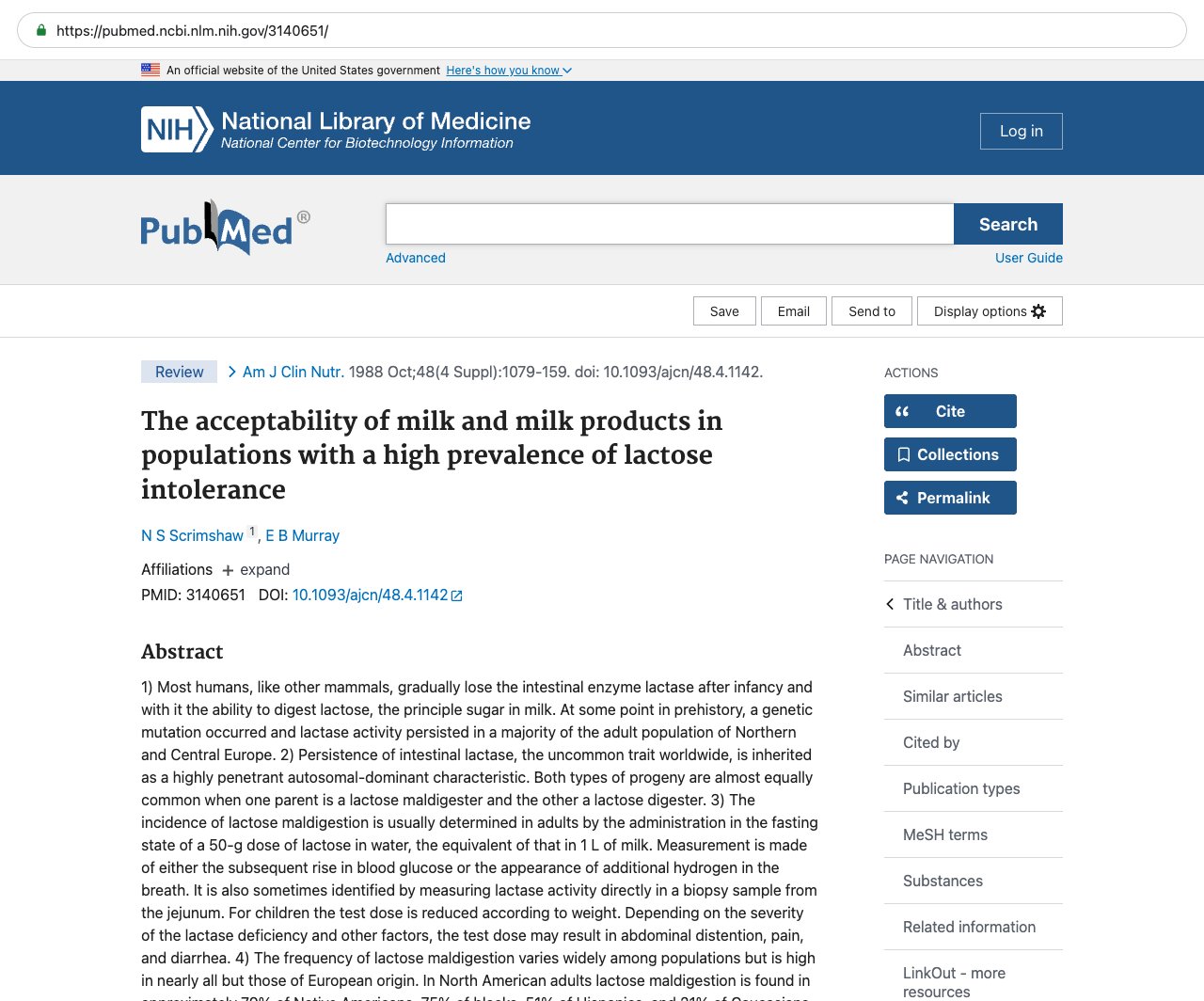
Screenshot of the PubMed page
This page mirrors the published abstract (© the authors / publisher) for reference and citation. The canonical source is the PubMed record linked above. This is not medical advice.