1988 · Holm — Role of blood flow in gastric acid secretion.
Super-Abstract
The relationship between blood flow and gastric acid secretion is more complex than long assumed: most measurement methods show no simple proportional link, but there is a critical minimum blood flow below which both oxygen use and acid secretion fall together. This review critically evaluates multiple blood flow measurement techniques — including hydrogen gas clearance — used to study gastric physiology. (The American Journal of Physiology, 1988.)
Commentary
This review examines how gastric mucosal blood flow relates to acid secretion, critically comparing several measurement techniques including aminopyrine clearance, hydrogen gas clearance, intravital microscopy, laser-Doppler flowmetry, radioactive microspheres, and inert gas elimination. Hydrogen gas clearance is used here as a blood flow measurement methodology — not as a therapeutic agent. The review's main contribution is methodological: it exposes the limitations of the most commonly used technique (aminopyrine clearance) and shows that other methods often find no simple proportional relationship between blood flow and acid secretion. This paper belongs to gastric physiology, not H₂ therapy research.
Key quotes
- „the efficiency of clearance of aminopyrine is low in the nonsecreting stomach and increases as secretion rate increases. This precludes the use of aminopyrine clearance as a reliable measure of gastric mucosal blood flow.“ — methodological critique: the most-used technique has fundamental limitations
- „One consistent finding is a strong correlation between stimulated acid secretion and gastric oxygen consumption.“ — oxygen consumption, not blood flow alone, tracks acid secretion reliably
- „Both acid secretion and oxygen consumption fall if celiac blood flow is reduced below a critical value.“ — there is a minimum perfusion threshold — below it, acid secretion collapses
Our assessment
This is a critical narrative review of gastric physiology methods. Hydrogen gas clearance is evaluated here as one of several blood flow measurement techniques — it is not being studied as a therapeutic agent. The review has no direct relevance to molecular hydrogen therapy; its value is in understanding how gastric blood flow was historically measured and what the true relationship between perfusion and acid secretion looks like.
Study design
- Type: critical narrative review · n: n/a (literature analysis of multiple blood flow studies) · H₂ role: hydrogen gas clearance is one of several blood flow measurement techniques reviewed
- Key findings: aminopyrine clearance overestimates blood flow at low secretion rates; no simple secretion–flow proportionality in most methods; critical minimum celiac flow exists (~30–40 ml/min/100g in anesthetized dogs) below which oxygen use and secretion fall; above threshold, increasing flow does not increase secretion further
Abstract
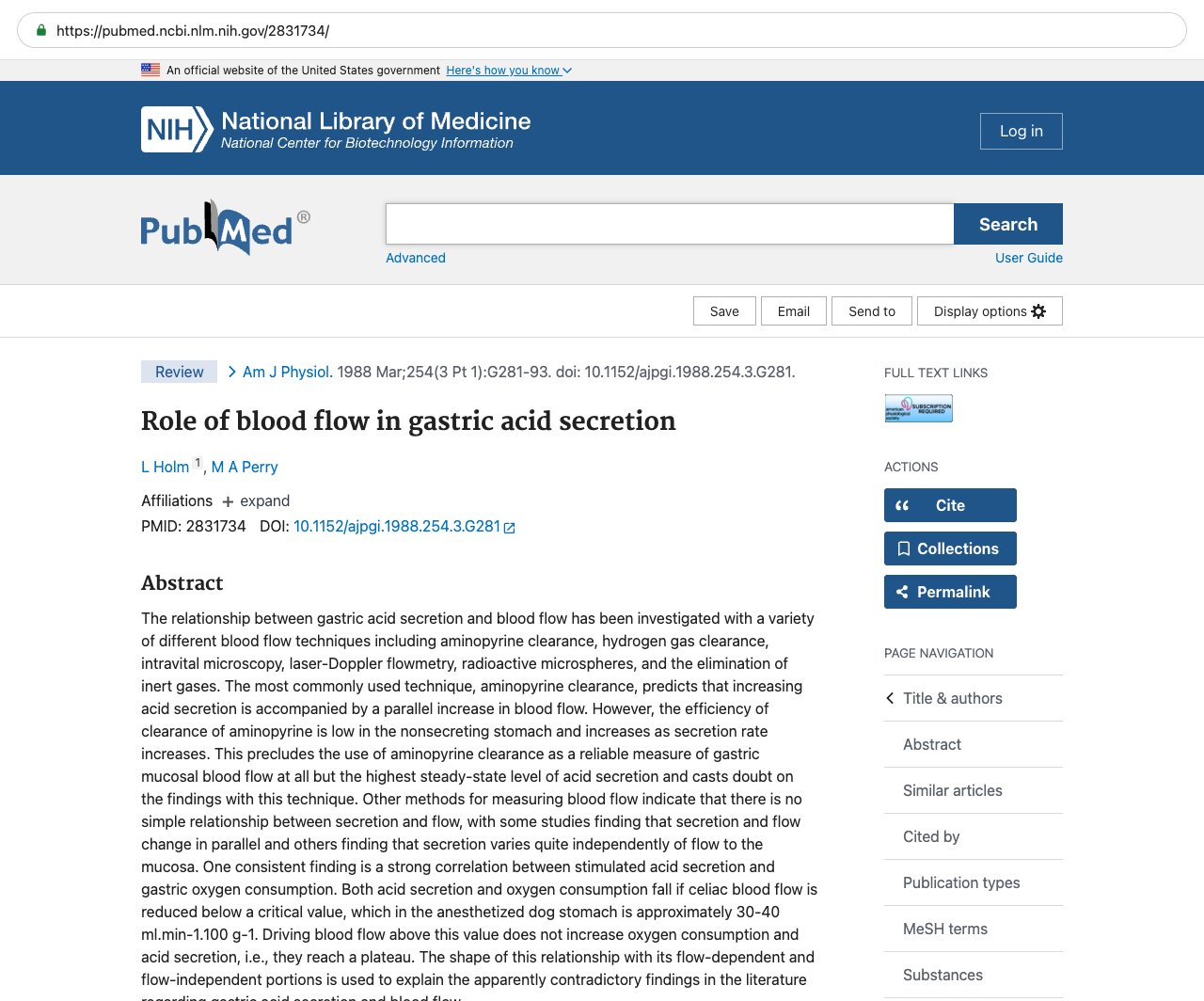
The relationship between gastric acid secretion and blood flow has been investigated with a variety of different blood flow techniques including aminopyrine clearance, hydrogen gas clearance, intravital microscopy, laser-Doppler flowmetry, radioactive microspheres, and the elimination of inert gases. The most commonly used technique, aminopyrine clearance, predicts that increasing acid secretion is accompanied by a parallel increase in blood flow. However, the efficiency of clearance of aminopyrine is low in the nonsecreting stomach and increases as secretion rate increases. This precludes the use of aminopyrine clearance as a reliable measure of gastric mucosal blood flow at all but the highest steady-state level of acid secretion and casts doubt on the findings with this technique. Other methods for measuring blood flow indicate that there is no simple relationship between secretion and flow, with some studies finding that secretion and flow change in parallel and others finding that secretion varies quite independently of flow to the mucosa. One consistent finding is a strong correlation between stimulated acid secretion and gastric oxygen consumption. Both acid secretion and oxygen consumption fall if celiac blood flow is reduced below a critical value, which in the anesthetized dog stomach is approximately 30-40 ml.min-1.100 g-1. Driving blood flow above this value does not increase oxygen consumption and acid secretion, i.e., they reach a plateau. The shape of this relationship with its flow-dependent and flow-independent portions is used to explain the apparently contradictory findings in the literature regarding gastric acid secretion and blood flow.
Source & links
Screenshot of the PubMed page
This page mirrors the published abstract (© the authors / publisher) for reference and citation. The canonical source is the PubMed record linked above. This is not medical advice.