2019 · Botek — Hydrogen Rich Water Improved Ventilatory, Perceptual and Lactate Responses to Exercise
Super-Abstract
600 ml of hydrogen water before exercise lowered the lactate level at high intensities and improved breathing efficiency and perception of effort. Randomized, double-blind, placebo-controlled crossover study with 12 healthy men. (Int J Sports Med, 2019.)
Commentary
Here a positive finding on H₂ water in sport — and, in contrast to a null study, with a higher dose. 12 healthy men, average age 27 years, completed an incremental exercise protocol on a cycle ergometer, each time 30 minutes after drinking 600 ml of H₂ water or placebo — randomized, double-blind, in crossover, so everyone against themselves. The load rose stepwise from 1 watt per kilo through 2, 3 to 4 watts per kilo of body weight. The results: at the high intensities of 3 and 4 watts per kilo, blood lactate was significantly lower with H₂ water — at 4 W/kg, 8.9 versus 10.6 mmol per liter. At the highest step, the ventilatory equivalent for oxygen was also better, meaning more efficient breathing, and the subjective perception of effort was lower. This indicates that a sufficient dose of H₂ water shortly before intense exercise can dampen the acid load in the blood and make training subjectively easier. Honestly: very small sample (n = 12), men only, an acute single dose, and surrogate endpoints such as lactate — no hard competition performance such as time or victory.
Key quotes
- „A significantly lower blood lactate was found with HRW (4.0±1.6 and 8.9±2.2 mmol.l-1) compared to Placebo (5.1±1.9 and 10.6±3.0 mmol.l-1) at 3.0, and 4.0 W.kg-1, respectively.“ — the central finding: lower lactate at high intensity
- „Ventilatory equivalent for oxygen and RPE exhibited significantly lower values with HRW (32.3±7.2, and 17.8±1.2 points, respectively) compared to Placebo (35.0±8.4, and 18.5±0.8 points, respectively) at 4 W.kg-1.“ — better breathing efficiency and lower perception of effort
- „acute pre-exercise supplementation with HRW reduced blood lactate at higher exercise intensities, improved exercise-induced perception of effort, and ventilatory efficiency.“ — the authors' conclusion
Our assessment
A methodologically solid double-blind, placebo-controlled crossover RCT with a positive result — and a good counterweight to null findings of other sports studies. The decisive difference likely lies in the dose (600 ml here vs. 2 × 290 ml there) and in the exercise type. Notable as evidence that H₂ water during intense endurance exercise can show measurable physiological effects (lower lactate, better breathing efficiency) given a sufficient amount. Limitations, stated honestly: very small sample (n = 12), exclusively healthy men, an acute single dose (no statement on long-term benefit), and the endpoints are physiological surrogate markers plus subjective RPE — no direct proof of competition performance.
Study design
- Type: RCT (randomized, double-blind, placebo-controlled, crossover) · n: 12 healthy men (27.1 ± 4.9 years) · Duration: acute (intake 30 min before exercise) · H₂ delivery: 600 ml H₂ water vs. placebo; cycle-ergometer step protocol (10 min warm-up at 1.0 W/kg, then 8 min each at 2.0 / 3.0 / 4.0 W/kg)
- Result metrics: lactate at 4.0 W/kg 8.9 ± 2.2 vs. 10.6 ± 3.0 mmol/l (HRW significantly lower, also at 3.0 W/kg); ventilatory equivalent O₂ 32.3 vs. 35.0 and RPE 17.8 vs. 18.5 at 4 W/kg (both significantly lower with HRW)
Abstract
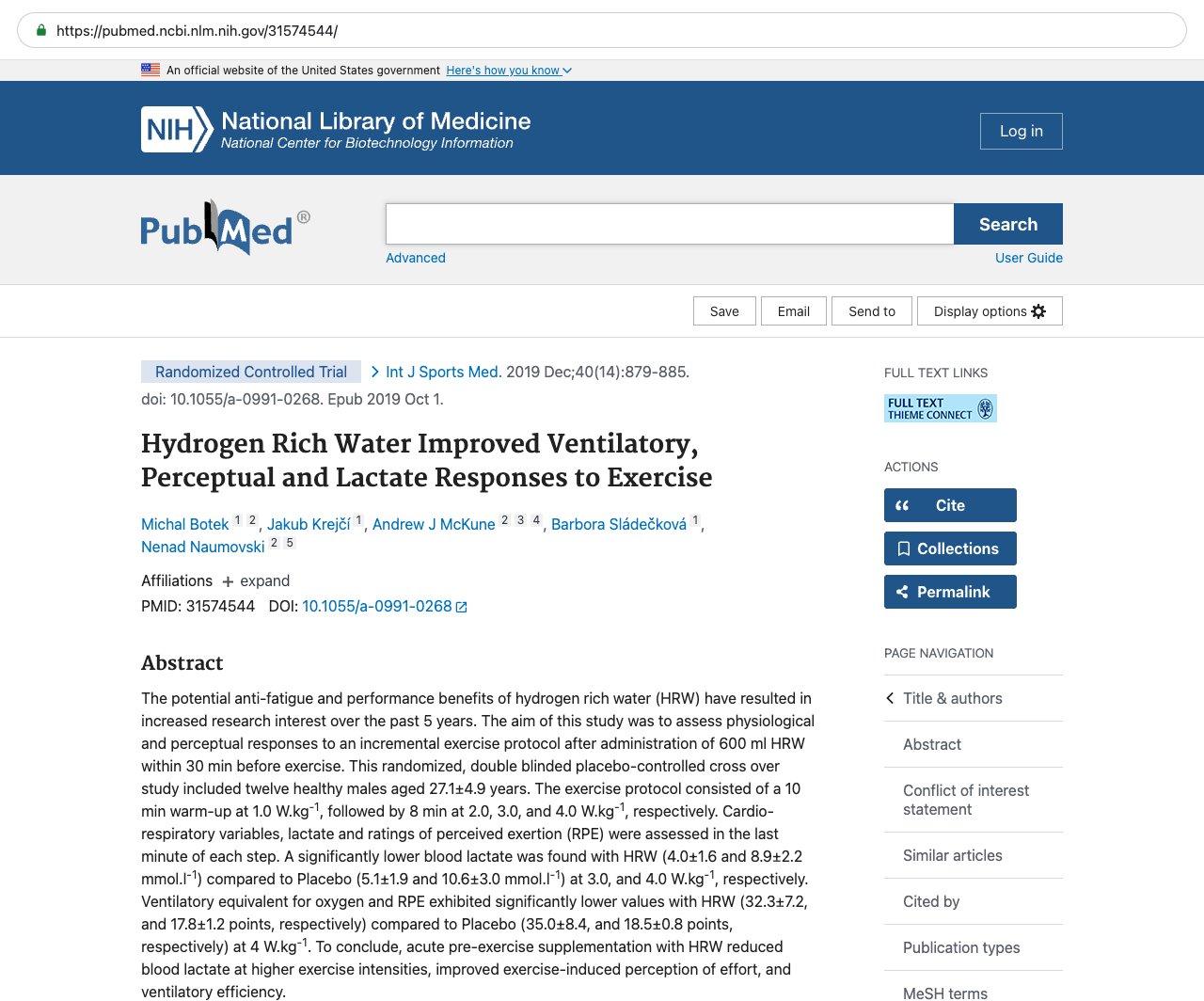
The potential anti-fatigue and performance benefits of hydrogen rich water (HRW) have resulted in increased research interest over the past 5 years. The aim of this study was to assess physiological and perceptual responses to an incremental exercise protocol after administration of 600 ml HRW within 30 min before exercise. This randomized, double blinded placebo-controlled cross over study included twelve healthy males aged 27.1±4.9 years. The exercise protocol consisted of a 10 min warm-up at 1.0 W.kg-1, followed by 8 min at 2.0, 3.0, and 4.0 W.kg-1, respectively. Cardio-respiratory variables, lactate and ratings of perceived exertion (RPE) were assessed in the last minute of each step. A significantly lower blood lactate was found with HRW (4.0±1.6 and 8.9±2.2 mmol.l-1) compared to Placebo (5.1±1.9 and 10.6±3.0 mmol.l-1) at 3.0, and 4.0 W.kg-1, respectively. Ventilatory equivalent for oxygen and RPE exhibited significantly lower values with HRW (32.3±7.2, and 17.8±1.2 points, respectively) compared to Placebo (35.0±8.4, and 18.5±0.8 points, respectively) at 4 W.kg-1. To conclude, acute pre-exercise supplementation with HRW reduced blood lactate at higher exercise intensities, improved exercise-induced perception of effort, and ventilatory efficiency.
Source & links
Screenshot of the PubMed page
This page mirrors the published abstract (© the authors / publisher) for reference and citation. The canonical source is the PubMed record linked above. This is not medical advice.