2022 International Journal of Environmental Research and Public Health RCT Human H₂ therapy Inhalation
2022 · Botek — Molecular Hydrogen Positively Affects Physical and Respiratory Function in Acute Post-COVID-19 Patients: A New Perspective in Rehabilitation
Super-Abstract
Hydrogen inhalation improves lung and body function after COVID-19. In a randomized, placebo-controlled study of 50 acute post-COVID patients, 14 days of H₂ inhalation increased the 6-minute walking distance by 64 m and measurably improved vital capacity (all p ≤ 0.025). (IJERPH, 2022.)
Commentary
Here hydrogen is tested in a highly topical indication: in people who feel weak and short of breath shortly after a COVID-19 infection. H₂ is interesting because it is said to act antioxidatively, anti-inflammatorily and fatigue-relieving — exactly the axes that are stressed after a viral infection. The design is randomized, single-blind and placebo-controlled with 50 participants (26 men, 24 women), enrolled 21 to 33 days after a positive PCR test. Over 14 days they inhaled either H₂ or a placebo gas twice daily for 60 minutes. The results are concrete and clinically tangible: the 6-minute walking distance rose by 64 ± 39 m versus placebo, forced vital capacity (FVC) by 0.19 L and FEV1 by 0.11 L — all significant (p ≤ 0.025). This suggests faster functional recovery. To be honest: it is only single-blind (not double-blind), the group is medium-sized, and the observation is short — so long-term benefit is not proven.
Key quotes
- „H2 therapy, compared with placebo, significantly increased 6 MWT distance by 64 ± 39 m, FVC by 0.19 ± 0.24 L, and, in FEV1, by 0.11 ± 0.28 L (all p ≤ 0.025).“ — the hard functional gains in respiration and exercise capacity
- „Molecular hydrogen (H2) is potentially a novel therapeutic gas for acute post-coronavirus disease 2019 (COVID-19) patients because it has antioxidative, anti-inflammatory, anti-apoptosis, and antifatigue properties.“ — the mechanistic rationale
- „H2 inhalation may represent a safe, effective approach for accelerating early function restoration in post-COVID-19 patients.“ — the authors' cautiously phrased conclusion
Our assessment
Relevant for the H₂ inhalation segment and as an example of a modern, clinically tangible indication. The endpoints (6-minute walk test, spirometry) are established, objective measures — not a pure well-being self-report. It demonstrates that H₂ inhalation is being investigated in a medically relevant rehabilitation context. Limitation, stated honestly: only single-blind (expectation effects in the walk test not fully excluded), n = 50, short 14-day phase, no statement on long-term benefit or on long COVID. No conflict-of-interest information can be derived from the abstract.
Study design
- Type: RCT, randomized/single-blind/placebo-controlled · n: 50 (26 m, 24 f) · Duration: 14 days, 2 × 60 min/day · H₂ delivery: inhalation
- Result: 6-minute walking distance +64 ± 39 m; FVC +0.19 ± 0.24 L; FEV1 +0.11 ± 0.28 L (all p ≤ 0.025)
Abstract
Molecular hydrogen (H2) is potentially a novel therapeutic gas for acute post-coronavirus disease 2019 (COVID-19) patients because it has antioxidative, anti-inflammatory, anti-apoptosis, and antifatigue properties. The aim of this study was to determine the effect of 14 days of H2 inhalation on the respiratory and physical fitness status of acute post-COVID-19 patients. This randomized, single-blind, placebo-controlled study included 26 males (44 ± 17 years) and 24 females (38 ± 12 years), who performed a 6-min walking test (6 MWT) and pulmonary function test, specifically forced vital capacity (FVC) and expiratory volume in the first second (FEV1). Symptomatic participants were recruited between 21 and 33 days after a positive polymerase chain reaction test. The experiment consisted of H2/placebo inhalation, 2 × 60 min/day for 14 days. Results showed that H2 therapy, compared with placebo, significantly increased 6 MWT distance by 64 ± 39 m, FVC by 0.19 ± 0.24 L, and, in FEV1, by 0.11 ± 0.28 L (all p ≤ 0.025). In conclusion, H2 inhalation had beneficial health effects in terms of improved physical and respiratory function in acute post-COVID-19 patients. Therefore, H2 inhalation may represent a safe, effective approach for accelerating early function restoration in post-COVID-19 patients.
Source & links
Screenshot of the PubMed page
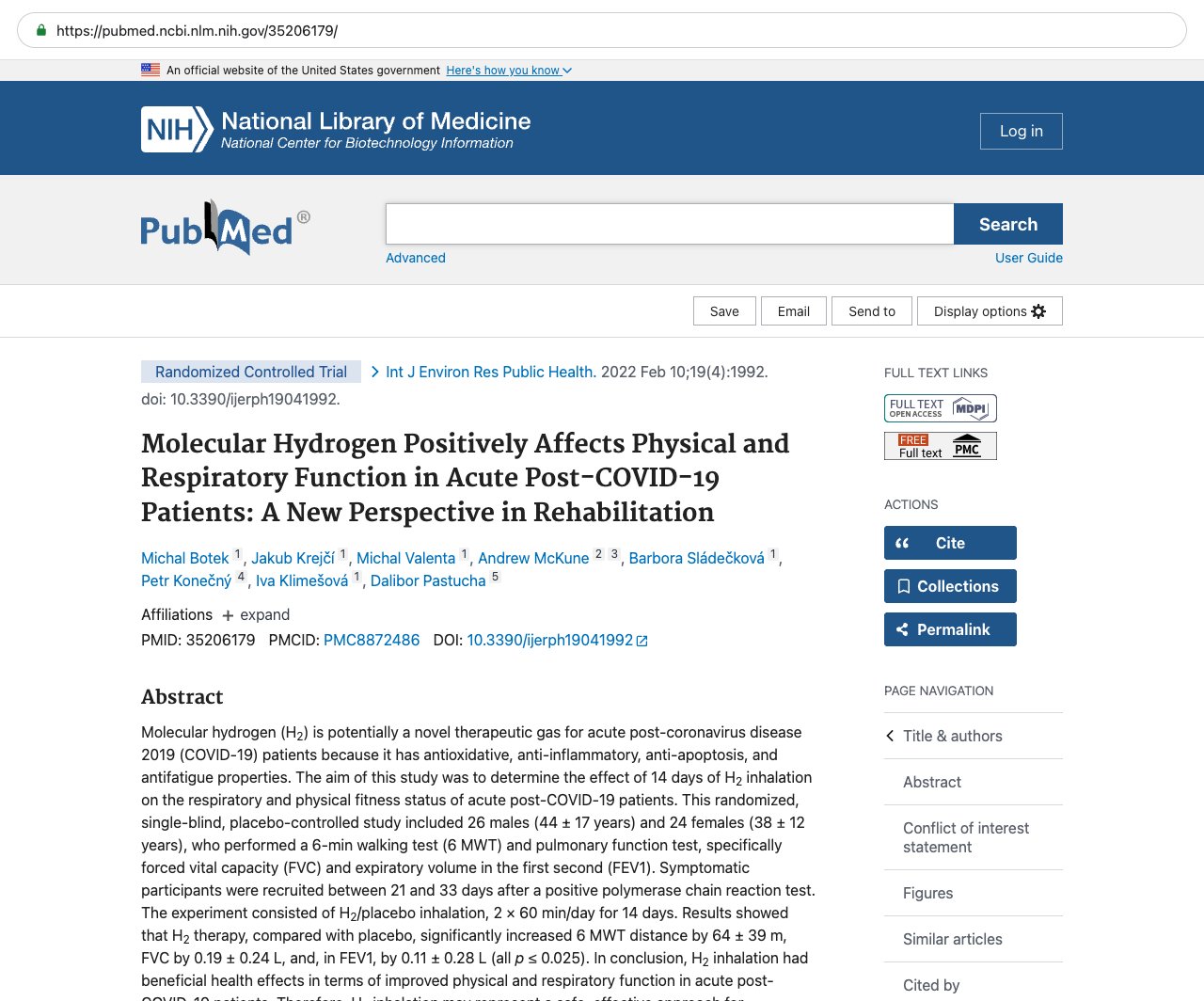
This page mirrors the published abstract (© the authors / publisher) for reference and citation. The canonical source is the PubMed record linked above. This is not medical advice.