2025 · Ji — Hydrolysis of 2D Nanosheets Reverses Rheumatoid Arthritis Through Anti-Inflammation and Osteogenesis.
Super-Abstract
Two-dimensional calcium disilicide nanoparticles (CSN) hydrolyse in joint fluid to release hydrogen gas, calcium hydroxide, and silica simultaneously — tackling three distinct processes that drive rheumatoid arthritis: oxidative stress, joint acidity, and bone erosion. In arthritic mouse and rabbit models, CSN treatment reversed joint inflammation and stimulated new bone formation significantly better than anti-inflammatory treatment alone. (Advanced Materials, 2025.)
Commentary
This is a preclinical animal study. Rheumatoid arthritis (RA) is driven by immune-mediated joint destruction involving oxidative stress, acidic joint pH, osteoclast overactivation, and impaired osteogenesis. Current therapies suppress inflammation but largely ignore bone repair. The CSN design is elegant in its multi-mechanistic approach: H₂ neutralises hydroxyl radicals and repolarises macrophages; Ca(OH)₂ buffers joint acidity and inhibits osteoclasts; dissolved Ca²⁺ promotes bone mineralisation. All three are derived from a single biodegradable nanoparticle, simplifying administration. The comparative superiority over anti-inflammation alone is demonstrated in two species (mouse and rabbit). The limitation is that all data remain preclinical, and the long-term fate of Si and Ca-P deposits in joint tissue and systemic safety require further investigation.
Key quotes
- „Hydrogen gas is validated to eliminate excessive hydroxyl radicals and regulate macrophage re-polarization; the generated Ca(OH)2 can neutralize the acidic microenvironment and inhibit the osteoclast activity.“ — dual anti-inflammatory mechanisms from CSN hydrolysis
- „The dissolved Ca2+ can effectively complex with phosphates to mineralize Ca3(PO4)2, promoting the osteogenesis of the focal joint.“ — bone-regeneration mechanism via calcium-phosphate mineralisation
- „The multifunctional performances of CSNs are further confirmed in arthritic mouse and rabbit models, providing an advanced and robust therapeutic strategy against RA with high biocompatibility and clinical transformable promises.“ — authors' conclusion on multi-species preclinical validation
Our assessment
This is a preclinical animal study (mouse + rabbit) — results cannot be directly transferred to humans with rheumatoid arthritis. The multi-mechanistic approach is scientifically well-motivated and delivers promising results across two animal models, going beyond pure anti-inflammation to also address bone repair — a genuine unmet need in RA. Translational challenges include joint pharmacokinetics of nanoparticles, systemic silicon and calcium accumulation, immune reactivity, and the complexity of RA pathophysiology in humans (autoantibodies, T-cell-mediated mechanisms) not fully captured in rodent models. Clinical trials are still many steps away.
Study design
- Type: preclinical animal study · Models: arthritic mouse and rabbit models (collagen-induced / AIA) · H₂ delivery: hydrolysis of calcium disilicide (CSN) nanosheets in joint fluid → H₂ + Ca(OH)₂ + silica
- Endpoints: joint histology, osteoclast activity, osteogenesis markers (Ca₃(PO₄)₂ mineralisation), macrophage polarisation (M2), hydroxyl-radical levels, joint pH · Result: superior RA reversal vs. anti-inflammation alone; promoted bone regeneration; high biocompatibility
Abstract
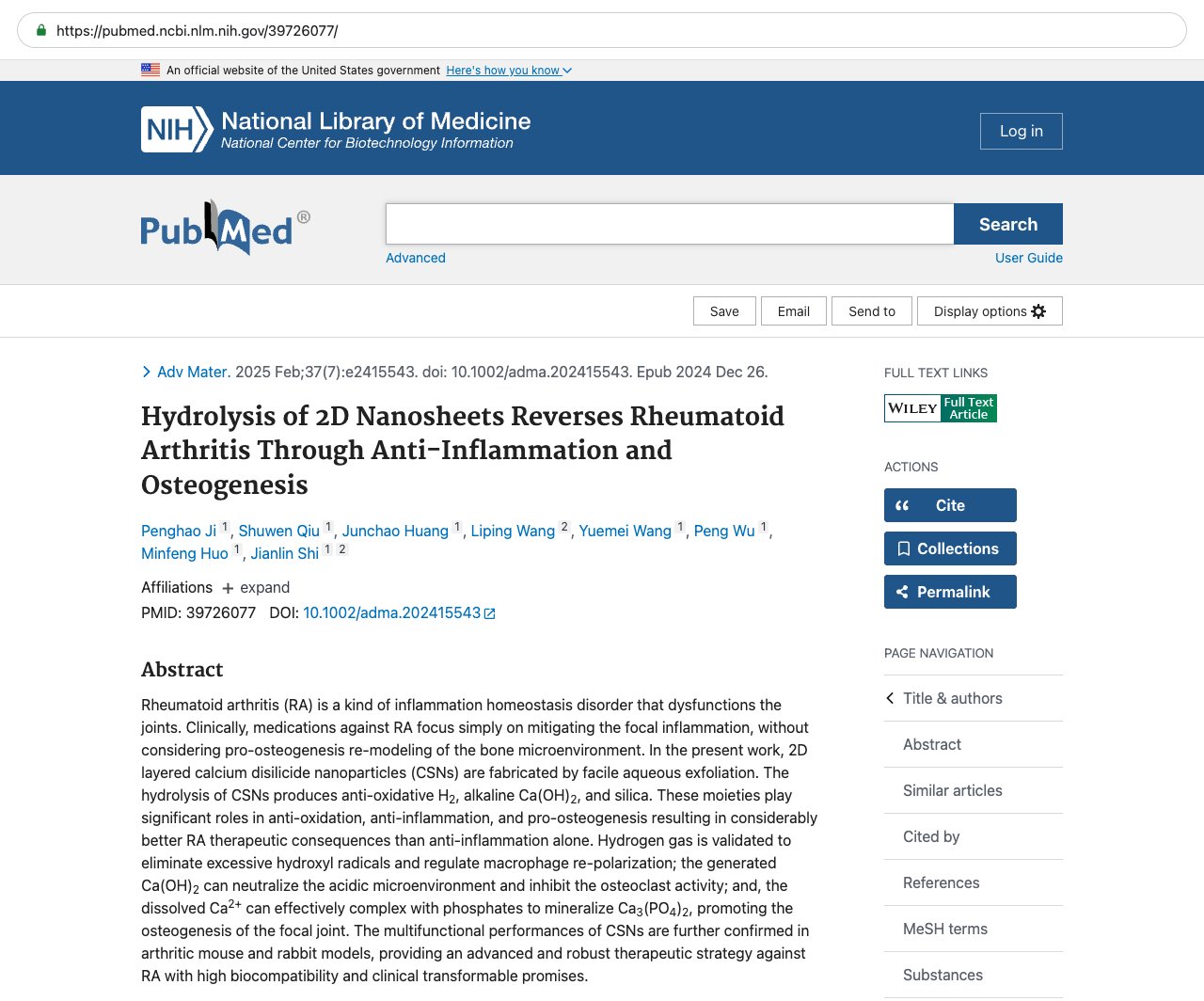
Rheumatoid arthritis (RA) is a kind of inflammation homeostasis disorder that dysfunctions the joints. Clinically, medications against RA focus simply on mitigating the focal inflammation, without considering pro-osteogenesis re-modeling of the bone microenvironment. In the present work, 2D layered calcium disilicide nanoparticles (CSNs) are fabricated by facile aqueous exfoliation. The hydrolysis of CSNs produces anti-oxidative H2, alkaline Ca(OH)2, and silica. These moieties play significant roles in anti-oxidation, anti-inflammation, and pro-osteogenesis resulting in considerably better RA therapeutic consequences than anti-inflammation alone. Hydrogen gas is validated to eliminate excessive hydroxyl radicals and regulate macrophage re-polarization; the generated Ca(OH)2 can neutralize the acidic microenvironment and inhibit the osteoclast activity; and, the dissolved Ca2+ can effectively complex with phosphates to mineralize Ca3(PO4)2, promoting the osteogenesis of the focal joint. The multifunctional performances of CSNs are further confirmed in arthritic mouse and rabbit models, providing an advanced and robust therapeutic strategy against RA with high biocompatibility and clinical transformable promises.
Source & links
Screenshot of the PubMed page
This page mirrors the published abstract (© the authors / publisher) for reference and citation. The canonical source is the PubMed record linked above. This is not medical advice.