2019 · Chen et al. — „Real world survey“ of hydrogen-controlled cancer: a follow-up report of 82 advanced cancer patients.
Super-Abstract
A prospective follow-up of 82 stage III/IV cancer patients inhaling H₂ for 3–46 months found that 41.5 % showed improved physical status, 36.2 % of those with elevated tumour markers saw markers decrease, and the overall disease control rate in imageable tumours was 57.5 % — with the best responses in lung cancer and the poorest in pancreatic cancer. This real-world observational study has no control group and uses heterogeneous endpoints across diverse cancer types. (Medical Gas Research, 2019.)
Commentary
This report from Fuda Cancer Hospital (same institution as PMID 32541132) uses a „real-world evidence“ framework to survey outcomes across a diverse stage III/IV cancer population treated with H₂ inhalation over an extended period. The strength is the breadth and duration of follow-up (up to 46 months) and the clinically meaningful endpoints: patient-reported symptoms, tumour markers, and imaging. The weakness is fundamental: there is no control group, cancer type and treatment history are highly heterogeneous, and disease control rates (57.5 %) cannot be benchmarked against untreated populations. Lung cancer performed best; pancreatic and hepatic cancers performed worst — which roughly mirrors what we would expect from the biology of these cancers independently of H₂. No haematological toxicity was observed, which is the most cleanly interpretable finding.
Key quotes
- „After 4 weeks of hydrogen inhalation, patients reported significant improvements in fatigue, insomnia, anorexia and pain.“ — quality-of-life improvement — patient-reported, no control comparison
- „41.5% of patients had improved physical status, with the best effect achieved in lung cancer patients and the poorest in patients with pancreatic and gynecologic cancers.“ — responder rate — no randomisation; cancer-type differences confounded by biology
- „No hematological toxicity was observed although minor adverse reactions that resolved spontaneously were seen in individual cases.“ — safety signal — the most reliable and interpretable finding in this uncontrolled study
Our assessment
A large, long-term uncontrolled observational series that documents real-world use of H₂ inhalation in advanced cancer. The symptom improvement and quality-of-life data are consistent with other reports and plausible. The disease control rates cannot be interpreted without a comparator. Limitations: no control group; heterogeneous cancer types (lung, pancreatic, liver, gynecologic, others); treatment histories not standardised; endpoints are a mix of subjective and objective with different measurement intervals; selection bias (patients who chose H₂ and tolerated it for months may differ systematically from those who did not). The safety profile is consistently reassuring across this series.
Study design
- Type: prospective observational follow-up (real-world evidence, no control) · n: 82 stage III/IV cancer patients (diverse types) · H₂ delivery: inhalation, 3–46 months follow-up
- Outcomes: patient-reported symptoms (fatigue, insomnia, anorexia, pain); tumour markers; imaging disease control rate (57.5 % overall); physical status (41.5 % improved)
- Safety: no haematological toxicity; minor self-resolving adverse reactions in isolated cases
Abstract
Advanced cancer treatment is a huge challenge and new ideas and strategies are required. Hydrogen exerts antioxidant and anti-inflammatory effects that may be exploited to control cancer, the occurrence and progression of which is closely related to peroxidation and inflammation. We conducted a prospective follow-up study of 82 patients with stage III and IV cancer treated with hydrogen inhalation using the "real world evidence" method. After 3-46 months of follow-up, 12 patients died in stage IV. After 4 weeks of hydrogen inhalation, patients reported significant improvements in fatigue, insomnia, anorexia and pain. Furthermore, 41.5% of patients had improved physical status, with the best effect achieved in lung cancer patients and the poorest in patients with pancreatic and gynecologic cancers. Of the 58 cases with one or more abnormal tumor markers elevated, the markers were decreased at 13-45 days (median 23 days) after hydrogen inhalation in 36.2%. The greatest marker decrease was in achieved lung cancer and the lowest in pancreatic and hepatic malignancies. Of the 80 cases with tumors visible in imaging, the total disease control rate was 57.5%, with complete and partial remission appearing at 21-80 days (median 55 days) after hydrogen inhalation. The disease control rate was significantly higher in stage III patients than in stage IV patients (83.0% and 47.7%, respectively), with the lowest disease control rate in pancreatic cancer patients. No hematological toxicity was observed although minor adverse reactions that resolved spontaneously were seen in individual cases. In patients with advanced cancer, inhaled hydrogen can improve patients' quality-of-life and control cancer progression. Hydrogen inhalation is a simple, low-cost treatment with few adverse reactions that warrants further investigation as a strategy for clinical rehabilitation of patients with advanced cancer. The study protocol received ethical approval from the Ethics Committee of Fuda Cancer Hospital of Jinan University on December 7, 2018 (approval number: Fuda20181207).
Source & links
Screenshot of the PubMed page
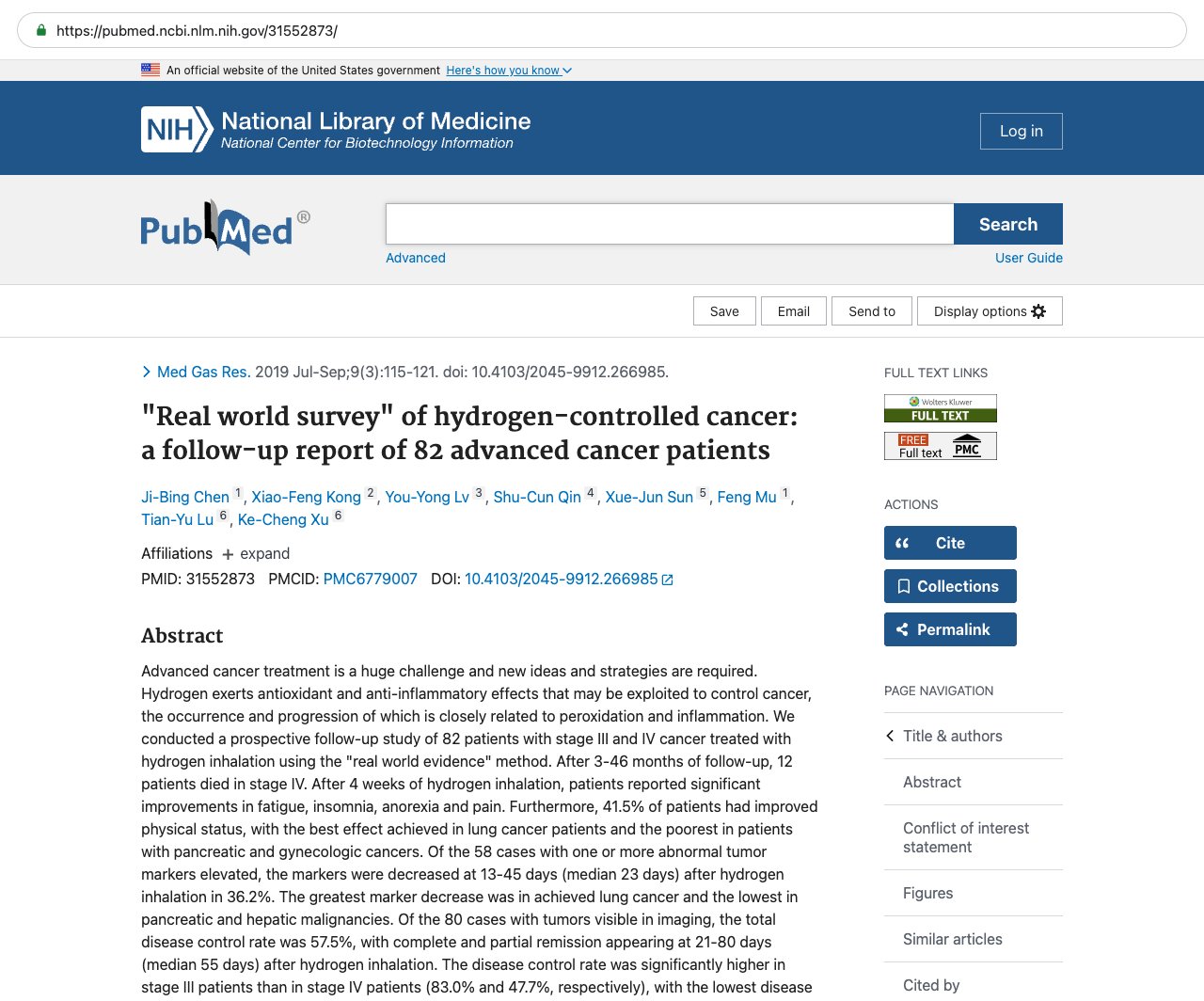
This page mirrors the published abstract (© the authors / publisher) for reference and citation. The canonical source is the PubMed record linked above. This is not medical advice.