2014 · Brenner — Parkinson's disease may be due to failure of melanin in the Substantia Nigra to produce molecular hydrogen from dissociation of water.
Super-Abstract
This is a speculative theoretical paper proposing that melanin in the brain's Substantia Nigra normally splits water into molecular hydrogen and oxygen — and that the loss of this capacity may underlie Parkinson's disease. The hypothesis is unproven and has not been experimentally validated, but it raises an interesting mechanistic question about endogenous H₂ production.
Commentary
This paper by Brenner is a medical hypothesis piece — a genre specifically for early-stage speculative ideas. The central claim is that neuromelanin in the Substantia Nigra acts as a photoelectrochemical catalyst capable of splitting water to produce H₂, which then acts as a local antioxidant protecting dopaminergic neurons. As melanin deteriorates in Parkinson's disease, H₂ production declines, and oxidative damage accelerates. Environmental toxins, which chelate to melanin, may further impair this protective function. The paper then proposes supplemental H₂ or melanin restoration as theoretical treatments. This is a creative hypothesis, but it is not supported by direct experimental data. The water-splitting capacity attributed to neuromelanin in this context remains unvalidated in neurological tissue, and the causal chain from melanin → H₂ → Parkinson's protection is speculative.
Key quotes
- „Melanin, a hybrid electronic/ionic conductor may have the potential to split the water molecule into molecular hydrogen and molecular oxygen.“ — the central theoretical claim: neuromelanin as an endogenous H₂ generator
- „Melanin, located in the Substantia Nigra, deteriorates in Parkinson's disease so may be related to the development and progression of the disease, since molecular hydrogen would no longer be generated as it deteriorates.“ — the proposed causal link between melanin loss and reduced H₂ protection
- „Restoring melanin function or providing supplemental molecular hydrogen might be potential treatments for Parkinson's disease.“ — speculative treatment proposals — not clinically validated
Our assessment
This is a pure theoretical hypothesis paper — no experimental data are presented or reviewed. The proposed mechanism (neuromelanin as a water-splitting H₂ generator) is creative but unvalidated. It should be read as early-stage speculation. The idea that supplemental H₂ might compensate for any such deficit is biologically plausible in principle, but this paper provides no evidence of efficacy or safety in Parkinson's disease. Human clinical data are entirely absent.
Study design
- Type: theoretical hypothesis (no experiments) · Subject: Parkinson's disease, neuromelanin, endogenous H₂ production · H₂ delivery proposed: supplemental molecular hydrogen (theoretical, not tested)
- Result: speculative mechanistic model only; no experimental data; hypothesis: melanin deterioration → H₂ deficit → oxidative neuronal damage → Parkinson's
Abstract
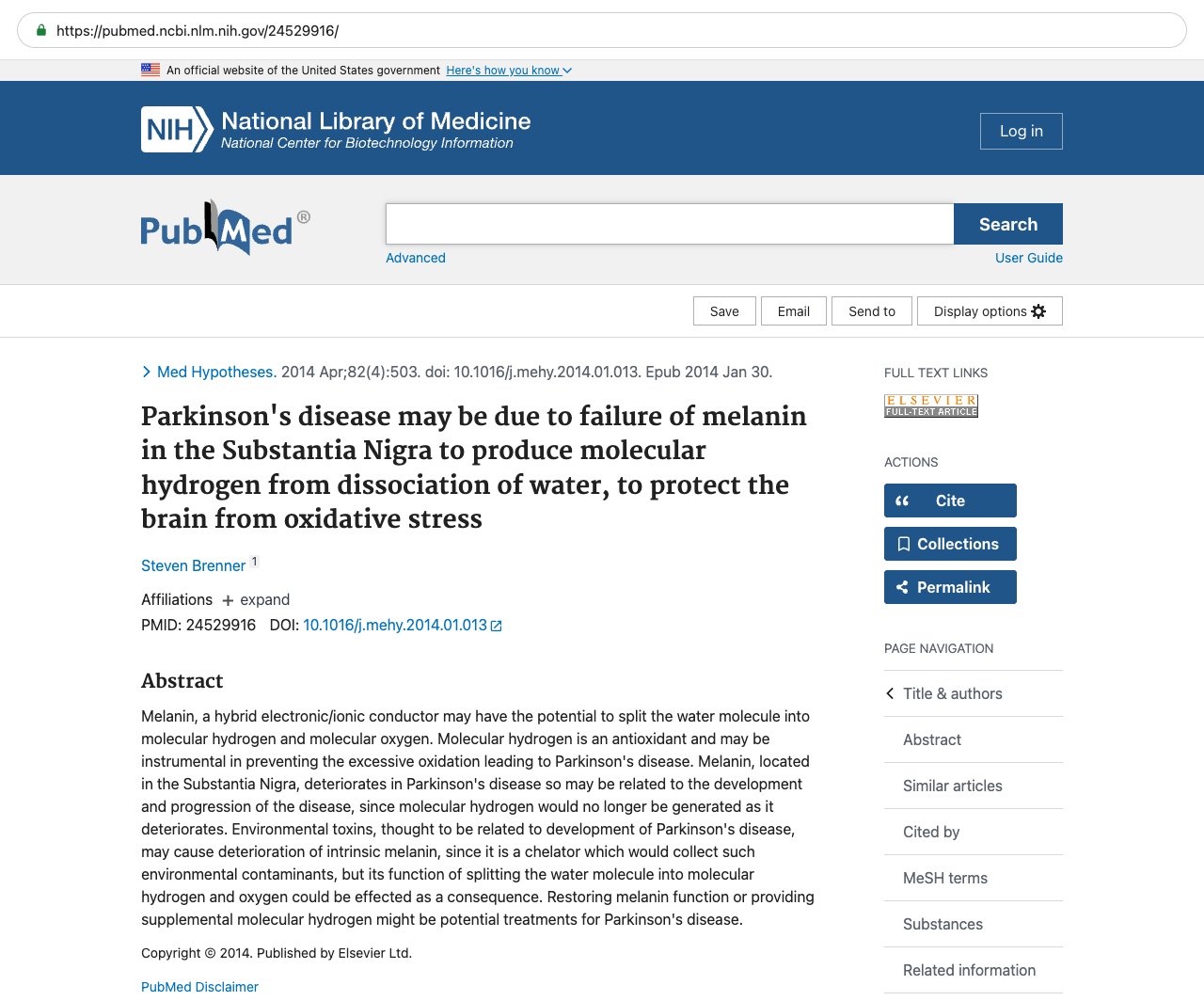
Melanin, a hybrid electronic/ionic conductor may have the potential to split the water molecule into molecular hydrogen and molecular oxygen. Molecular hydrogen is an antioxidant and may be instrumental in preventing the excessive oxidation leading to Parkinson's disease. Melanin, located in the Substantia Nigra, deteriorates in Parkinson's disease so may be related to the development and progression of the disease, since molecular hydrogen would no longer be generated as it deteriorates. Environmental toxins, thought to be related to development of Parkinson's disease, may cause deterioration of intrinsic melanin, since it is a chelator which would collect such environmental contaminants, but its function of splitting the water molecule into molecular hydrogen and oxygen could be effected as a consequence. Restoring melanin function or providing supplemental molecular hydrogen might be potential treatments for Parkinson's disease.
Source & links
Screenshot of the PubMed page
This page mirrors the published abstract (© the authors / publisher) for reference and citation. The canonical source is the PubMed record linked above. This is not medical advice.