2012 · Carbonero et al. — Contributions of the microbial hydrogen economy to colonic homeostasis.
Super-Abstract
This review from Nature Reviews Gastroenterology & Hepatology examines how H₂ produced by gut bacteria — as part of the colonic „hydrogen economy“ — affects colonic health, breath-gas diagnostics (lactose intolerance, SIBO, IBS), and the balance between potentially protective and harmful gas species (H₂, methane, hydrogen sulphide). This is a review of endogenous gut H₂ biology, not of administered molecular hydrogen therapy.
Commentary
The colon hosts a complex ecosystem of H₂-producing fermentative bacteria (producing H₂ from carbohydrate fermentation) and H₂-consuming organisms: sulphate-reducing bacteria (SRB, producing hydrogen sulphide), methanogenic archaea (producing methane), and reductive acetogens (producing acetate). The balance between these producers and consumers — the „microbial hydrogen economy“ — profoundly affects colonic physiology. Clinically, breath H₂ and methane are used as diagnostic markers for lactose and glucose intolerance and small intestinal bacterial overgrowth (SIBO). The review raises an interesting point directly relevant to H₂ medicine: in healthy colons, physiological H₂ concentrations may protect the mucosa from oxidative insults (antioxidant role). Conversely, an impaired H₂ economy — e.g. SRB outcompeting H₂ consumers — might generate excess hydrogen sulphide, linked to IBD. This context matters for interpreting H₂ therapy studies: humans already have a significant endogenous H₂ background from gut bacteria.
Key quotes
- „H(2) has been shown to have antioxidant properties and, in the healthy colon, physiological H(2) concentrations might protect the mucosa from oxidative insults, whereas an impaired H(2) economy might facilitate inflammation or carcinogenesis.“ — key hypothesis: endogenous gut H₂ may be mucoprotective
- „Clinically, H(2) and methane measured in breath can indicate lactose and glucose intolerance, small intestinal bacterial overgrowth and IBS.“ — clinical application: breath-gas diagnostics
- „standardized breath gas measurements combined with ever-improving molecular methodologies could provide novel strategies to prevent, diagnose or manage numerous colonic disorders.“ — future direction: breath gas as diagnostic and therapeutic target
Our assessment
A high-quality review in a leading gastroenterology journal, providing the biological context for understanding why H₂ has physiological relevance in the gut. It does not test or endorse exogenous H₂ administration as a therapy; rather, it maps the ecology of endogenous H₂ metabolism. Relevance to H₂ medicine: important background for understanding how gut-derived H₂ may already contribute to colonic antioxidant defence — and why adding small amounts of exogenous H₂ (e.g., via H₂-rich water) might produce biological effects even against a high endogenous H₂ background. This review does not provide evidence for therapeutic H₂ administration, but establishes physiological plausibility.
Study design
- Type: narrative review (gastroenterology) · Scope: colonic H₂ economy — producing bacteria, consuming organisms (SRB, methanogens, acetogens), and clinical implications
- H₂ relevance: endogenous gut H₂ biology; not exogenous H₂ therapy — but provides mechanistic context for H₂'s biological relevance
- Clinical topics covered: breath H₂/methane diagnostics (lactose intolerance, SIBO, IBS, constipation); H₂ sulphide and IBD/colorectal cancer; antioxidant role of physiological H₂ concentrations in the colon
Abstract
Colonic gases are among the most tangible features of digestion, yet physicians are typically unable to offer long-term relief from clinical complaints of excessive gas. Studies characterizing colonic gases have linked changes in volume or composition with bowel disorders and shown hydrogen gas (H(2)), methane, hydrogen sulphide, and carbon dioxide to be by-products of the interplay between H(2)-producing fermentative bacteria and H(2) consumers (reductive acetogens, methanogenic archaea and sulphate-reducing bacteria [SRB]). Clinically, H(2) and methane measured in breath can indicate lactose and glucose intolerance, small intestinal bacterial overgrowth and IBS. Methane levels are increased in patients with constipation or IBS. Hydrogen sulphide is a by-product of H(2) metabolism by SRB, which are ubiquitous in the colonic mucosa. Although higher hydrogen sulphide and SRB levels have been detected in patients with IBD, and to a lesser extent in colorectal cancer, this colonic gas might have beneficial effects. Moreover, H(2) has been shown to have antioxidant properties and, in the healthy colon, physiological H(2) concentrations might protect the mucosa from oxidative insults, whereas an impaired H(2) economy might facilitate inflammation or carcinogenesis. Therefore, standardized breath gas measurements combined with ever-improving molecular methodologies could provide novel strategies to prevent, diagnose or manage numerous colonic disorders.
Source & links
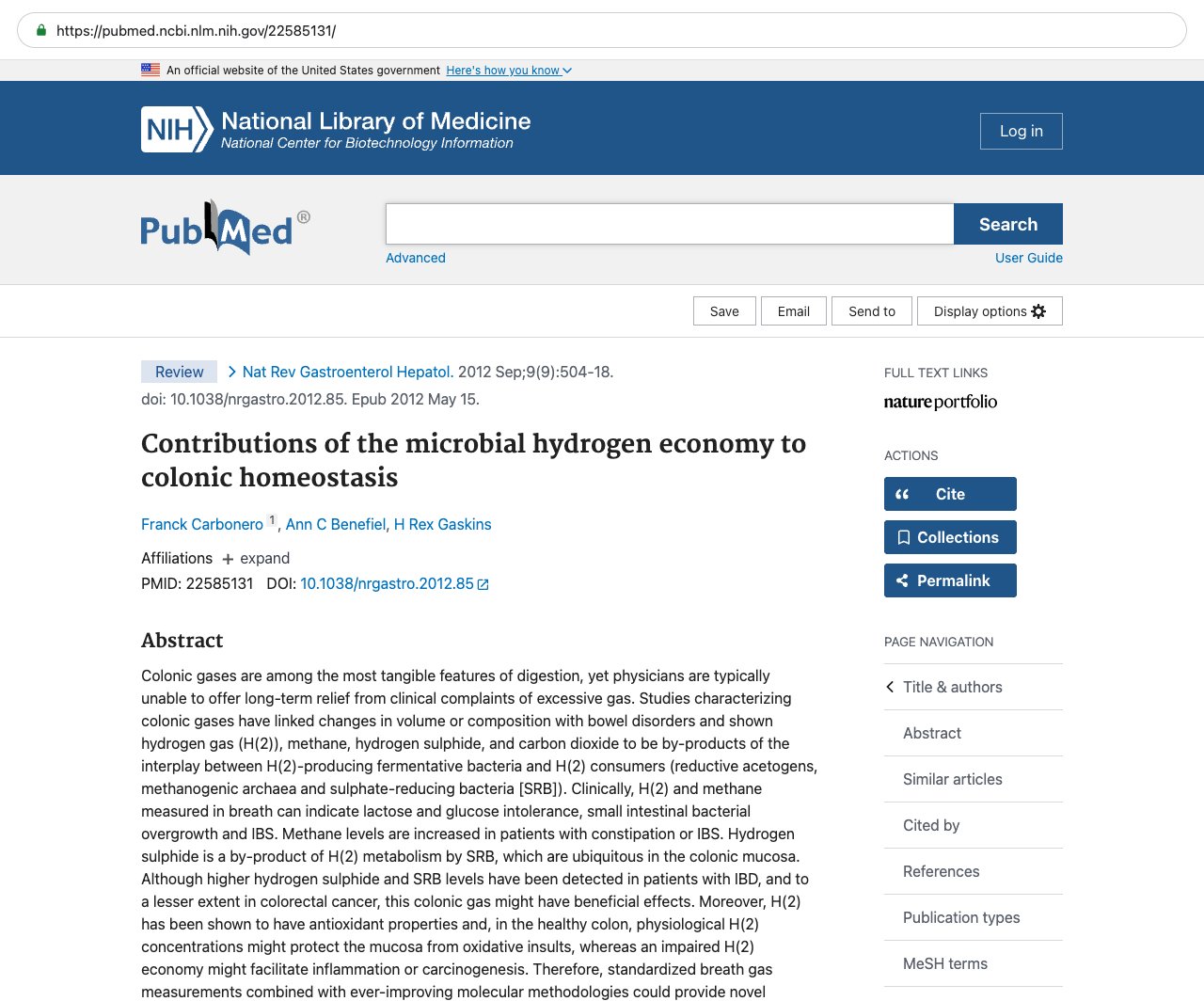
Screenshot of the PubMed page
This page mirrors the published abstract (© the authors / publisher) for reference and citation. The canonical source is the PubMed record linked above. This is not medical advice.