2022 · Catlett — Metabolic Synergy between Human Symbionts Bacteroides and Methanobrevibacter
Super-Abstract
Two dominant gut microbes — Bacteroides thetaiotaomicron and the hydrogen-consuming archaeon Methanobrevibacter smithii — form a mutual metabolic partnership that depends on hydrogen gas. A controlled co-culture system revealed that when vitamin B12, hematin, and hydrogen are all abundant, the two microbes together outgrow what either achieves alone. This is a theoretical and in-vitro study; findings describe microbial relationships, not human health outcomes. (Microbiology Spectrum, 2022.)
Commentary
This study investigates the fundamental ecology of gut microbiota, specifically the syntrophic (mutually beneficial) relationship between two major gut taxa. Bacteroides thetaiotaomicron breaks down dietary fibers and generates hydrogen as a fermentation by-product; Methanobrevibacter smithii consumes that hydrogen to produce methane, theoretically relieving feedback inhibition and allowing Bacteroides to ferment more efficiently. The authors designed a seven-component minimal medium and combined high-throughput growth assays with machine-learning analysis to map the interaction landscape systematically. A notable finding is the formation of interspecies granules — physical clumps where the two organisms grow in close proximity, similar to syntrophic aggregates observed in soil and wastewater digesters. This is purely mechanistic microbiology: it does not measure any health endpoint in humans or animals and does not test any hydrogen therapy.
Key quotes
- „when vitamin B12, hematin, and hydrogen gas are abundant, coculture growth is greater than the sum of growth observed for monocultures, suggesting that both organisms benefit from a synergistic mutual metabolic relationship.“ — the key synergy finding: coculture outperforms monocultures only when H₂ is plentiful
- „B. thetaiotaomicron and M. smithii form interspecies granules consistent with behavior observed for syntrophic partnerships between microbes in soil or sediment enrichments and anaerobic digesters.“ — physical evidence of a close metabolic partnership
- „Our approach can be broadly applied to studying microbial interactions and may be extended to evaluate and curate computational metabolic models.“ — methodological relevance beyond this specific pair
Our assessment
This is a theory and in-vitro study — no humans, no animals, no clinical endpoints. Its value lies in illuminating how gut-derived hydrogen gas functions as a metabolic currency between microbial species, which is background knowledge relevant for understanding the microbiome's hydrogen economy. No direct conclusions about human health or hydrogen supplementation can be drawn. The machine-learning-assisted co-culture platform itself is a methodological contribution for future gut-ecology research.
Study design
- Type: in-vitro co-culture + theoretical/computational study · Model: B. thetaiotaomicron × M. smithii in defined 7-component medium · H₂ delivery: endogenous (fermentation-derived) and exogenous gas supplementation in culture
- Result: coculture growth exceeded sum of monocultures when H₂, vitamin B12, and hematin were all present; interspecies granule formation observed under certain nutrient conditions
Abstract
Trophic interactions between microbes are postulated to determine whether a host microbiome is healthy or causes predisposition to disease. Two abundant taxa, the Gram-negative heterotrophic bacterium Bacteroides thetaiotaomicron and the methanogenic archaeon Methanobrevibacter smithii, are proposed to have a synergistic metabolic relationship. Both organisms play vital roles in human gut health; B. thetaiotaomicron assists the host by fermenting dietary polysaccharides, whereas M. smithii consumes end-stage fermentation products and is hypothesized to relieve feedback inhibition of upstream microbes such as B. thetaiotaomicron. To study their metabolic interactions, we defined and optimized a coculture system and used software testing techniques to analyze growth under a range of conditions representing the nutrient environment of the host. We verify that B. thetaiotaomicron fermentation products are sufficient for M. smithii growth and that accumulation of fermentation products alters secretion of metabolites by B. thetaiotaomicron to benefit M. smithii. Studies suggest that B. thetaiotaomicron metabolic efficiency is greater in the absence of fermentation products or in the presence of M. smithii. Under certain conditions, B. thetaiotaomicron and M. smithii form interspecies granules consistent with behavior observed for syntrophic partnerships between microbes in soil or sediment enrichments and anaerobic digesters. Furthermore, when vitamin B12, hematin, and hydrogen gas are abundant, coculture growth is greater than the sum of growth observed for monocultures, suggesting that both organisms benefit from a synergistic mutual metabolic relationship. IMPORTANCE The human gut functions through a complex system of interactions between the host human tissue and the microbes which inhabit it. These diverse interactions are difficult to model or examine under controlled laboratory conditions. We studied the interactions between two dominant human gut microbes, B. thetaiotaomicron and M. smithii, using a seven-component culturing approach that allows the systematic examination of the metabolic complexity of this binary microbial system. By combining high-throughput methods with machine learning techniques, we were able to investigate the interactions between two dominant genera of the gut microbiome in a wide variety of environmental conditions. Our approach can be broadly applied to studying microbial interactions and may be extended to evaluate and curate computational metabolic models. The software tools developed for this study are available as user-friendly tutorials in the Department of Energy KBase.
Source & links
Screenshot of the PubMed page
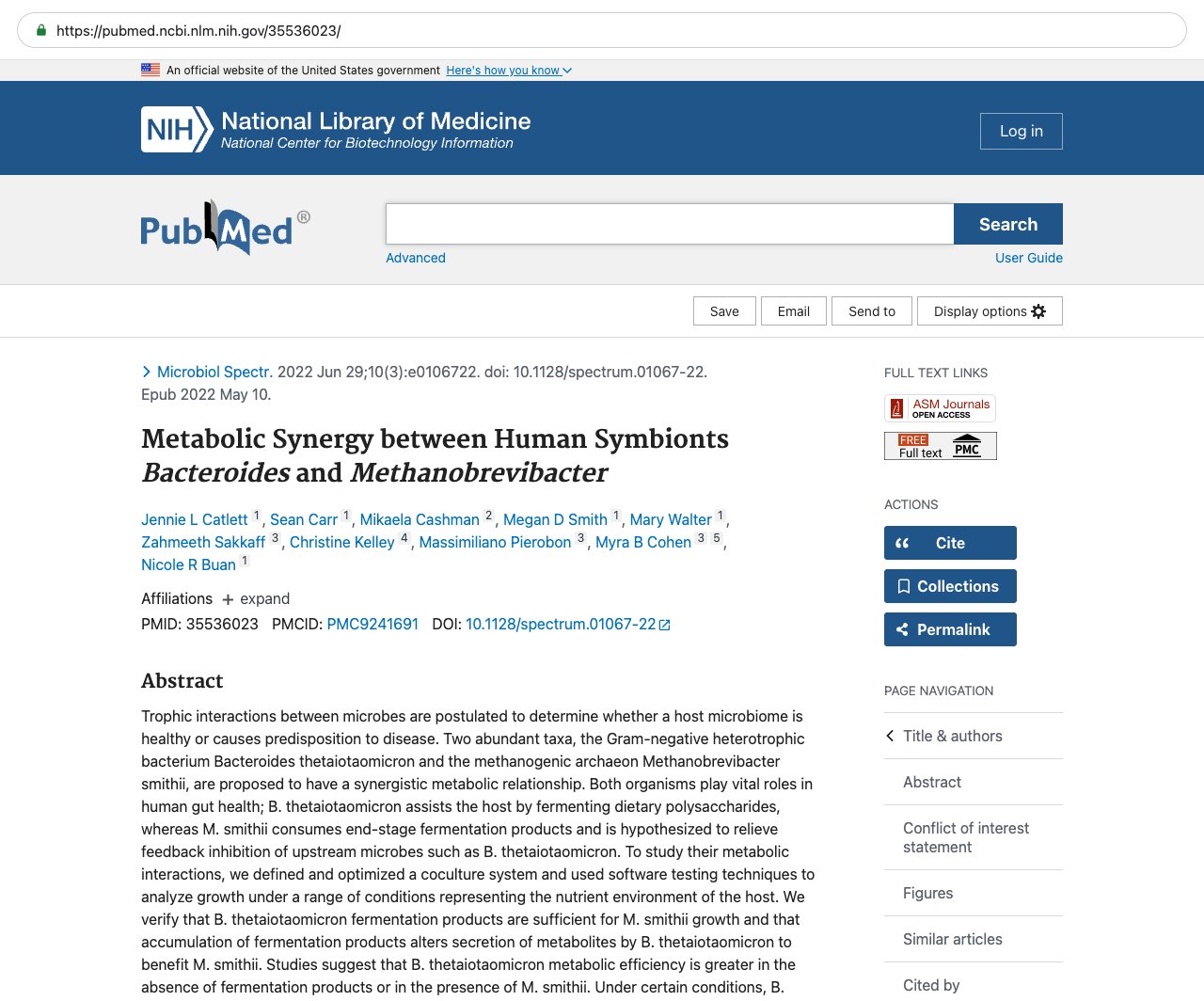
This page mirrors the published abstract (© the authors / publisher) for reference and citation. The canonical source is the PubMed record linked above. This is not medical advice.