2018 · Perisin — Human gut microbe co-cultures have greater potential than monocultures for food waste remediation to commodity chemicals
Super-Abstract
This computational study models how co-cultures of human gut bacteria convert food waste to useful chemicals (butanol, acetate, hydrogen gas, methane) more efficiently than monocultures. The hydrogen here is H₂ gas produced as a byproduct of anaerobic bacterial fermentation — not molecular hydrogen administered therapeutically. This paper is not a study of H₂ therapy and has no direct relevance to hydrogen medicine. (Scientific Reports, 2018.)
Commentary
Perisin and colleagues use genome-scale metabolic models and flux-balance analysis to predict which combinations of gut bacteria most efficiently ferment a simulated Western diet into commodity chemicals. Hydrogen gas appears as one of several products alongside butanol, methane, propionate, formaldehyde, and urea. The context is industrial biotechnology — using gut bacteria to process food waste — not human health or H₂ therapeutics. The connection to H₂ medicine is essentially nil; the appearance in an H₂-medicine database is almost certainly due to keyword indexing of “hydrogen gas” in the abstract.
Key quotes
- „Microbe combinations result in emergent or increased commodity chemical production including butanol, methane, formaldehyde, propionate, hydrogen gas, and urea.“ — H₂ is one product among many — a metabolic byproduct of co-culture fermentation, not a therapeutic agent
- „Every organism analyzed can benefit from interactions with another microbe, as evidenced by increased biomass fluxes in co-culture vs. monoculture.“ — the core finding: microbial synergy outperforms isolation in fermentation
- „These overproducing co-cultures are enriched for mutualistic and commensal interactions.“ — ecological structure of productive microbe partnerships
Our assessment
This paper is not relevant to H₂ therapy. It is a computational biotechnology study modelling microbial fermentation of food waste. The “hydrogen gas” mentioned is a microbial metabolic byproduct — endogenous and industrial in context — not related to drinking hydrogen-rich water, inhaling H₂, or any other therapeutic H₂ application. Its inclusion in an H₂-medicine context reflects a keyword mismatch. Methodological note: the entire study is in-silico (computational); no wet-lab validation of predicted yields is described in the abstract.
Study design
- Type: computational/in-silico study · Model: genome-scale metabolic models + flux-balance analysis of human gut bacterial co-cultures · H₂ relevance: none — H₂ is a fermentation byproduct in a food-waste biotechnology model
- Result: co-cultures predicted to outperform monocultures in commodity chemical production; H₂ listed among several byproducts; no experimental validation reported
Abstract
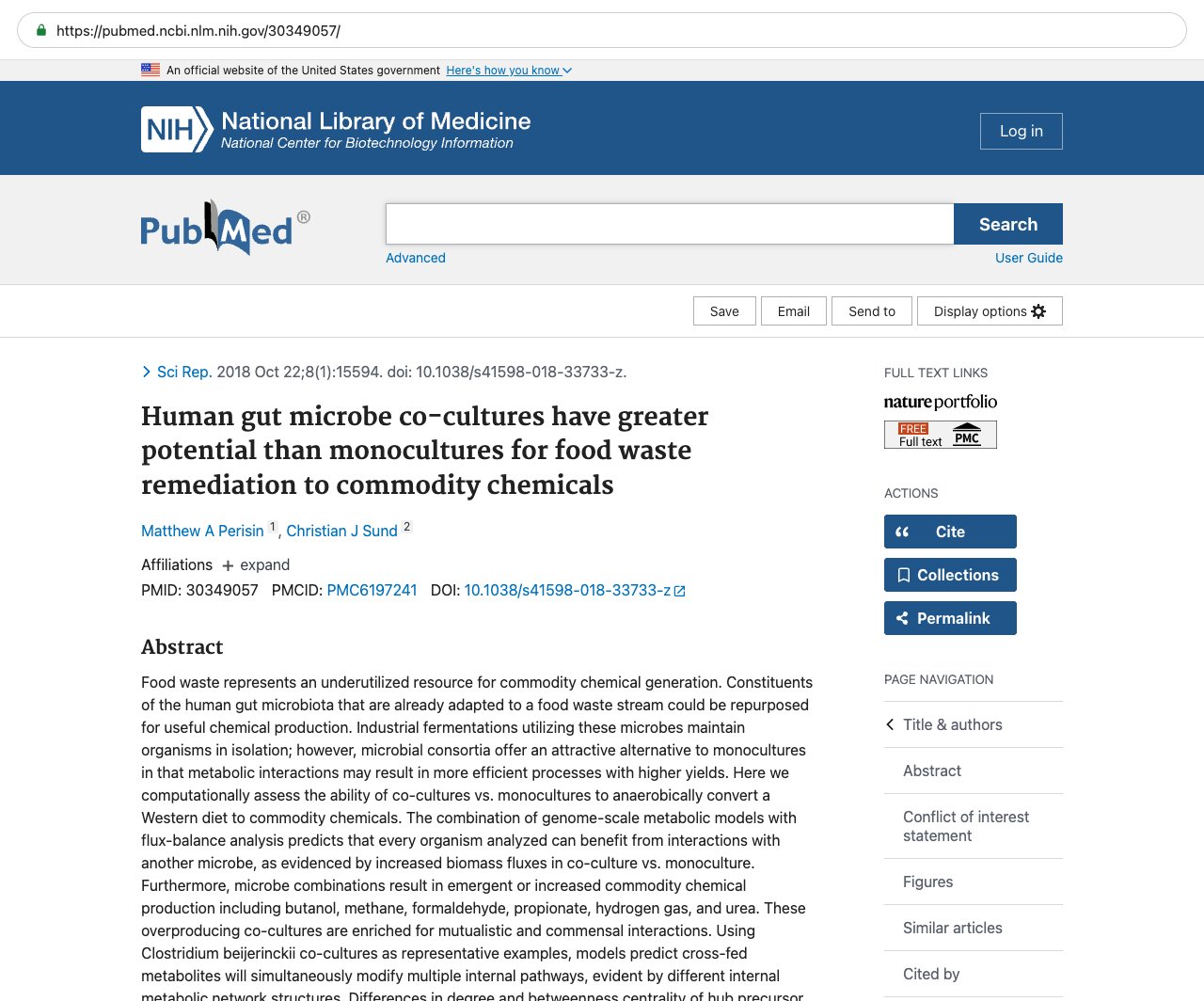
Food waste represents an underutilized resource for commodity chemical generation. Constituents of the human gut microbiota that are already adapted to a food waste stream could be repurposed for useful chemical production. Industrial fermentations utilizing these microbes maintain organisms in isolation; however, microbial consortia offer an attractive alternative to monocultures in that metabolic interactions may result in more efficient processes with higher yields. Here we computationally assess the ability of co-cultures vs. monocultures to anaerobically convert a Western diet to commodity chemicals. The combination of genome-scale metabolic models with flux-balance analysis predicts that every organism analyzed can benefit from interactions with another microbe, as evidenced by increased biomass fluxes in co-culture vs. monoculture. Furthermore, microbe combinations result in emergent or increased commodity chemical production including butanol, methane, formaldehyde, propionate, hydrogen gas, and urea. These overproducing co-cultures are enriched for mutualistic and commensal interactions. Using Clostridium beijerinckii co-cultures as representative examples, models predict cross-fed metabolites will simultaneously modify multiple internal pathways, evident by different internal metabolic network structures. Differences in degree and betweenness centrality of hub precursor metabolites were correlated to C. beijerinckii metabolic outputs, and thus demonstrate the potential of co-cultures to differentially direct metabolisms to useful products.
Source & links
Screenshot of the PubMed page
This page mirrors the published abstract (© the authors / publisher) for reference and citation. The canonical source is the PubMed record linked above. This is not medical advice.