2019 · Cejka et al. — The preventive and therapeutic effects of molecular hydrogen in ocular diseases and injuries where oxidative stress is involved.
Super-Abstract
Molecular hydrogen (H₂) is uniquely suited for eye diseases because it is the only antioxidant that crosses both the blood-brain and blood-ocular barriers. This 2019 review by Cejka and colleagues surveys preclinical animal studies and some early clinical investigations showing that H₂ treatment suppresses oxidative stress in the eye, helping prevent or improve conditions ranging from glaucoma to age-related macular degeneration.
Commentary
The eye is particularly vulnerable to oxidative stress because of its high metabolic rate, exposure to light, and relative isolation behind specialised vascular barriers. Most antioxidants cannot penetrate these barriers effectively. H₂'s small molecular size allows rapid tissue penetration and selective removal of the most reactive species — hydroxyl radicals and peroxynitrite — without disturbing physiological redox balance. The review covers a range of conditions: glaucoma, ischemia-reperfusion injury to the retina, corneal damage, cataracts, and degenerative diseases. Results from animal experiments are promising; some early human clinical data are included but the clinical evidence base remains limited.
Key quotes
- „H2 is the only antioxidant that crosses the blood-brain and blood-ocular barriers.“ — the key pharmacokinetic advantage of H₂ for eye and brain conditions
- „the suppression of oxidative stress by H2 treatment leads to the prevention or improvement of ocular diseases.“ — the general conclusion of the animal and early clinical data reviewed
- „In severe degenerative diseases, H2 slows disease progression.“ — cautious framing for serious chronic conditions: slowing, not curing
Our assessment
This is a review of mostly preclinical (animal) research with limited early human data. Its value lies in highlighting H₂'s unique ability to penetrate ocular barriers — a genuine pharmacokinetic advantage not shared by conventional antioxidants. Limitations: the majority of cited evidence comes from animal experiments; extrapolation to human patients requires dedicated clinical trials. The review correctly characterises results as „prevention or improvement“ and „slowing progression“ rather than cures. No clinical toxicity is reported, but administration route for eye conditions (e.g., eye drops, systemic delivery) is not standardised.
Study design
- Type: narrative review · n: n/a (animal and early clinical studies synthesised) · H₂ delivery: various (not specified for most cited studies)
- Conditions covered: glaucoma, retinal ischemia-reperfusion, corneal damage, cataracts, age-related macular degeneration · Key advantage: H₂ crosses blood-ocular barrier — unique among antioxidants
Abstract
Oxidative stress initiates, accompanies and contributes to the development of several human diseases and injuries, including ocular diseases. Reactive oxygen species (ROS) can generate oxidative stress via excessive ROS production and/or decreased physiologically occurring antioxidants. To replace these weakened antioxidants, substances with effective antioxidant properties are needed in order to suppress oxidative stress and enable healing. Molecular hydrogen (H2) is very suitable for this purpose due to its unique properties. H2 is the only antioxidant that crosses the blood-brain and blood-ocular barriers. It quickly penetrates through tissue due to its small molecular size and effectively removes ROS, mainly hydroxyl radicals and peroxynitrite. Apart from its antioxidant effects, H2 also displays anti-inflammatory, antiapoptotic, cytoprotective and mitohormetic properties. A significant advantage of H2 is its nontoxicity, even when applied at high concentrations. In this review, we present the results of studies utilising H2 in the treatment of ocular diseases involving oxidative stress. These results, obtained in experimental animals as well as in human clinical studies, show that the suppression of oxidative stress by H2 treatment leads to the prevention or improvement of ocular diseases. In severe degenerative diseases, H2 slows disease progression.
Source & links
Screenshot of the PubMed page
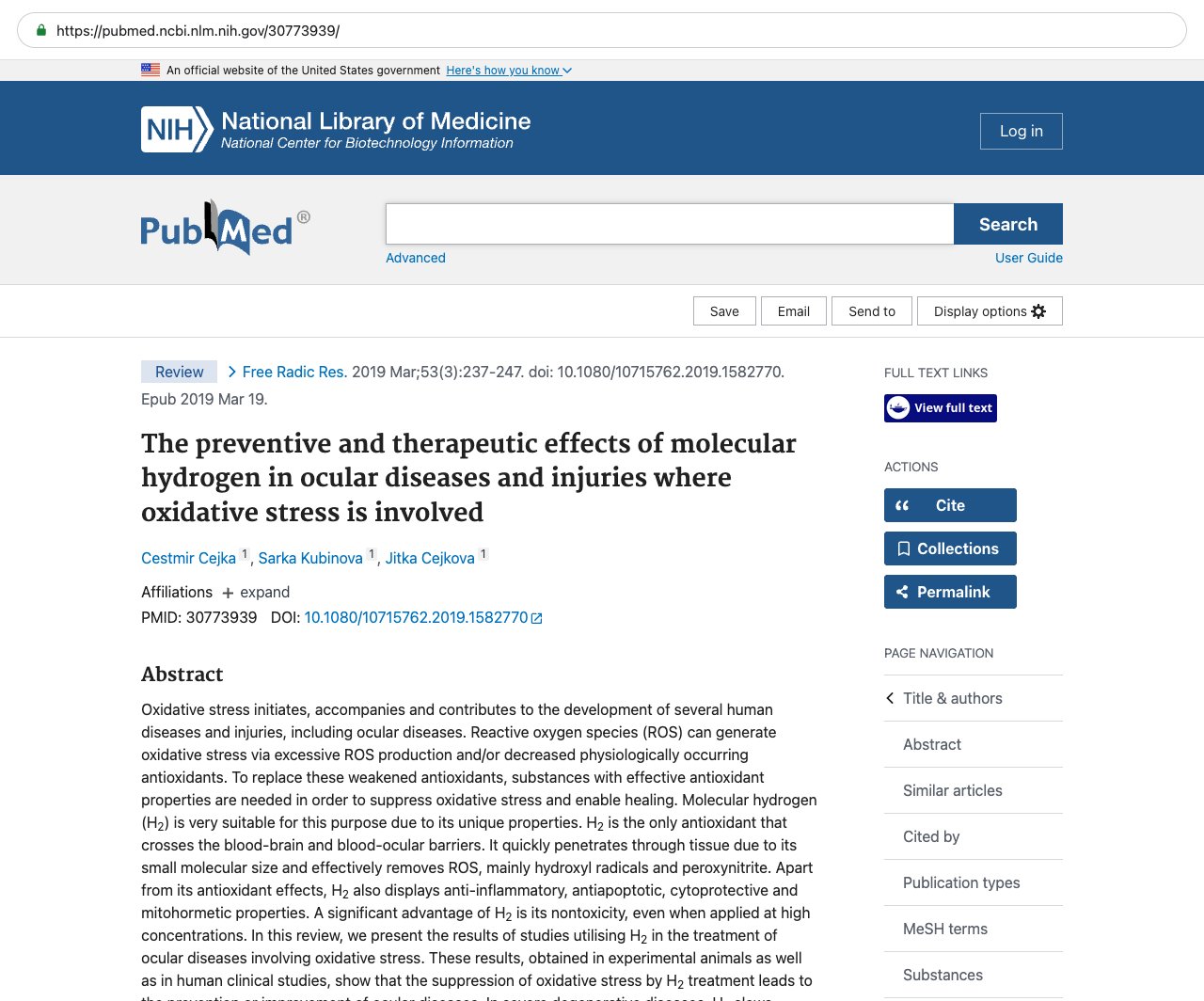
This page mirrors the published abstract (© the authors / publisher) for reference and citation. The canonical source is the PubMed record linked above. This is not medical advice.