2026 · Zhu — Self-Adaptive Hydrogen Nano-Delivery System in Glaucoma Management: Synergistic Antioxidation and Anti-inflammation Therapeutic Strategy
Super-Abstract
Glaucoma-induced optic nerve damage remains a leading cause of blindness, and current treatments focus only on lowering intraocular pressure — ignoring the oxidative stress and inflammation that drive the underlying damage. In this preclinical study, researchers developed a self-adaptive nanosheet (HyNDs) built on hydrogenated silicene that releases H₂ continuously under physiological conditions, scavenges reactive oxygen species, and — in both cellular and animal models — significantly reduced intraocular pressure while showing negligible toxicity. (ACS Nano, 2026.)
Commentary
This is a creative materials-science approach to an ophthalmological problem. The nanoagent HyNDs is engineered to deliver H₂ in a sustained, self-regulated manner directly in the ocular microenvironment, sidestepping the volatility problems of conventional H₂ delivery. The dual mechanism — reducing intraocular pressure and simultaneously scavenging oxidative radicals — is a notable feature. Results are demonstrated in cell culture and mouse models; the study does not include primate models or human data. The biocompatibility data (negligible cytotoxicity) are encouraging but not sufficient to infer human safety. This is a well-executed proof-of-concept animal and in-vitro study that requires substantial further development before any clinical relevance can be claimed.
Key quotes
- „current therapies mainly focus on reducing intraocular pressure without paying significant attention to the oxidative stress and inflammation in ocular tissues.“ — the therapeutic gap that the H₂ nanoagent is designed to fill
- „HyNDs can efficiently scavenge oxidative radicals and downregulate the expression of oxidative stress-associated biomarkers in both cellular and animal models, contributing to significantly reduced intraocular pressure.“ — the key preclinical finding — animal and cell models only
- „This hydrogen-based therapeutic approach features a dual mechanism of intraocular pressure reduction and oxidative stress mitigation.“ — the claimed mechanistic advantage over current glaucoma treatments
Our assessment
This is a preclinical animal and in-vitro study — results are from mouse models and cell culture, not from humans. The nanoagent HyNDs is a novel material not approved for clinical use. No conclusions about benefit in human glaucoma patients can be drawn from this work. It is a promising proof-of-concept that establishes a new research direction in ocular H₂ delivery; clinical translation would require toxicology studies, primate trials and regulatory approval processes that do not yet exist for this material.
Study design
- Type: preclinical study (in vitro + animal) · Model: cell culture + mouse glaucoma model · H₂ delivery: HyNDs nanosheet (hydrogenated silicene + TPGS polymer coating)
- Key finding: significant intraocular pressure reduction + ROS scavenging in cell and mouse models; negligible cytotoxicity observed
- Limitation: no human or primate data; novel nanomaterial not yet assessed for full toxicological profile
Abstract
Glaucoma-induced optic nerve damage is known to be a leading cause of blindness worldwide, yet current therapies mainly focus on reducing intraocular pressure without paying significant attention to the oxidative stress and inflammation in ocular tissues. Here, we address this issue by developing a self-adaptive two-dimensional nanosheet that enables sustained hydrogen release in the ocular microenvironment. The nanoagent (termed HyNDs) is constructed by modifying the surface of hydrogenated silicene (SiH), a biocompatible nanosheet that self-decomposes to generate hydrogen under physiological conditions, with d-α-tocopheryl polyethylene glycol 1000 succinate (TPGS) polymer. HyNDs exhibit excellent dispersity, making them suitable for ocular delivery, while the TPGS coating ensures prolonged hydrogen release through its shielding effect. We demonstrate that HyNDs can efficiently scavenge oxidative radicals and downregulate the expression of oxidative stress-associated biomarkers in both cellular and animal models, contributing to significantly reduced intraocular pressure. Additionally, the nanoagent exhibits negligible cytotoxicity and adverse effects on ocular tissues. This hydrogen-based therapeutic approach features a dual mechanism of intraocular pressure reduction and oxidative stress mitigation, thereby exhibiting attractive promise for advancing the clinical management of glaucoma.
Source & links
Screenshot of the PubMed page
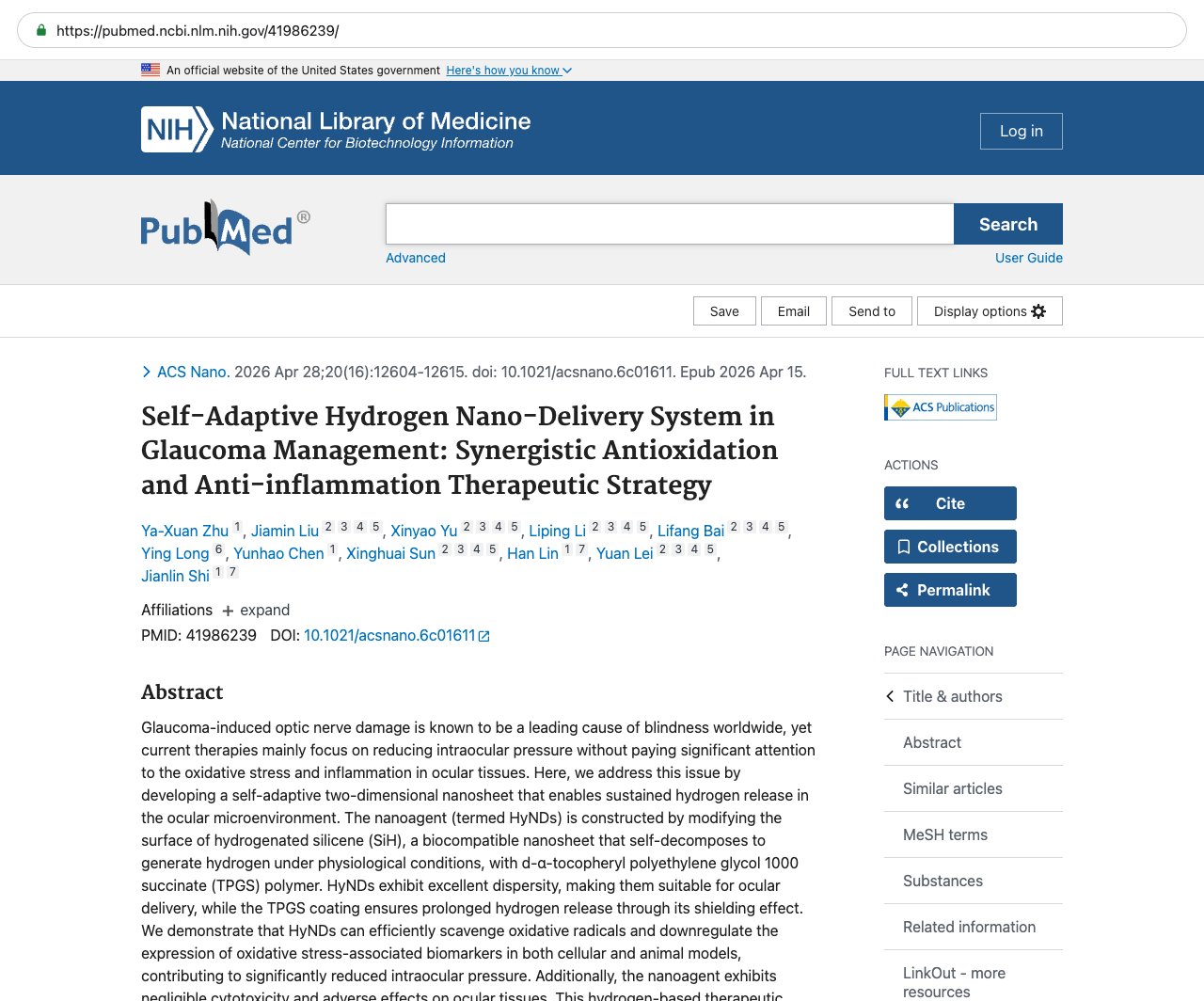
This page mirrors the published abstract (© the authors / publisher) for reference and citation. The canonical source is the PubMed record linked above. This is not medical advice.