2011 · Chai — Perfusion Electrodeposition of Calcium Phosphate on Additive Manufactured Titanium Scaffolds for Bone Engineering
Super-Abstract
This biomaterials engineering study develops a perfusion-based electrodeposition system to uniformly coat 3D-printed titanium bone scaffolds with hydroxyapatite — a calcium phosphate mineral that promotes bone cell adhesion and growth — while addressing hydrogen gas removal as a technical process challenge. This is bone engineering research; the hydrogen mentioned is an unwanted electrochemical byproduct, not a therapeutic agent. (Acta Biomaterialia, 2011.)
Commentary
Additive manufacturing (3D printing) of titanium alloy scaffolds allows complex, patient-specific bone implant geometries that cannot be made by conventional machining. However, coating the internal pore surfaces of such scaffolds with bioactive calcium phosphate (CaP) — to promote osseointegration — is technically difficult because conventional dip-coating methods cannot reach the scaffold interior. This study presents a perfusion electrodeposition (P-ELD) system where electrolyte solution is actively pumped through the scaffold pores during deposition. Four key process parameters (current density, deposition time, flow rate, and temperature) were optimised, and computational fluid dynamics modelling was used to understand electrolyte flow behaviour. The coating produced was highly crystalline carbonated hydroxyapatite (Ca/P ratio ≈ 1.41). Human periosteum-derived cells showed good viability and adhesion on coated scaffolds. The paper mentions hydrogen gas removal as part of the electrochemistry — during electrodeposition, H₂ is generated as a byproduct at the cathode and must be removed to prevent coating defects. This is purely a technical process consideration.
Key quotes
- „Computational fluid dynamic analysis showed a relatively low electrolyte velocity within the struts and a high velocity in the open areas within the P-ELD chamber, which were not influenced by a change in f. This is beneficial for promoting a controlled CaP deposition and hydrogen gas removal.“ — H₂ gas removal as an electrochemical process challenge — not a therapeutic use
- „High cell viability and cell-material interactions were demonstrated by in vitro culture of human periosteum derived cells on coated scaffolds.“ — biocompatibility confirmed with clinically relevant cell type
- „P-ELD provides a technological tool to functionalize complex scaffold structures with a biocompatible CaP layer that has controlled and reproducible physicochemical properties suitable for bone engineering.“ — the main engineering conclusion
Our assessment
This is an in-vitro biomaterials engineering study. Hydrogen gas appears here only as an unwanted electrochemical byproduct that must be managed during coating deposition — it is not a therapeutic agent. Honest note: this paper has no relevance to H₂ therapy and should not be cited in that context. It is valid biomedical engineering research on bone implant coatings. All outcomes are from laboratory testing; clinical performance in living bone would require animal and human studies.
Study design
- Type: in-vitro biomaterials engineering study · Model: 3D-printed Ti6Al4V scaffolds, perfusion electrodeposition, human periosteum-derived cells · H₂ relevance: H₂ gas as electrochemical byproduct requiring removal — not therapeutic H₂
- Result: uniform highly crystalline hydroxyapatite coating achieved (Ca/P ≈ 1.41); minimum 6 h deposition needed for complete scaffold coating; high cell viability and adhesion confirmed
Abstract
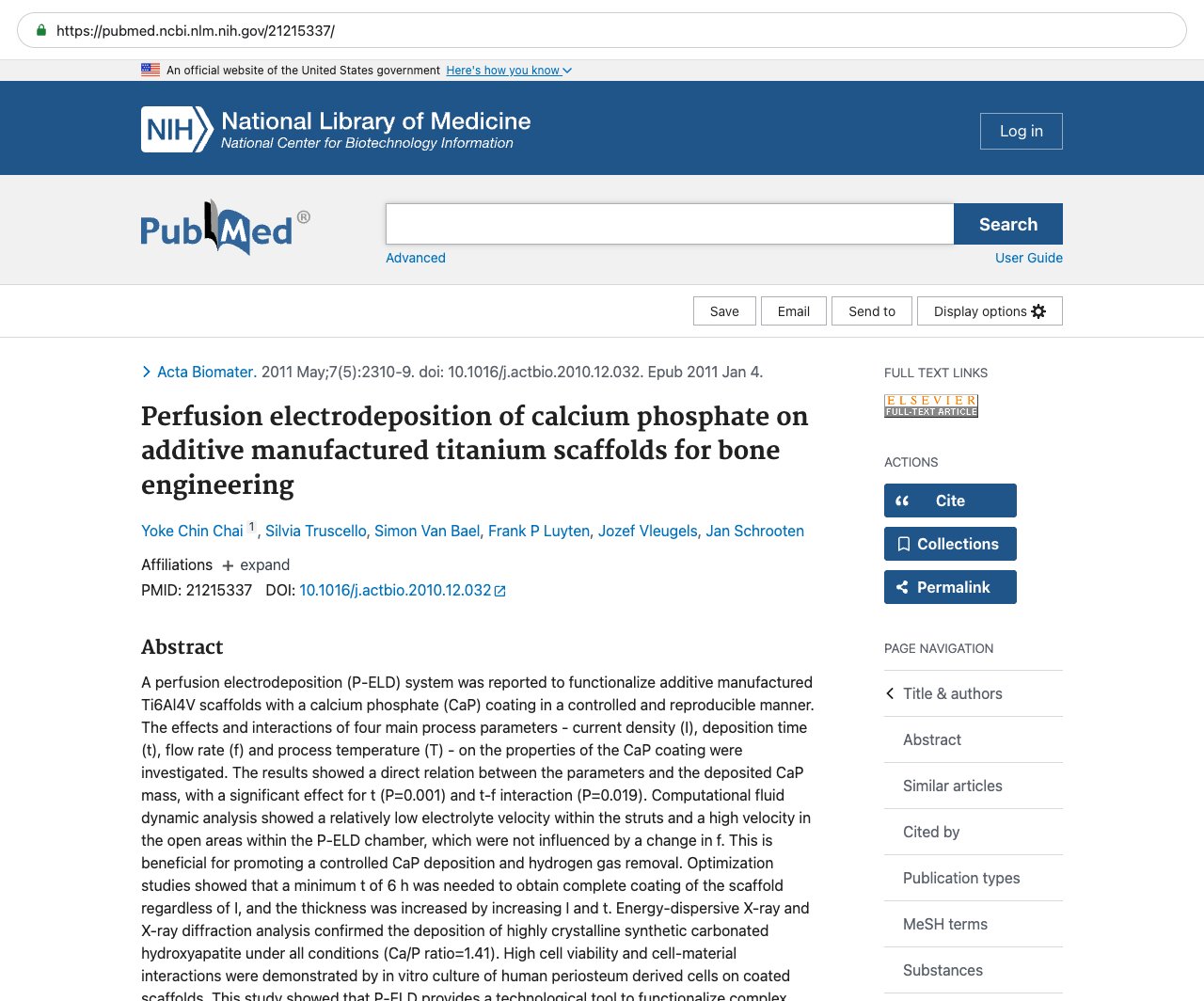
A perfusion electrodeposition (P-ELD) system was reported to functionalize additive manufactured Ti6Al4V scaffolds with a calcium phosphate (CaP) coating in a controlled and reproducible manner. The effects and interactions of four main process parameters - current density (I), deposition time (t), flow rate (f) and process temperature (T) - on the properties of the CaP coating were investigated. The results showed a direct relation between the parameters and the deposited CaP mass, with a significant effect for t (P=0.001) and t-f interaction (P=0.019). Computational fluid dynamic analysis showed a relatively low electrolyte velocity within the struts and a high velocity in the open areas within the P-ELD chamber, which were not influenced by a change in f. This is beneficial for promoting a controlled CaP deposition and hydrogen gas removal. Optimization studies showed that a minimum t of 6 h was needed to obtain complete coating of the scaffold regardless of I, and the thickness was increased by increasing I and t. Energy-dispersive X-ray and X-ray diffraction analysis confirmed the deposition of highly crystalline synthetic carbonated hydroxyapatite under all conditions (Ca/P ratio=1.41). High cell viability and cell-material interactions were demonstrated by in vitro culture of human periosteum derived cells on coated scaffolds. This study showed that P-ELD provides a technological tool to functionalize complex scaffold structures with a biocompatible CaP layer that has controlled and reproducible physicochemical properties suitable for bone engineering.
Source & links
Screenshot of the PubMed page
This page mirrors the published abstract (© the authors / publisher) for reference and citation. The canonical source is the PubMed record linked above. This is not medical advice.