2026 · Lin et al. — Adjunctive Molecular Hydrogen Therapy Modulates T Cell Markers and Reduces Anti-Ro Antibody in Refractory Oral Ulcers of Behçet's Disease and Sjögren's Syndrome: A Case Report
Super-Abstract
A 67-year-old woman with both Behçet's disease and primary Sjögren's syndrome — whose recurrent painful oral ulcers had not responded to years of standard therapy — showed marked clinical improvement and falling anti-Ro antibody levels after adding oral molecular hydrogen capsules to her regimen. Immunophenotyping documented shifts in T-cell subsets consistent with immunomodulation. (In Vivo, 2026.)
Commentary
This case report is one of several published in 2025–2026 from a Taiwanese clinical group exploring hydrogen as an adjuvant in refractory autoimmune disease. The combination of Behçet's and Sjögren's in one patient is clinically unusual and creates a complex immunological background, making it difficult to attribute any change to a single intervention. The patient had already received hydroxychloroquine, colchicine, high-dose intravenous vitamin C and glutathione — a formidable antioxidant cocktail — yet still suffered from recurrent ulcers. The addition of hydrogen capsules led to clinical improvement and measurable immunological changes over several months. Whether hydrogen was the decisive factor, or whether the cumulative antioxidant burden finally crossed a therapeutic threshold, cannot be determined from a single uncontrolled case. The immunological markers reported (increased naïve T helper Fas+ and cytotoxic PD-1+ subsets) are biologically interesting but require validation in larger cohorts.
Key quotes
- „Over several months, she showed marked clinical improvement, with less mucosal bleeding and decreased anti-Ro antibody levels.“ — the primary clinical observation
- „Immunophenotyping revealed increased naïve T helper Fas cell surface death receptor-positive (Fas+) and cytotoxic T cell programmed death-1-positive (PD-1+) subsets, suggesting immunomodulatory effects.“ — mechanistic signal supporting immune modulation
- „Molecular hydrogen may aid refractory oral ulcers in Behçet's and primary Sjögren's syndromes, with clinical and immunologic benefits.“ — cautious authors' conclusion
Our assessment
A single case report — the weakest level of clinical evidence. No control, no randomisation, no placebo, concurrent multidrug therapy makes causal attribution impossible. The clinically interesting signals (antibody reduction, mucosal healing, T-cell shifts) justify further study but cannot be generalised. Limitations: n = 1, highly complex disease overlap (Behçet's + Sjögren's), extensive background medication, no washout, observer bias not excluded. Useful for hypothesis generation and for showing tolerability; insufficient to guide practice.
Study design
- Type: case report · n: 1 (67-year-old woman) · H₂ delivery: oral molecular hydrogen capsules (adjunct to existing medication)
- Result: marked reduction in mucosal bleeding and oral ulcer frequency; anti-Ro antibody levels decreased; immunophenotyping showed shifts in Fas+ and PD-1+ T-cell subsets · Follow-up: approx. 20 months (January 2024 – August 2025)
Abstract
BACKGROUND/AIM: Behçet's Disease is a systemic vasculitis affecting both venous and arterial vessels, characterized by painful oral and genital ulcers. Primary Sjögren's Syndrome is an autoimmune disorder mainly targeting exocrine glands, especially the salivary and lacrimal glands, with possible systemic involvement. Molecular hydrogen has emerged as a potential adjuvant therapy due to its antioxidant and immunomodulatory effects. This report evaluates the efficacy of molecular hydrogen as adjunctive therapy for refractory oral ulcers in a patient with Behçet's disease and primary Sjögren's syndrome. CASE REPORT: A 67-year-old Taiwanese woman with Behçet's disease and primary Sjögren's syndrome had recurrent painful oral ulcers and mucosal atrophy since 2018, meeting the International Study Group (ISG) criteria. In 2020, she fulfilled the 2016 European League Against Rheumatism (EULAR)/American College of Rheumatology (ACR) criteria for Sjögren's syndrome based on Schirmer's test (0/0 mm), positive anti-Ro antibody (29 U/ml), and labial salivary gland biopsy findings. Despite long-term, hydroxychloroquine, colchicine, and monthly high-dose intravenous vitamin C and glutathione, her oral ulcers recurred with petechiae and bleeding. In January 2024, oral molecular hydrogen capsules were added as adjunctive therapy. Over several months, she showed marked clinical improvement, with less mucosal bleeding and decreased anti-Ro antibody levels. Immunophenotyping revealed increased naïve T helper Fas cell surface death receptor-positive (Fas+) and cytotoxic T cell programmed death-1-positive (PD-1+) subsets, suggesting immunomodulatory effects. The therapy was well tolerated, with no major adverse events. By August 2025, oral ulcers had markedly improved, and systemic disease remained stable on maintenance with hydroxychloroquine, azathioprine, corticosteroid infusions, and hydrogen therapy. CONCLUSION: Molecular hydrogen may aid refractory oral ulcers in Behçet's and primary Sjögren's syndromes, with clinical and immunologic benefits.
Source & links
Screenshot of the PubMed page
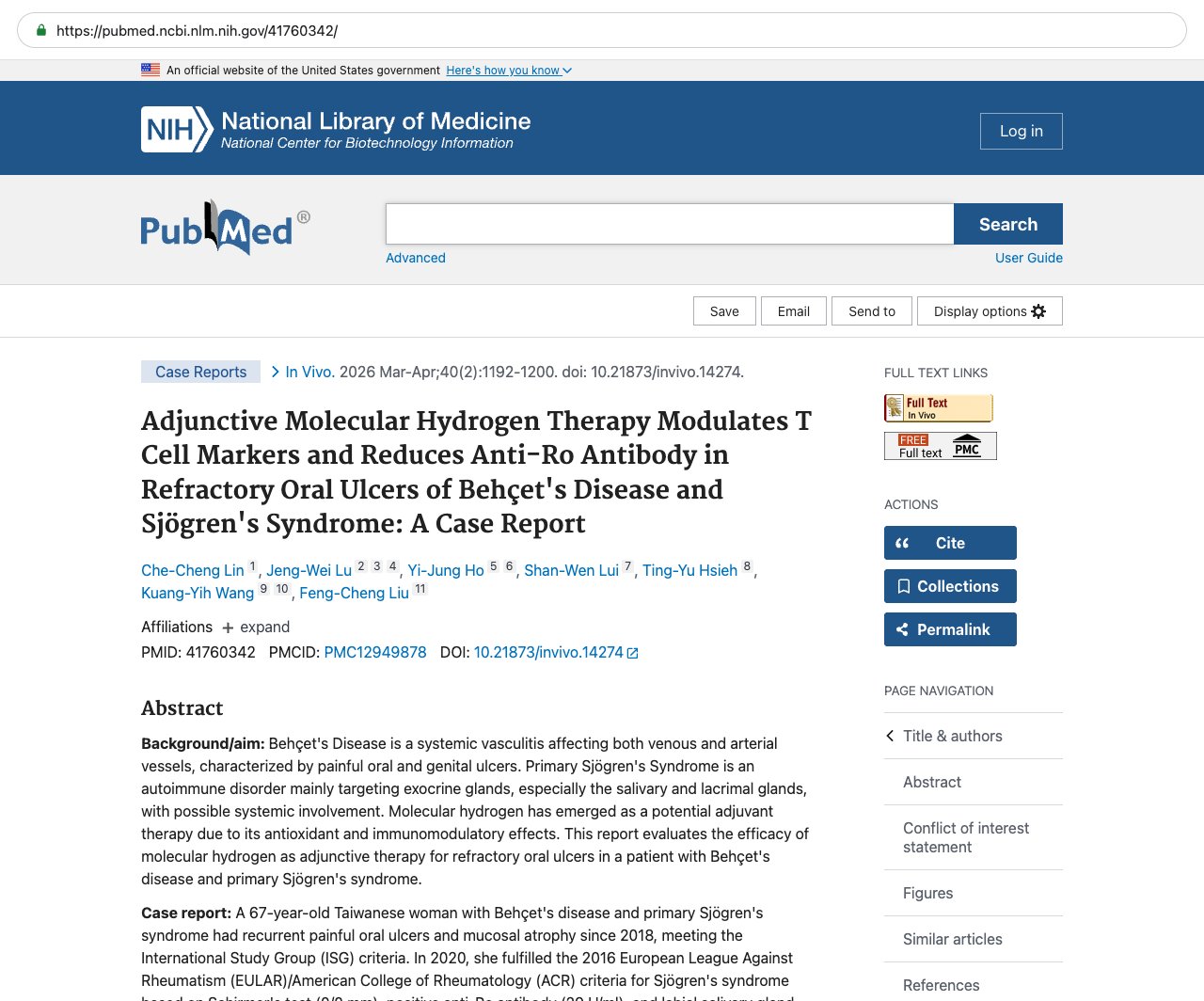
This page mirrors the published abstract (© the authors / publisher) for reference and citation. The canonical source is the PubMed record linked above. This is not medical advice.