2023 · Kuo — Molecular Hydrogen: Emerging Treatment for Stroke Management
Super-Abstract
Molecular hydrogen (H₂) is an emerging therapeutic approach in ischemic stroke — antioxidative, anti-inflammatory and anti-apoptotic. Across numerous preclinical and clinical studies (inhalation, infusion, H₂ water), favourable results were seen. (Review, Chemical Research in Toxicology, 2023.)
Commentary
This is a review that bundles the state of research on H₂ in stroke. Ischemic stroke is one of the leading causes of death and disability worldwide — so far only thrombolysis (mechanical thrombectomy or the clot-buster tPA) counts as an approved, effective treatment. The authors describe H₂ as an „emerging therapeutic agent“ that acts through antioxidative, anti-inflammatory and anti-apoptotic mechanisms and has been tested in numerous studies in several administration formats: inhalation of H₂ gas, intravenous or intraperitoneal injection of H₂-enriched solutions, and drinking of hydrogen water. They emphasise that safety and efficacy were „carefully evaluated“ and that „favorable outcomes“ were achieved. Crucially for honesty: this is a summarising review with no patient data of its own — it frames H₂ as a „promising treatment option ... in the future“, a future perspective rather than an established therapy. Good evidence that H₂ is being seriously researched in neurology.
Key quotes
- „Molecular hydrogen is involved in antioxidative, anti-inflammatory, and antiapoptotic functions in normal physical processes and may play an important role in stroke management.“ — the three core mechanisms and the cautious claim („may“)
- „it has been evaluated in numerous preclinical and clinical studies in several administration formats, including inhalation of hydrogen gas, intravenous or intraperitoneal injection of hydrogen-enriched solution, or drinking of hydrogen-enriched water.“ — the range of administration routes
- „All available evidence indicates that molecular hydrogen may be a promising treatment option for stroke management in the future.“ — the conclusion as a future perspective
Our assessment
The work is a good overview that places H₂ across several routes of administration in stroke — including hydrogen water. But beware: stroke is an acute emergency, for which mainly inhalation and infusions are discussed here — no evidence that everyday H₂ water prevents or treats a stroke. Limitations, stated honestly: a pure review, no study of its own, a small number of authors, and the language remains throughout in the conditional („may“, „in the future“). Valuable as mechanistic and overarching context, not as proof of efficacy.
Study design
- Type: review · n: — (no cohort of its own) · Duration: — · H₂ delivery: summarised — inhalation, i.v./i.p. H₂ solution, hydrogen water
- Result: qualitative — favourable results across preclinical and clinical studies; mechanisms: antioxidative, anti-inflammatory, anti-apoptotic
Abstract
Ischemic stroke is a major cause of death and disability worldwide. However, only intravenous thrombolysis using mechanical thrombectomy or tissue plasminogen activator is considered an effective and approved treatment. Molecular hydrogen is an emerging therapeutic agent and has recently become a research focus. Molecular hydrogen is involved in antioxidative, anti-inflammatory, and antiapoptotic functions in normal physical processes and may play an important role in stroke management; it has been evaluated in numerous preclinical and clinical studies in several administration formats, including inhalation of hydrogen gas, intravenous or intraperitoneal injection of hydrogen-enriched solution, or drinking of hydrogen-enriched water. In addition to investigation of the underlying mechanisms, the safety and efficacy of using molecular hydrogen have been carefully evaluated, and favorable outcomes have been achieved. All available evidence indicates that molecular hydrogen may be a promising treatment option for stroke management in the future. This review aimed to provide an overview of the role of molecular hydrogen in the management of stroke and possible further modifications of treatment conditions and procedures in terms of dose, duration, and administration route.
Source & links
Screenshot of the PubMed page
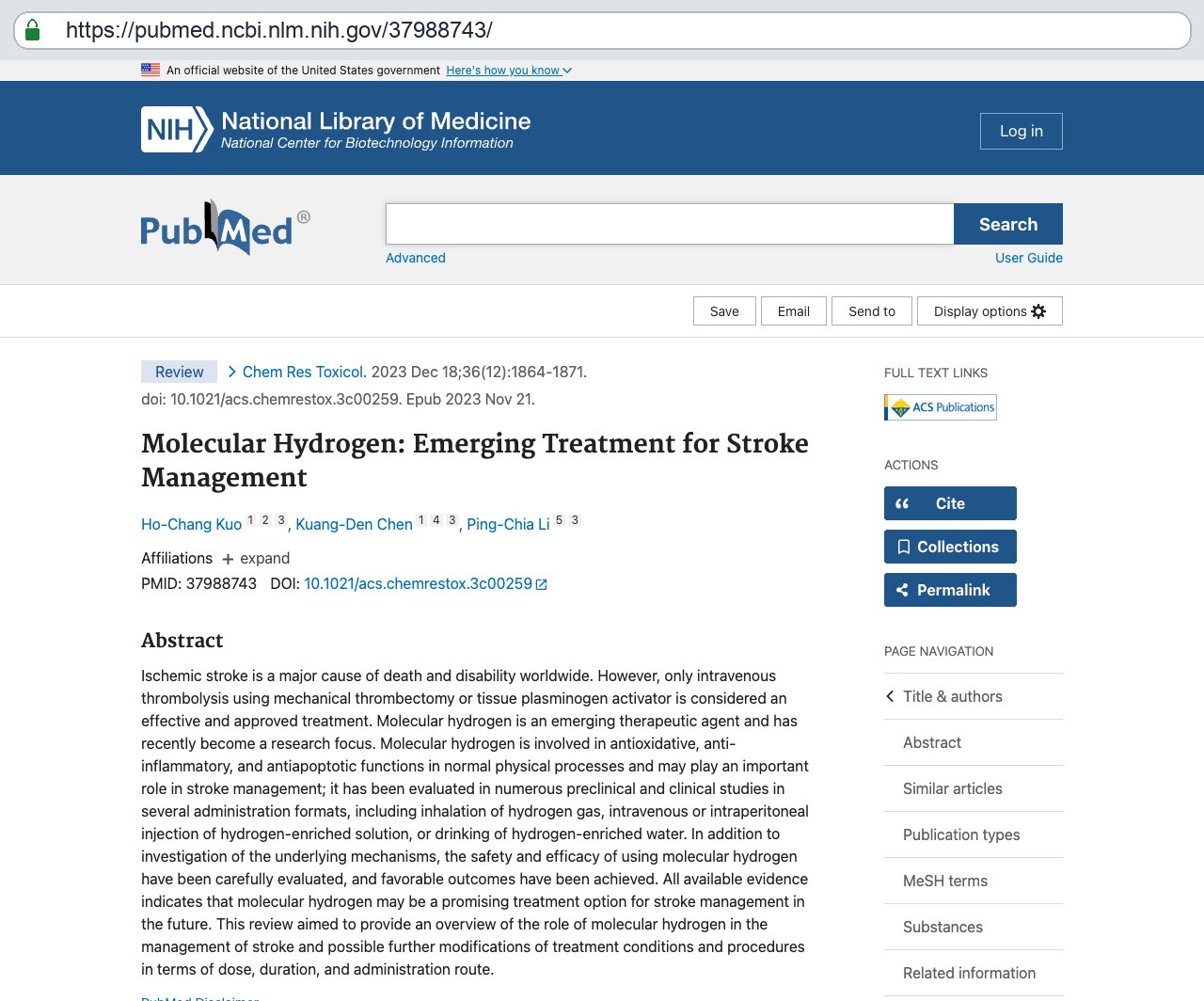
This page mirrors the published abstract (© the authors / publisher) for reference and citation. The canonical source is the PubMed record linked above. This is not medical advice.