2021 Experimental biology and medicine (Maywood, N.J.) Review / Meta-analysis InhalationSaline / IVBath / TopicalDrinking (HRW)
2021 · Quan — Protective effects of molecular hydrogen on lung injury from lung transplantation.
Super-Abstract
This review synthesizes the experimental evidence showing that H₂ — administered via inhalation, drinking, injection, or topical bath — can reduce the oxidative stress and inflammation responsible for primary graft dysfunction after lung transplantation. All reviewed evidence comes from animal models; clinical translation requires further trials. (Experimental Biology and Medicine, 2021.)
Commentary
Lung transplantation is uniquely vulnerable to ischemia-reperfusion injury: the graft experiences warm ischemia during retrieval, cold ischemia during preservation, and a second oxidative hit at reperfusion. The resulting primary graft dysfunction (PGD) is the leading cause of early morbidity and mortality after lung transplantation. Quan et al. systematically review the literature on H₂ in animal models of lung transplantation, covering multiple administration routes. H₂ consistently reduced oxidative stress biomarkers, pro-inflammatory cytokines, and histological injury in the reviewed studies, operating through modulation of signal transduction and gene expression. The breadth of delivery routes assessed (inhalation, HRW drinking, H₂-rich saline IV, H₂-rich water bath) is a practical strength — it suggests flexibility for clinical implementation. The honest caveat the authors themselves state is that the exact mechanisms remain elusive and that animal-to-human translation requires dedicated preliminary clinical trials before H₂ can be integrated into transplant protocols.
Key quotes
- „H2 improved the outcomes of lung transplantation by decreasing oxidative stress and inflammation at the donor and recipient phases.“ — core finding from reviewed animal studies — both pre-harvest donor treatment and recipient treatment showed benefit
- „its exact mechanisms of action remain elusive.“ — honest acknowledgment of the mechanistic knowledge gap despite promising data
- „Further animal experiments and preliminary human clinical trials will lay the foundation for the use of H2 as a treatment in the clinic.“ — authors' call for next steps — clinical use is not yet established
Our assessment
This is a review of animal studies — no clinical trial data in humans are available for H₂ in lung transplantation. The consistent preclinical signal across multiple delivery routes is encouraging and the mechanistic rationale is sound. The clinical need is real: primary graft dysfunction is a major unsolved problem in lung transplantation. However, the gap between animal models (typically rodents or large animals) and the complexity of human lung transplantation is significant. Clinical trials are explicitly identified by the authors as the required next step.
Study design
- Type: narrative review of animal experiments · Scope: H₂ administration in lung transplantation models (ischemia, cold preservation, reperfusion) · H₂ delivery: inhalation, drinking hydrogen-rich water, H₂-rich saline IV, hydrogen-rich water bath
- Conclusion: H₂ reduces transplant-related lung injury via oxidative stress and inflammation suppression in animal models; clinical evidence in humans absent; trials recommended
Abstract
Lung grafts may experience multiple injuries during lung transplantation, such as warm ischaemia, cold ischaemia, and reperfusion injury. These injuries all contribute to primary graft dysfunction, which is a major cause of morbidity and mortality after lung transplantation. As a potential selective antioxidant, hydrogen molecule (H2) protects against post-transplant complications in animal models of multiple organ transplantation. Herein, the authors review the current literature regarding the effects of H2 on lung injury from lung transplantation. The reviewed studies showed that H2 improved the outcomes of lung transplantation by decreasing oxidative stress and inflammation at the donor and recipient phases. H2 is primarily administered via inhalation, drinking hydrogen-rich water, hydrogen-rich saline injection, or a hydrogen-rich water bath. H2 favorably modulates signal transduction and gene expression, resulting in the suppression of pro-inflammatory cytokines and excess reactive oxygen species production. Although H2 appears to be a physiological regulatory molecule with antioxidant, anti-inflammatory and anti-apoptotic properties, its exact mechanisms of action remain elusive. Taken together, accumulating experimental evidence indicates that H2 can significantly alleviate transplantation-related lung injury, mainly via inhibition of inflammatory cytokine secretion and reduction in oxidative stress through several underlying mechanisms. Further animal experiments and preliminary human clinical trials will lay the foundation for the use of H2 as a treatment in the clinic.
Source & links
Screenshot of the PubMed page
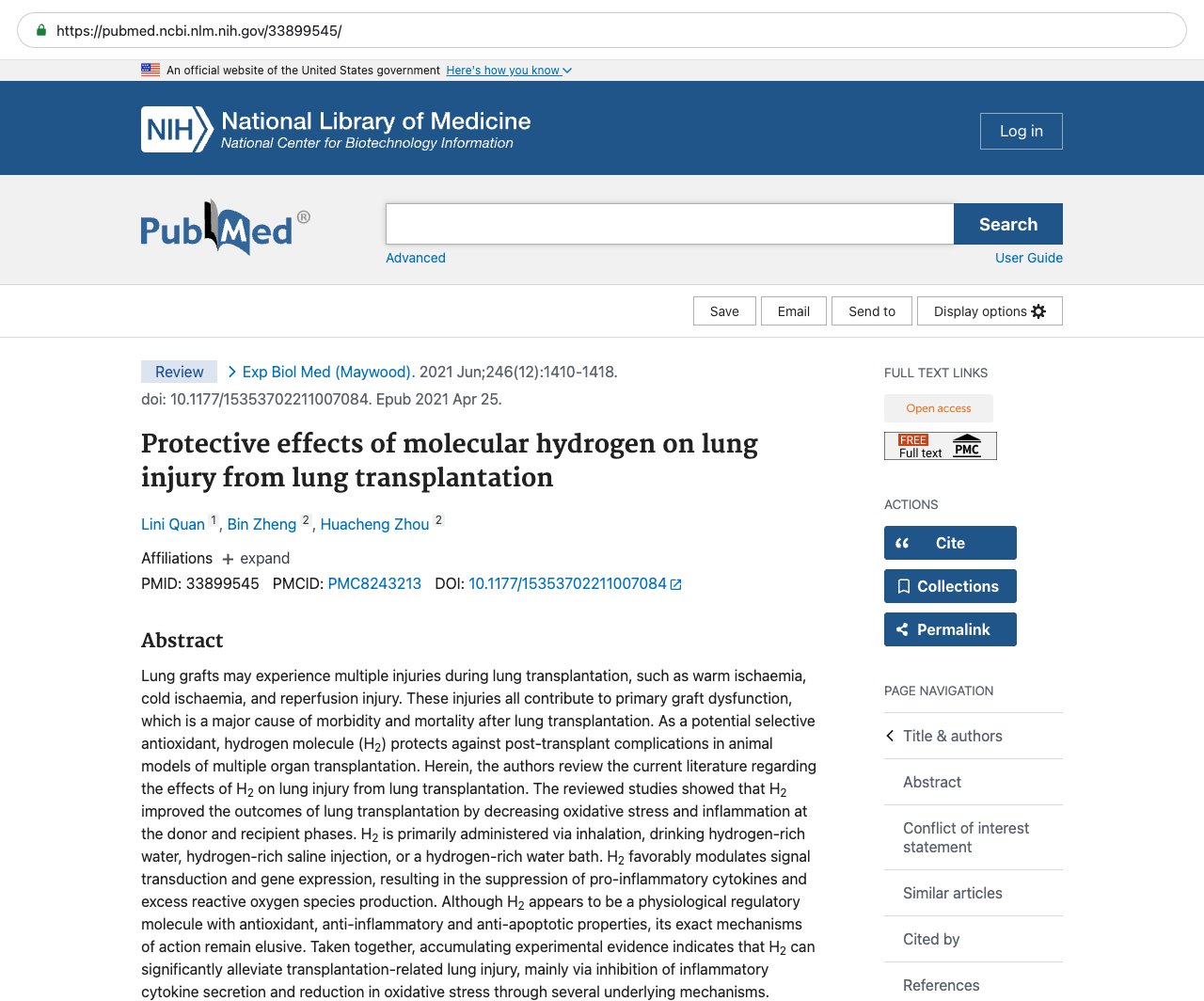
This page mirrors the published abstract (© the authors / publisher) for reference and citation. The canonical source is the PubMed record linked above. This is not medical advice.