2019 · Chen et al. — Inhaling Hydrogen Ameliorates Early Postresuscitation EEG Characteristics in an Asphyxial Cardiac Arrest Rat Model.
Super-Abstract
In a rat model of asphyxial cardiac arrest, breathing 2% hydrogen gas after resuscitation dramatically improved both survival (90% vs. 40%) and the recovery of brain electrical activity (EEG) within four hours. EEG characteristics in the hydrogen-treated animals correlated with better neurological outcomes at 96 hours — but this is an animal study and does not directly translate to human cardiopulmonary resuscitation.
Commentary
Cardiac arrest causes global brain ischemia, and the quality of EEG recovery after resuscitation is used clinically to predict neurological prognosis. This study tested whether hydrogen inhalation (2% H₂ in 98% O₂ for one hour post-resuscitation) would improve EEG recovery in rats after five minutes of untreated asphyxial cardiac arrest. The results were striking: survival at 96 hours was 90% in the H₂ group versus 40% in controls (p < 0.01), and four quantitative EEG metrics all favoured H₂. Burst onset was earlier, time to normal trace was shorter, and entropy measures — reflecting brain signal complexity — were higher. The AUCs for predicting 96-hour survival using EEG ranged from 0.82 to 0.88, suggesting these EEG measures may serve as useful prognostic tools in conjunction with H₂ treatment.
Key quotes
- „the survival rate was significantly higher in the H2 group than in the Ctrl group (90% vs. 40%, P < 0.01).“ — the most dramatic result: H₂ more than doubled 96-hour survival in this rat model
- „the H2 group showed a shorter burst onset time and time to normal trace.“ — EEG recovery was faster in hydrogen-treated animals
- „the improved postresuscitation EEG characteristics for animals treated with hydrogen are correlated with the better 96 h neurological outcome and predicted survival.“ — the authors' conclusion linking EEG measures to neurological and survival outcomes
Our assessment
This is a well-controlled preclinical animal study (rat asphyxial cardiac arrest model) with impressive results that raise genuine scientific interest. Limitations: rat physiology and cardiac arrest models differ substantially from human cardiopulmonary resuscitation; 40 animals is a small sample; the study was conducted under normothermia, whereas clinical post-resuscitation care often includes targeted temperature management that may interact with H₂; the EEG analysis methods need validation in human settings. The results are hypothesis-generating and support further clinical research, but cannot be directly applied to human post-cardiac-arrest care.
Study design
- Type: preclinical randomised controlled animal study · n: 40 adult female Sprague-Dawley rats, randomised 1:1 · H₂ delivery: 2% H₂ in 98% O₂ by inhalation for 1 hour post-resuscitation
- Model: 5 min asphyxial cardiac arrest + cardiopulmonary resuscitation · Endpoints: 96 h survival, EEG characteristics (burst onset time, time to normal trace, burst suppression ratio, weighted-permutation entropy) · Key result: 90% vs. 40% survival (p < 0.01); all EEG metrics favoured H₂
Abstract
BACKGROUND: Electroencephalography (EEG) is commonly used to assess the neurological prognosis of comatose patients after cardiac arrest (CA). However, the early prognostic accuracy of EEG may be affected by postresuscitation interventions. Recent animal studies found that hydrogen inhalation after CA greatly improved neurological outcomes by selectively neutralizing highly reactive oxidants, but the effect of hydrogen inhalation on EEG recovery and its prognostication value are still unclear. The present study investigated the effects of hydrogen inhalation on early postresuscitation EEG characteristics in an asphyxial CA rat model. METHODS: Cardiopulmonary resuscitation was initiated after 5 min of untreated CA in 40 adult female Sprague-Dawley rats. Animals were randomized for ventilation with 98% oxygen plus 2% hydrogen (H2) or 98% oxygen plus 2% nitrogen (Ctrl) under normothermia for 1 h. EEG characteristics were continuously recorded for 4 h, and the relationships between quantitative EEG characteristics and 96 h neurological outcomes were investigated. RESULTS: No differences in baseline and resuscitation data were observed between groups, but the survival rate was significantly higher in the H2 group than in the Ctrl group (90% vs. 40%, P < 0.01). Compared to the Ctrl group, the H2 group showed a shorter burst onset time (21.85 [20.00-23.38] vs. 25.70 [22.48-30.05], P < 0.01) and time to normal trace (169.83 [161.63-208.55] vs. 208.39 [186.29-248.80], P < 0.01). Additionally, the burst suppression ratio (0.66 ± 0.09 vs. 0.52 ± 0.17, P < 0.01) and weighted-permutation entropy (0.47 ± 0.16 vs. 0.34 ± 0.13, P < 0.01) were markedly higher in the H2 group. The areas under the receiver operating characteristic curves for the 4 EEG characteristics in predicting survival were 0.82, 0.84, 0.88, and 0.83, respectively. CONCLUSIONS: In this asphyxial CA rat model, the improved postresuscitation EEG characteristics for animals treated with hydrogen are correlated with the better 96 h neurological outcome and predicted survival.
Source & links
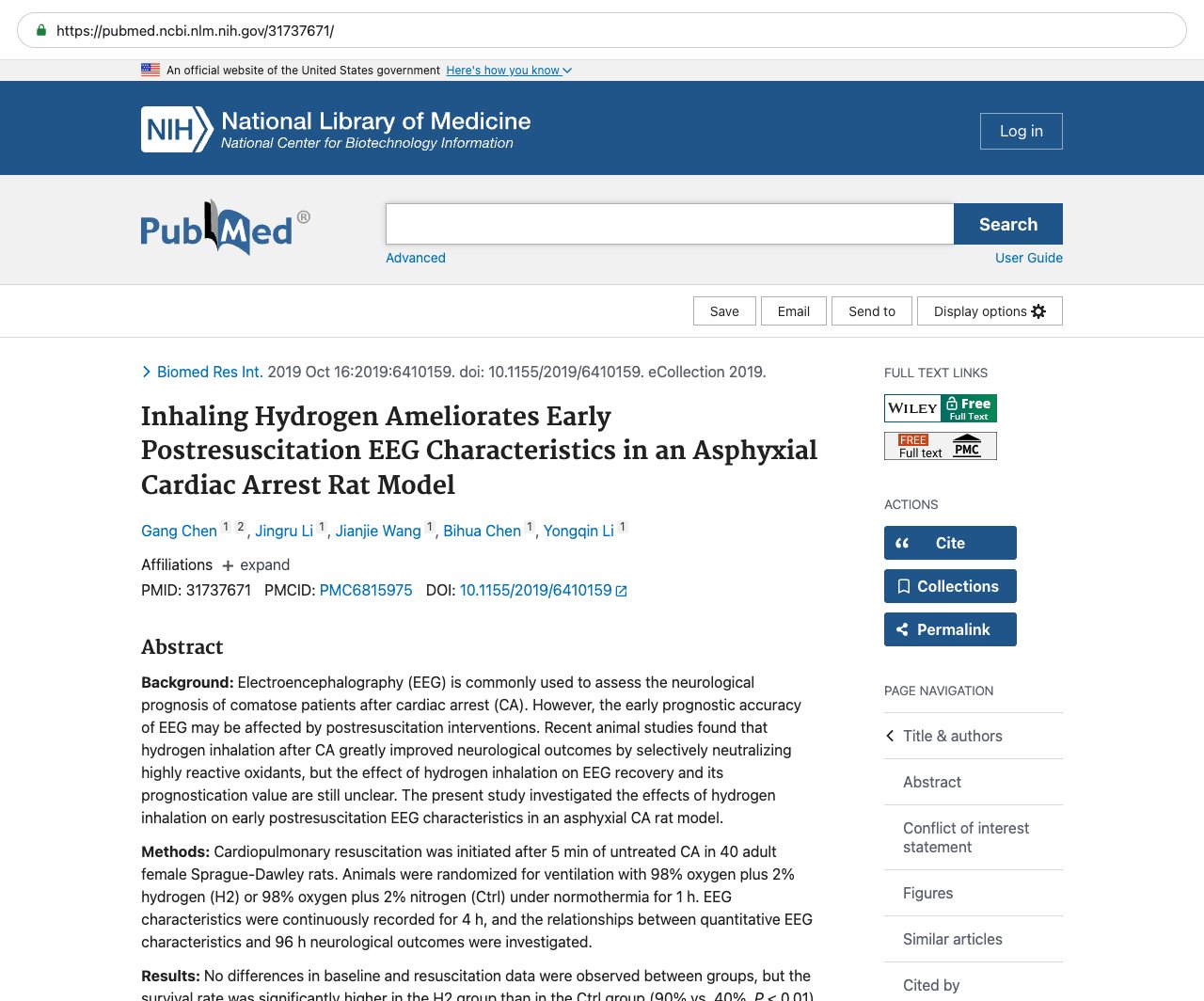
Screenshot of the PubMed page
This page mirrors the published abstract (© the authors / publisher) for reference and citation. The canonical source is the PubMed record linked above. This is not medical advice.