2025 · Habet et al. — Hydrogen-FAST: Study Protocol for Inhaled Hydrogen Gas as Adjunctive Therapy in Refractory Cardiac Arrest (ECPR)
Super-Abstract
The Hydrogen-FAST trial is a phase 1 multicenter randomised controlled trial investigating whether inhaled 2 % hydrogen gas, delivered continuously for 72 hours during extracorporeal cardiopulmonary resuscitation (ECPR), is feasible and safe in patients with refractory cardiac arrest and underlying heart disease. This publication describes the study protocol — results are pending. (Trials, 2025.)
Commentary
Extracorporeal CPR is a last-resort rescue for patients in cardiac arrest who do not respond to conventional resuscitation. Even when ECPR successfully restores circulation, the ischaemia-reperfusion injury to brain, heart, and other organs that follows remains a major cause of death and severe disability. Hydrogen gas has shown promising protection against ischaemia-reperfusion injury in numerous animal models, providing a strong preclinical rationale for testing it in this extreme scenario. What makes this trial particularly notable is the target population: patients of any age with congenital heart disease — a group that is often excluded from trials, lacks tailored evidence, and faces particularly severe ischaemia-reperfusion burden during ECPR. The use of an Exception from Informed Consent process (EFIC) is legally and ethically grounded in the emergency context but adds regulatory and communication complexity. Primary endpoints are pragmatically defined as feasibility (≥ 90 % of 72-hour period with hydrogen successfully delivered) and safety (treatment-related serious adverse events) — appropriate for a phase 1 safety trial. Efficacy data (survival, neurological function) are secondary endpoints to inform later phase trials.
Key quotes
- „Hydrogen gas (H2) has demonstrated promising preclinical efficacy in reducing IRI.“ — the preclinical rationale for testing H₂ in this high-stakes setting
- „Fifty-three participants will be randomized to standard care or standard care plus inhaled 2% H2 gas delivered continuously for 72 h via mechanical ventilator and extracorporeal membrane oxygenation (ECMO) circuit.“ — trial design: 2 % H₂ via ventilator + ECMO for 72 hours
- „The Hydrogen-FAST trial will provide essential data on the feasibility and safety of H2 administration during ECPR, informing larger efficacy studies and potential broader clinical use in critical care settings.“ — what this phase 1 trial is designed to deliver
Our assessment
This is a study protocol publication — no efficacy results yet. Its scientific value is the transparent pre-registration of methodology for a high-stakes clinical context (ECPR + ischaemia-reperfusion injury) where H₂ has strong preclinical support. What to watch: the feasibility endpoint (≥ 90 % H₂ delivery time) is demanding given the technical complexity of ECPR; congenital heart disease patients are a heterogeneous population; sample size (n = 53) is appropriate for a safety/feasibility trial only. If phase 1 results are positive, a properly powered efficacy trial will be needed. The ECMO-circuit delivery of H₂ is technically innovative and its safety in this context is precisely what Hydrogen-FAST is designed to establish.
Study design
- Type: study protocol for phase 1 multicenter randomised controlled trial · n planned: 53 · H₂ delivery: 2 % H₂ gas via mechanical ventilator + ECMO circuit, continuously for 72 h
- Population: patients of any age with refractory cardiac arrest + underlying cardiac morbidity (congenital heart disease), enrolled via Exception from Informed Consent
- Primary endpoints: feasibility (≥ 90 % H₂ delivery time in first 72 h) and safety (treatment-related serious adverse events) · Secondary: survival to discharge, ICU stay, neurological function at 6 months, ischaemic injury markers
Abstract
BACKGROUND: Extracorporeal cardiopulmonary resuscitation (ECPR) improves survival for patients experiencing refractory cardiac arrest but is often associated with severe ischemia-reperfusion injury (IRI). Hydrogen gas (H2) has demonstrated promising preclinical efficacy in reducing IRI. The Hydrogen-FAST trial investigates the feasibility and safety of inhaled hydrogen gas as an adjunctive therapy during ECPR in patients with congenital heart disease (CHD). METHODS: This phase 1 multicenter randomized controlled trial enrolls patients of any age undergoing ECPR due to refractory cardiac arrest associated with underlying cardiac morbidity. Due to the emergent nature of ECPR events, the trial leverages an Exception from Informed Consent enrollment process. Fifty-three participants will be randomized to standard care or standard care plus inhaled 2% H2 gas delivered continuously for 72 h via mechanical ventilator and extracorporeal membrane oxygenation (ECMO) circuit. Primary endpoints include feasibility, measured as the percentage of the first 72 h post-arrest in which hydrogen is successfully administered, with feasibility defined as a mean percentage of ≥90%, and safety, evaluated through incidence rates of treatment-related serious adverse events (SAEs). Secondary endpoints examine clinical outcomes including survival to discharge, ICU length of stay, functional status at 6 months, neurologic function, and markers of ischemic injury. DISCUSSION: The Hydrogen-FAST trial will provide essential data on the feasibility and safety of H2 administration during ECPR, informing larger efficacy studies and potential broader clinical use in critical care settings. TRIAL REGISTRATION: ClinicalTrials.gov NCT05574296. Registered on October 6, 2022. https://clinicaltrials.gov/study/NCT05574296 .
Source & links
Screenshot of the PubMed page
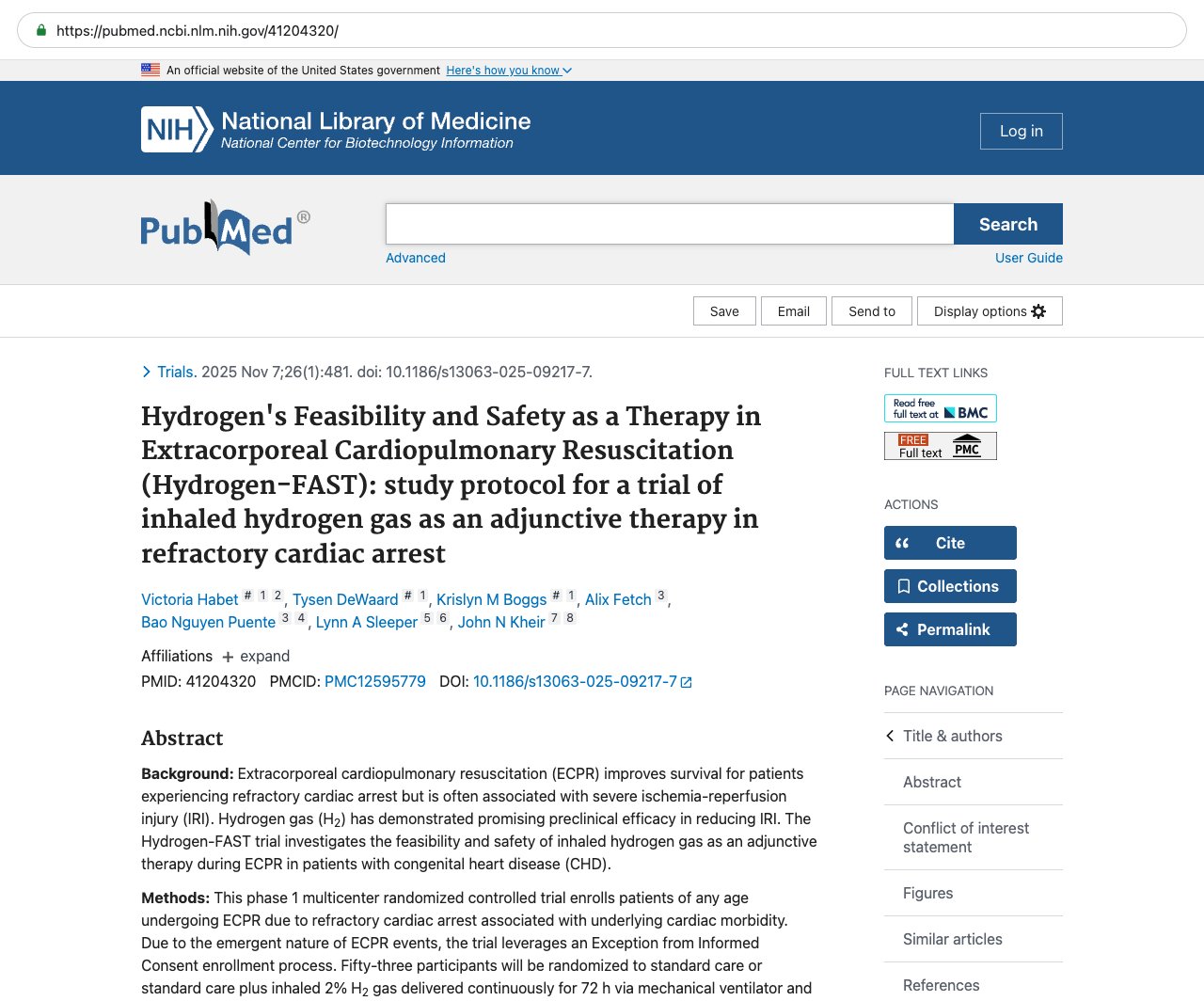
This page mirrors the published abstract (© the authors / publisher) for reference and citation. The canonical source is the PubMed record linked above. This is not medical advice.