2021 · Chen et al. — Chemical and Biochemical Aspects of Molecular Hydrogen in Treating Kawasaki Disease and COVID-19.
Super-Abstract
Kawasaki disease and COVID-19 both involve damaging vascular inflammation; this review explores the chemical and biochemical rationale for using inhaled molecular hydrogen (H₂) in both conditions. H₂ is presented as a stable antioxidant that targets oxidative damage, inflammation, and abnormal blood vessel inflammation. (Chemical Research in Toxicology, 2021.)
Commentary
This review takes an unusual angle: it connects the vasculitic mechanism of classic Kawasaki disease with the „multisystem inflammatory syndrome in children“ (MIS-C) triggered by COVID-19, noting the 6–10-fold increase in Kawasaki-like presentations during the pandemic. The authors then examine how H₂ inhalation might address the shared pathophysiology — oxidative stress, inflammation, cell apoptosis, and vascular inflammation. The text is primarily mechanistic/theoretical. Direct clinical trial data for H₂ in either Kawasaki disease or COVID-19 are not presented; the paper is a biochemical plausibility argument. The Chinese regulatory context is relevant: China's National Health Commission included H₂ inhalation in COVID-19 treatment guidelines.
Key quotes
- „Hydrogen gas is a stable and efficient antioxidant, which has a positive effect on oxidative damage, inflammation, cell apoptosis, and abnormal blood vessel inflammation.“ — the core biochemical rationale for H₂ use in both conditions
- „Kawasaki-like disease caused by COVID-19 shares some symptoms with KD, referred to as multisystem inflammatory syndrome in children.“ — the clinical link between KD and MIS-C that motivates this review
- „This review reports the chemical and biochemical aspects of hydrogen gas inhalation in treating KD and COVID-19.“ — the authors explicitly scope this as a mechanistic review, not a clinical trial
Our assessment
This is a mechanistic review — it presents a biochemical plausibility argument for H₂ in Kawasaki disease and COVID-19, not clinical trial evidence. The hypothesis is scientifically coherent given H₂'s known antioxidant and anti-inflammatory properties, but no controlled human trials in KD or COVID-19 are cited as completed evidence. The Chinese guideline inclusion is noteworthy but was based on limited data at the time. Readers should distinguish between mechanistic plausibility and proven clinical benefit.
Study design
- Type: narrative/mechanistic review · n: n/a (no original experiment) · H₂ delivery: inhalation (proposed/reviewed)
- Result: theoretical and biochemical basis established for H₂ in KD and COVID-19; direct clinical trial evidence in these two conditions was not available at time of publication
Abstract
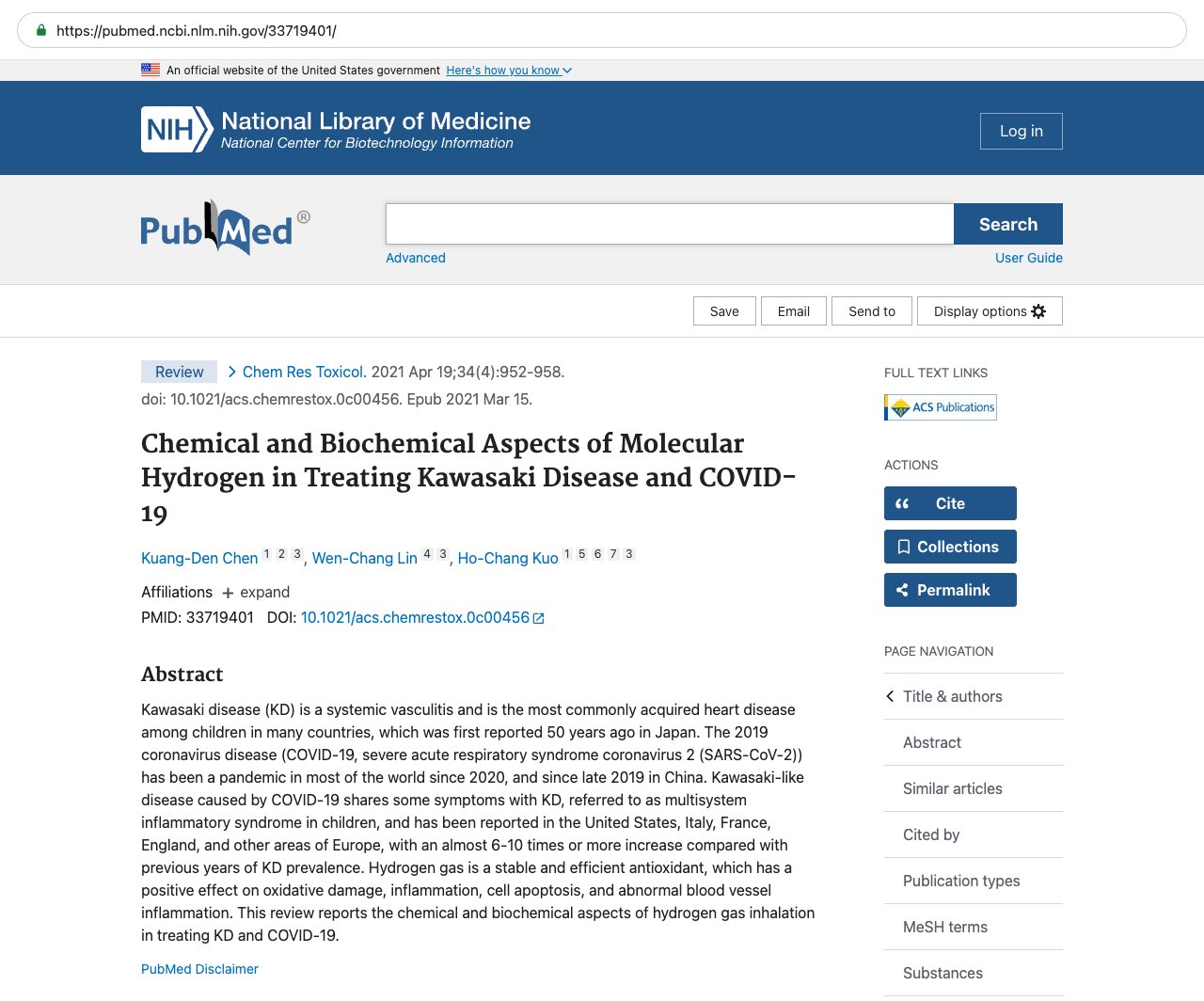
Kawasaki disease (KD) is a systemic vasculitis and is the most commonly acquired heart disease among children in many countries, which was first reported 50 years ago in Japan. The 2019 coronavirus disease (COVID-19, severe acute respiratory syndrome coronavirus 2 (SARS-CoV-2)) has been a pandemic in most of the world since 2020, and since late 2019 in China. Kawasaki-like disease caused by COVID-19 shares some symptoms with KD, referred to as multisystem inflammatory syndrome in children, and has been reported in the United States, Italy, France, England, and other areas of Europe, with an almost 6-10 times or more increase compared with previous years of KD prevalence. Hydrogen gas is a stable and efficient antioxidant, which has a positive effect on oxidative damage, inflammation, cell apoptosis, and abnormal blood vessel inflammation. This review reports the chemical and biochemical aspects of hydrogen gas inhalation in treating KD and COVID-19.
Source & links
Screenshot of the PubMed page
This page mirrors the published abstract (© the authors / publisher) for reference and citation. The canonical source is the PubMed record linked above. This is not medical advice.