2021 · Chen et al. — Neuroprotective Effects of Molecular Hydrogen: A Critical Review.
Super-Abstract
Molecular hydrogen (H₂) has demonstrated protective effects across a wide range of nervous system disorders in both preclinical and clinical studies — including ischaemia/reperfusion injury, Parkinson's disease, and cognitive dysfunction — acting through antioxidant, anti-inflammatory, anti-apoptotic, and mitochondria-preserving mechanisms. This critical review by Chen and colleagues provides one of the most comprehensive summaries of the neuroprotection evidence as of 2021. (Neuroscience Bulletin, 2021.)
Commentary
Chen et al. deliver a structured, comprehensive review of H₂ neuroprotection, covering an unusually broad range of CNS conditions: ischaemia/reperfusion, traumatic brain injury, subarachnoid haemorrhage, neuropathic pain, Parkinson's disease, Alzheimer's disease, surgery/anaesthesia-related cognitive decline, and even anxiety and depression. The paper reviews both pharmacokinetics of H₂ donors and administration routes, making it practically oriented as well as mechanistic. The authors include a frank safety assessment: H₂ has shown no major side effects in the conditions studied. The paper's critical framing is a strength — it does not uniformly praise H₂ but attempts to assess the quality and consistency of evidence across conditions.
Key quotes
- „H2 has protective effects against a variety of diseases, particularly nervous system disorders, which include ischemia/reperfusion injury, traumatic injury, subarachnoid hemorrhage, neuropathic pain, neurodegenerative diseases, cognitive dysfunction induced by surgery and anesthesia, anxiety, and depression.“ — the breadth of neurological conditions for which evidence is reviewed
- „H2 is easy to use and has neuroprotective effects with no major side-effects, indicating that H2 administration is a potential therapeutic strategy in clinical settings.“ — the authors' favourable safety profile assessment
- „H2 can be a simple and effective clinical therapy for CNS diseases such as ischemia-reperfusion brain injury, Parkinson's disease, and diseases characterized by cognitive dysfunction.“ — the authors' conclusion — optimistic but based on the combined preclinical and clinical record reviewed
Our assessment
This is one of the more thorough H₂ neuroprotection reviews. Its „critical“ framing is relatively honest, though the overall tone is favourable. Important context: while clinical data are referenced for some conditions (e.g. Parkinson's disease has small human trials), many cited studies are preclinical. The conclusion that H₂ is a „simple and effective clinical therapy“ should be qualified: the evidence strength varies considerably by condition. For ischaemia-reperfusion and Parkinson's disease the human evidence is stronger; for conditions like anxiety or traumatic brain injury it is more preliminary. The review is a valuable reference but should not be taken as a uniform endorsement of H₂ for all listed conditions.
Study design
- Type: comprehensive critical review (preclinical and clinical studies combined) · n: n/a (literature synthesis across many CNS conditions) · H₂ delivery: unspecified (various across cited studies)
- Result: neuroprotective evidence reviewed for multiple CNS conditions; safety profile favourable; evidence quality varies by condition; H₂ donors and pharmacokinetics also reviewed
Abstract
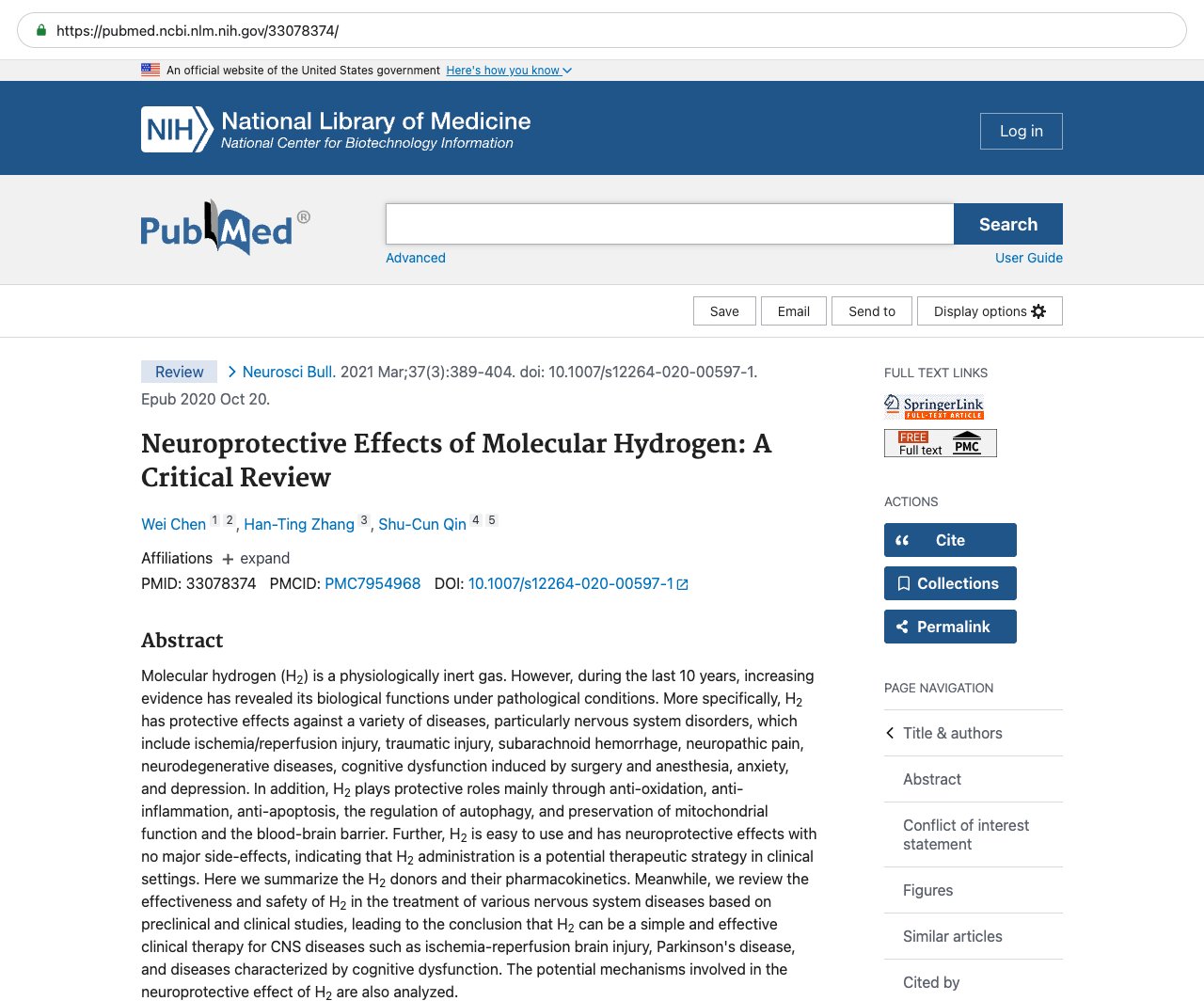
Molecular hydrogen (H2) is a physiologically inert gas. However, during the last 10 years, increasing evidence has revealed its biological functions under pathological conditions. More specifically, H2 has protective effects against a variety of diseases, particularly nervous system disorders, which include ischemia/reperfusion injury, traumatic injury, subarachnoid hemorrhage, neuropathic pain, neurodegenerative diseases, cognitive dysfunction induced by surgery and anesthesia, anxiety, and depression. In addition, H2 plays protective roles mainly through anti-oxidation, anti-inflammation, anti-apoptosis, the regulation of autophagy, and preservation of mitochondrial function and the blood-brain barrier. Further, H2 is easy to use and has neuroprotective effects with no major side-effects, indicating that H2 administration is a potential therapeutic strategy in clinical settings. Here we summarize the H2 donors and their pharmacokinetics. Meanwhile, we review the effectiveness and safety of H2 in the treatment of various nervous system diseases based on preclinical and clinical studies, leading to the conclusion that H2 can be a simple and effective clinical therapy for CNS diseases such as ischemia-reperfusion brain injury, Parkinson's disease, and diseases characterized by cognitive dysfunction. The potential mechanisms involved in the neuroprotective effect of H2 are also analyzed.
Source & links
Screenshot of the PubMed page
This page mirrors the published abstract (© the authors / publisher) for reference and citation. The canonical source is the PubMed record linked above. This is not medical advice.