2022 · Ahmad et al. — Narrative on Hydrogen Therapy and its Clinical Applications: Safety and Efficacy
Super-Abstract
This narrative review surveys the growing body of evidence on molecular hydrogen (H₂) as a therapeutic agent across cardiovascular, respiratory, neurological, metabolic, and infectious diseases — summarising both its proposed mechanisms and current safety data. The authors highlight H₂'s anti-inflammatory, antioxidative, and cytoprotective properties while acknowledging that evidence remains preliminary and that large-scale controlled trials are still needed. (Current Pharmaceutical Design, 2022.)
Commentary
Hydrogen therapy is a field that has expanded rapidly since the landmark 2007 Ohsawa study. This review by Ahmad and colleagues attempts a broad synthesis across multiple organ systems and disease categories. The mechanistic basis — selective neutralisation of hydroxyl radicals and peroxynitrite, NF-κB inhibition, Nrf2 pathway activation — is now reasonably well-established in preclinical work. The clinical evidence is more uneven: some areas (e.g., ischaemia-reperfusion injury, metabolic syndrome) have more human data than others. The authors also discuss nanotechnology-based H₂ delivery systems, which represent an emerging frontier. The honest framing from the paper itself — calling for „higher-scale trials targeting personalized treatments” — accurately captures where the field stands.
Key quotes
- „Hydrogen Therapy (HT) has gained scientists' attention with the proven clinical ability to attenuate chronic inflammation, diminish oxidative stress, restrict apoptosis, minimize cellular injury, and refine tissue functioning.“ — the claimed mechanistic profile of H₂ therapy — primarily supported by preclinical and some early clinical data
- „Therapeutic Implementation of H2 for disease prevention and treatment is a newly emerging field with limited knowledge available on formulations, tissue-specific effects, efficacy, and safety.“ — the authors themselves acknowledge the field's immaturity
- „There is a need to study and conduct higher-scale trials targeting personalized treatments under molecular and genetic vitals.“ — the honest conclusion: much more rigorous clinical research is required
Our assessment
This is a narrative review — it synthesises existing literature but does not add new clinical data. The scope is broad (cardiovascular, respiratory, neurological, metabolic, hematological, infectious diseases), which is both a strength (comprehensive overview) and a limitation (depth in any single area is limited). The authors are honest about the field's preliminary state. Limitations to note: narrative reviews are subject to selection bias; the paper does not perform a systematic search or meta-analysis. The optimism should be tempered by the fact that most supporting evidence remains preclinical. This is a useful orientation piece, not clinical proof of efficacy across the diseases listed.
Study design
- Type: narrative review · n: n/a (literature synthesis) · H₂ delivery: multiple modalities discussed (inhalation, HRW, injection, nanotechnology) across reviewed studies
- Result: no pooled effect sizes; narrative synthesis of mechanistic and clinical evidence across multiple disease areas; authors call for larger personalised trials; nanotechnology-based delivery identified as emerging direction
Abstract
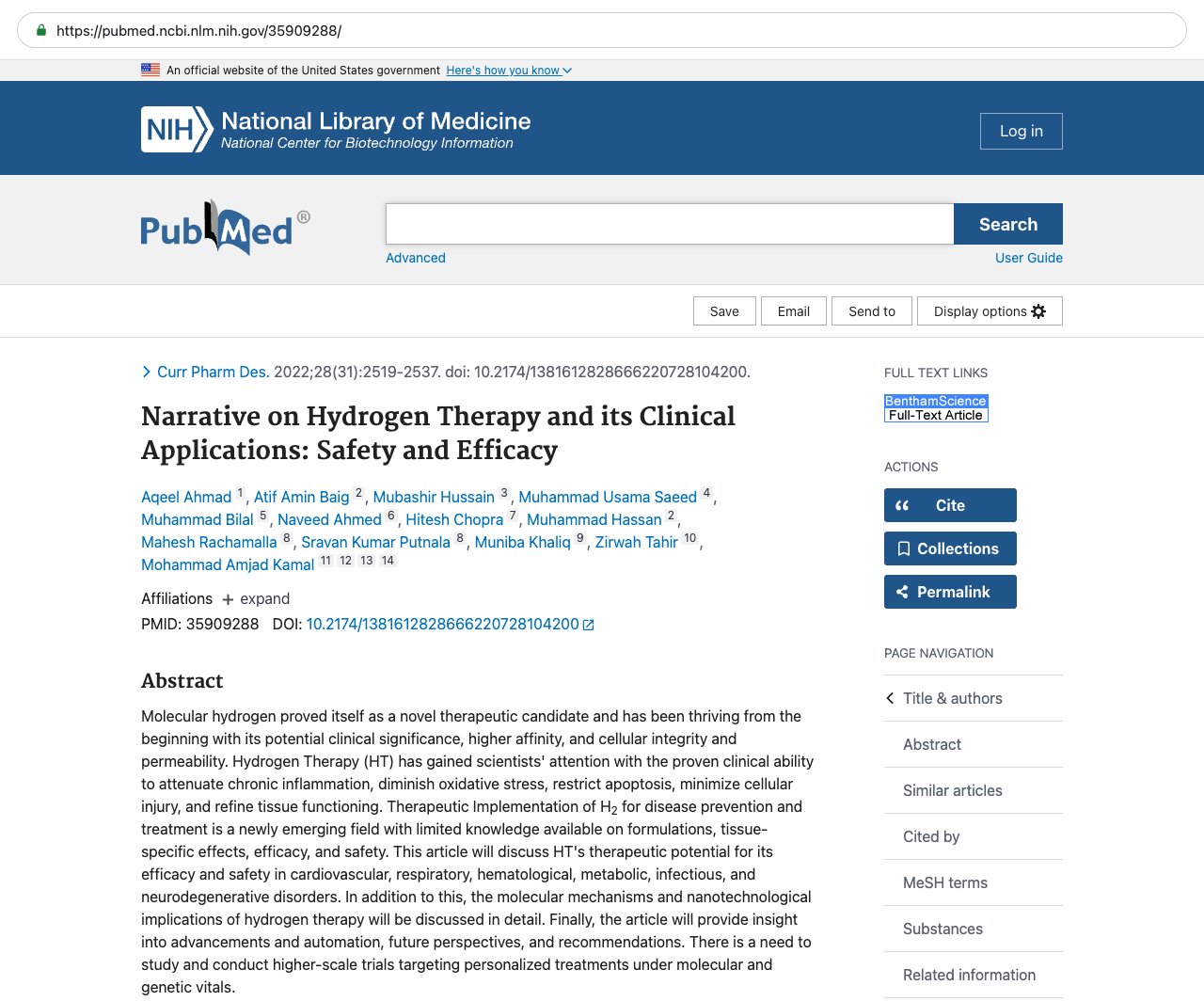
Molecular hydrogen proved itself as a novel therapeutic candidate and has been thriving from the beginning with its potential clinical significance, higher affinity, and cellular integrity and permeability. Hydrogen Therapy (HT) has gained scientists' attention with the proven clinical ability to attenuate chronic inflammation, diminish oxidative stress, restrict apoptosis, minimize cellular injury, and refine tissue functioning. Therapeutic Implementation of H2 for disease prevention and treatment is a newly emerging field with limited knowledge available on formulations, tissue-specific effects, efficacy, and safety. This article will discuss HT's therapeutic potential for its efficacy and safety in cardiovascular, respiratory, hematological, metabolic, infectious, and neurodegenerative disorders. In addition to this, the molecular mechanisms and nanotechnological implications of hydrogen therapy will be discussed in detail. Finally, the article will provide insight into advancements and automation, future perspectives, and recommendations. There is a need to study and conduct higher-scale trials targeting personalized treatments under molecular and genetic vitals.
Source & links
Screenshot of the PubMed page
This page mirrors the published abstract (© the authors / publisher) for reference and citation. The canonical source is the PubMed record linked above. This is not medical advice.