2024 · Chen et al. — Endogenous Melanin and Hydrogen-Based Specific Activated Theranostics Nanoagents: A Novel Multi-Treatment Paradigm for Rheumatoid Arthritis
Super-Abstract
Researchers developed nanoparticles (MAHI NGs) that release molecular hydrogen, melanin nanoparticles, and a clinical fluorescent dye directly into inflamed joints — guided by the specific chemical environment of rheumatoid arthritis (RA). In cell-culture and animal experiments, the combination of hydrogen's antioxidant/anti-inflammatory effect and photothermal melanin ablation of inflamed fibroblasts achieved strong synergistic suppression of RA-related inflammation. This is a purely preclinical in-vitro/in-vivo study; no human data exist yet.
Commentary
This study sits at the intersection of nanotechnology, photomedicine, and hydrogen research. The authors engineer a smart nanocarrier that exploits two hallmarks of the RA joint microenvironment — local hypoxia and mild acidity — as the release trigger. The hydrogen component plays a targeted synergistic role: photothermal therapy (PTT) with melanin nanoparticles destroys rheumatoid synovial fibroblasts, but heat also drives reactive oxygen species (ROS) production. The controlled H₂ release under acidic conditions precisely scavenges this PTT-induced oxidative burst, reducing collateral inflammation. Near-infrared imaging with ICG (already clinically approved) adds diagnostic guidance. The conceptual elegance is real — but the work is entirely cell-culture and mouse-model based. The jump to human joints involves formidable hurdles: nanoparticle biodistribution, immune clearance, scale-up, and regulatory approval for novel nanoagents. The study is an important proof-of-concept, not a therapy.
Key quotes
- „the controlled release of H2 exhibits precise synergistic antioxidant and anti-inflammatory effects with MNPs.“ — the core finding: H₂ counteracts PTT-induced oxidative stress in the RA joint
- „the MAHI NGs passively accumulate in the diseased joint region and undergo rapid responsive degradation, precisely releasing functionalized components.“ — the trigger mechanism: hypoxia + acidity drive targeted payload release
- „Due to optimal size, the MAHI NGs passively accumulate in the diseased joint region.“ — size-dependent passive joint targeting — EPR-like accumulation in inflamed tissue
Our assessment
An innovative preclinical concept combining nanotechnology, photothermal therapy, and molecular hydrogen — demonstrated in cell culture and mouse models. The synergistic H₂ + melanin approach is mechanistically compelling. Honest limitation: this is an in-vitro/animal study with no human data. Nanoagent translation to clinical RA therapy is complex and long-term. No therapeutic claims for humans can be derived from this work at this stage.
Study design
- Type: preclinical in-vitro + animal study (mice) · Model: rheumatoid arthritis synovial fibroblasts (RASFs) + mouse RA model · H₂ delivery: acid-triggered release from MAHI nanoparticle gels
- Intervention: MAHI NGs combining melanin nanoparticles, H₂ gas, and ICG dye — released in hypoxic/acidic RA microenvironment with photothermal activation
- Result: synergistic suppression of RASFs via PTT; H₂ attenuated PTT-induced ROS/inflammatory rebound; NIR-II fluorescence + photoacoustic dual imaging demonstrated — all in preclinical models only
Abstract
Rheumatoid arthritis (RA) is a systemic autoimmune disorder characterized by excessive proliferation of rheumatoid arthritis synovial fibroblasts (RASFs) and accumulation of inflammatory cytokines. Exploring the suppression of RASFs and modulation of the RA microenvironment is considered a comprehensive strategy for RA. In this work, specifically activated nanoagents (MAHI NGs) based on the hypoxic and weakly acidic RA microenvironment are developed to achieve a second near-infrared fluorescence (NIR-II FL)/photoacoustic (PA) dual-model imaging-guided multi-treatment. Due to optimal size, the MAHI NGs passively accumulate in the diseased joint region and undergo rapid responsive degradation, precisely releasing functionalized components: endogenous melanin-nanoparticles (MNPs), hydrogen gas (H2), and indocyanine green (ICG). The released MNPs play a crucial role in ablating RASFs within the RA microenvironment through photothermal therapy (PTT) guided by accurate PA imaging. However, the regional hyperthermia generated by PTT may exacerbate reactive oxygen species (ROS) production and inflammatory response following cell lysis. Remarkably, under the acidic microenvironment, the controlled release of H2 exhibits precise synergistic antioxidant and anti-inflammatory effects with MNPs. Moreover, the ICG, the second near-infrared dye currently approved for clinical use, possesses excellent NIR-II FL imaging properties that facilitate the diagnosis of deep tissue diseases and provide the right time-point for PTT.
Source & links
Screenshot of the PubMed page
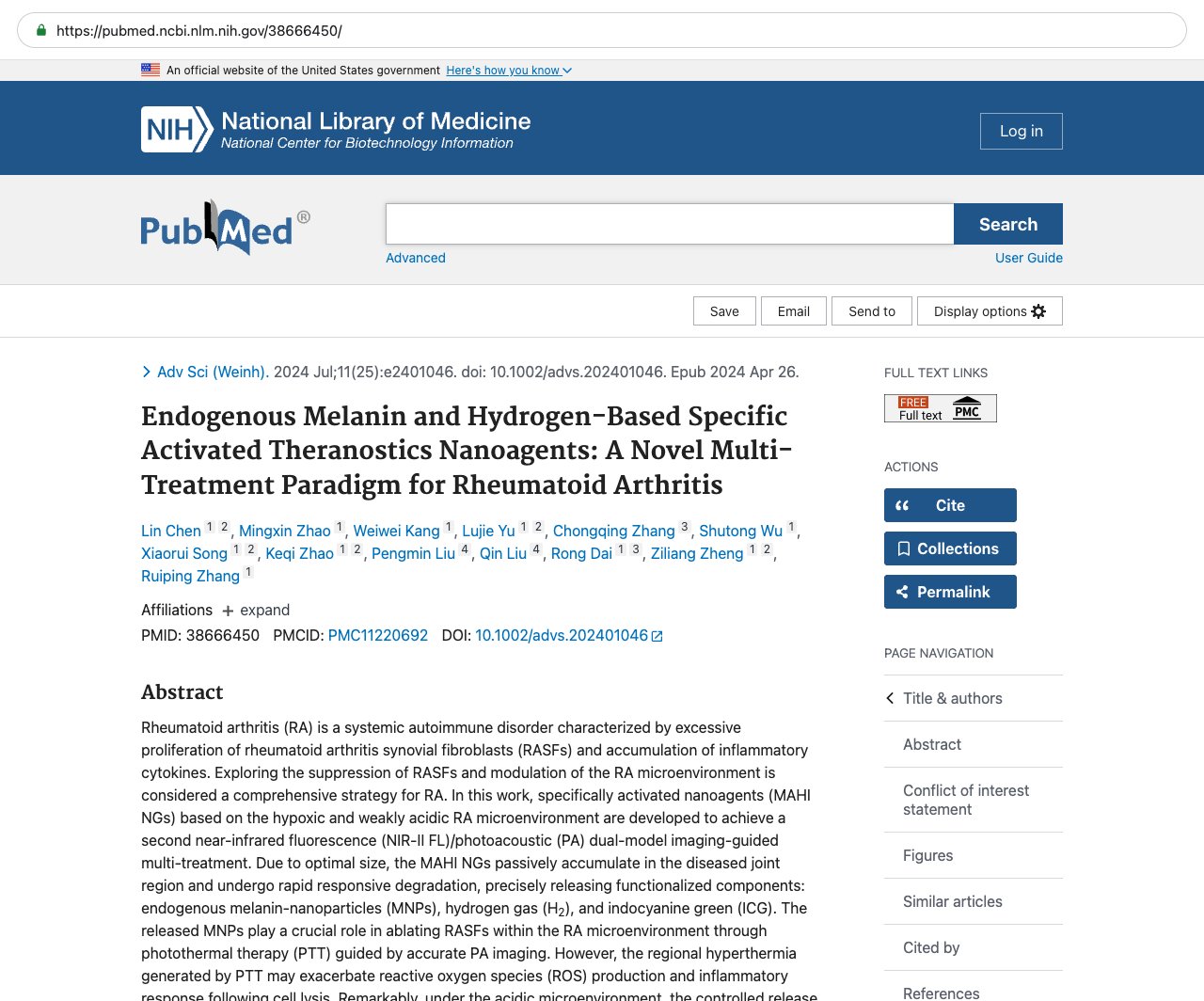
This page mirrors the published abstract (© the authors / publisher) for reference and citation. The canonical source is the PubMed record linked above. This is not medical advice.