2025 · Lu — Pyroptosis-responsive microspheres modulate the inflammatory microenvironment to retard osteoporosis in female mice.
Super-Abstract
Bone loss in osteoporosis is partly driven by a destructive inflammation mechanism called pyroptosis — and a newly designed implantable microsphere scaffold that releases hydrogen gas, magnesium ions, and an anti-inflammatory drug simultaneously can interrupt this process. In female mice, the scaffold reversed inflammatory bone microenvironments and significantly promoted bone tissue repair. This is a preclinical animal study; no human data are available. (Nature Communications, 2025.)
Commentary
This study sits at the intersection of biomaterial engineering, hydrogen medicine, and bone biology. The innovation is a composite microsphere scaffold (GelMa/Mg/DMF) implanted directly into a bone defect, simultaneously providing three therapeutic inputs: H₂ (via magnesium-water reaction), magnesium ions Mg²⁺ (known to support bone repair), and dimethyl fumarate DMF (activates Nrf2 to block osteoblast pyroptosis). The study provides evidence that pyroptosis — a form of inflammatory cell death — plays a key role in disrupting bone homeostasis in osteoporosis, which is a mechanistically important finding. The data are from murine in-vivo and in-vitro models. While publication in Nature Communications reflects peer-reviewed quality, the biological complexity of human osteoporosis — including its hormonal, metabolic, and age-related drivers — is not captured by this model. The local delivery approach also limits applicability to focal bone defects rather than systemic osteoporosis.
Key quotes
- „This study identifies pyroptosis-driven inflammation as a key disruptor of bone homeostasis.“ — the central mechanistic claim — pyroptosis as a novel osteoporosis driver
- „DMF act by activating the nuclear factor erythroid-related factor 2 to prevent osteoblast pyroptosis, and combine with the antioxidant effects of hydrogen, effectively remodel the inflammatory microenvironment.“ — how the three components work together to block the inflammation cascade
- „These results suggest the combination of hydrogen therapy and pyroptosis blockade as a potential therapeutic strategy.“ — cautious conclusion — a potential strategy, not yet a proven treatment
Our assessment
A methodologically interesting preclinical study that links pyroptosis to osteoporosis pathology and proposes H₂-containing composite implants as a local intervention. The multi-agent scaffold design is creative and the mechanistic rationale is well-supported. Decisive limitation: this is an animal study only — findings cannot be directly transferred to humans. Human osteoporosis is a systemic, multifactorial disease that a locally implanted scaffold cannot address in a generalised way. The DMF component (a known pharmaceutical) also raises questions about systemic exposure when implanted. Clinical translation requires substantial additional safety and efficacy work. Promising proof-of-concept for local bone-defect repair, not yet relevant for common osteoporosis management.
Study design
- Type: animal study (preclinical) + in-vitro · Model: female osteoporotic mice (bone defect model) · H₂ delivery: magnesium embedded in GelMa/Mg/DMF microsphere scaffold — H₂ released via Mg-water reaction in situ
- Co-agents: Mg²⁺ (bone repair) + dimethyl fumarate DMF (Nrf2 activation, pyroptosis blockade)
- Result: reversal of inflammatory bone microenvironment in vivo and in vitro; significant bone tissue repair vs. controls; inhibition of osteoblast pyroptosis confirmed
Abstract
The treatment of osteoporosis and related bone defects remains challenging. This study identifies pyroptosis-driven inflammation as a key disruptor of bone homeostasis. To address this, we develop a magnesium-gelatin composite microsphere scaffold (GelMa/Mg/DMF MS) that exploit pyroptosis blockade and hydrogen-mediated inflammation regulation for osteoporosis treatment. This porous microsphere scaffold is implanted into bone defects to achieve the sustained release of hydrogen gas, magnesium ions (Mg2+), and dimethyl fumarate (DMF). DMF act by activating the nuclear factor erythroid-related factor 2 to prevent osteoblast pyroptosis, and combine with the antioxidant effects of hydrogen, effectively remodel the inflammatory microenvironment and create favorable conditions for the restoration of bone homeostasis. Mg2+ further expedite bone tissue repair. These results demonstrate that the GelMa/Mg/DMF MS effectively reverse inflammatory microenvironments both in vivo and in vitro, resulting in significant tissue repair. These results suggest the combination of hydrogen therapy and pyroptosis blockade as a potential therapeutic strategy.
Source & links
Screenshot of the PubMed page
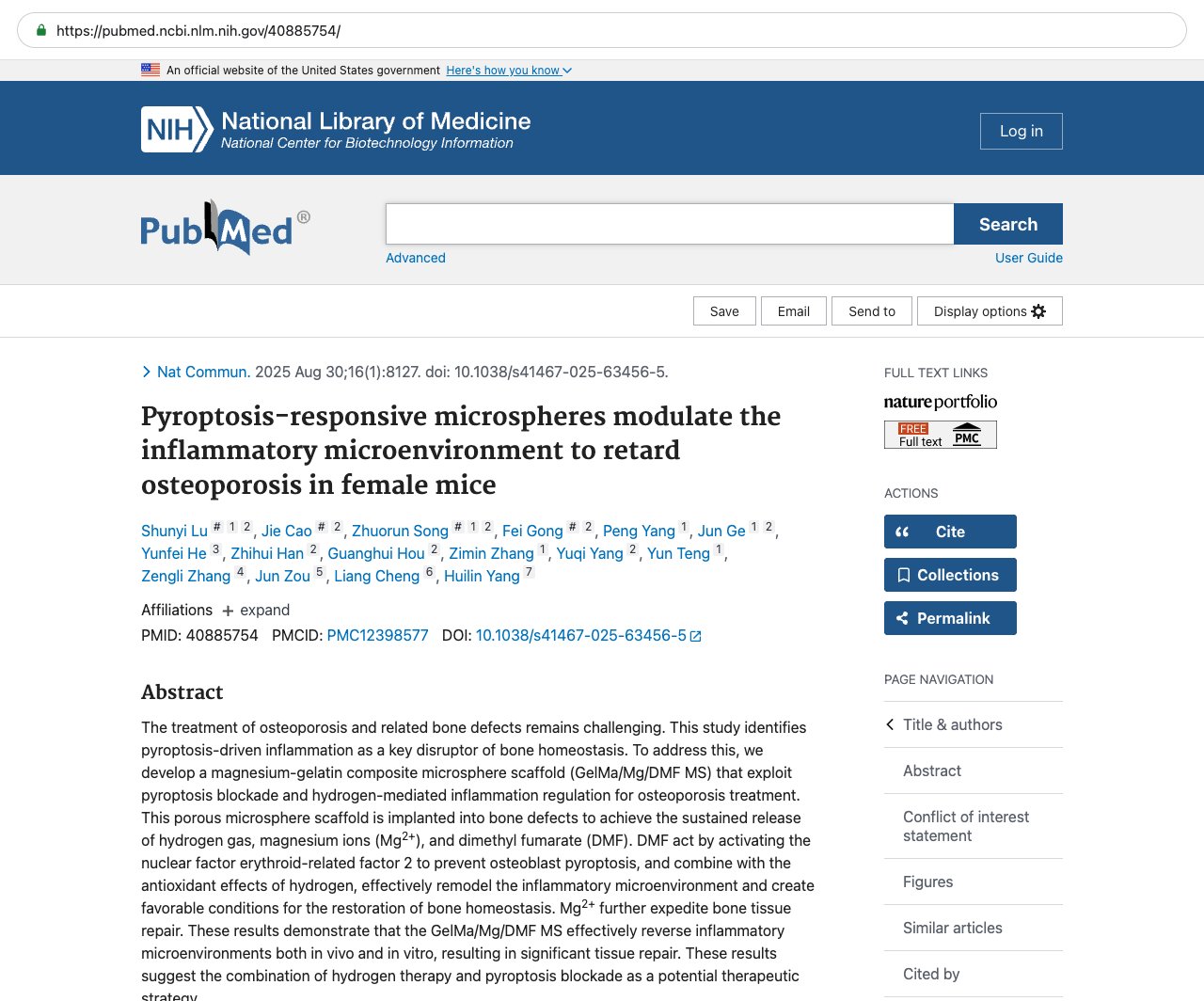
This page mirrors the published abstract (© the authors / publisher) for reference and citation. The canonical source is the PubMed record linked above. This is not medical advice.