2015 Molecular medicine reports Pilot / Observational Human H₂ therapy InhalationSaline / IVDrinking (HRW)
2015 · Ishibashi et al. — Improvement of psoriasis-associated arthritis and skin lesions by treatment with molecular hydrogen: A report of three cases.
Super-Abstract
In three patients with psoriasis-associated arthritis and skin lesions, H₂ treatment (via saline infusion, inhalation, and/or high-concentration drinking water) reduced DAS28 and PASI scores, caused near-complete clearing of skin lesions, and lowered inflammatory cytokines (IL-6, IL-17, TNFα) in at least one patient. This is a case report series, not a controlled trial. (Molecular Medicine Reports, 2015.)
Commentary
Psoriasis is a complex chronic inflammatory skin disease driven by a cytokine cascade involving TNFα, IL-6, and IL-17 — all targets of modern biologics. Reactive oxygen species (ROS) play a role in sustaining the inflammatory loop, making H₂ as a selective ROS scavenger a mechanistically plausible candidate. Three patients received H₂ via different routes (IV saline, inhalation, high-concentration H₂ water), and all three showed clinically meaningful improvement in both skin and joint involvement, regardless of the delivery method. IL-6 and IL-17 also decreased. However, three cases with no control, no washout from prior treatments, and no standardized dosing protocol cannot establish causality. The heterogeneity of delivery methods (1 ppm saline, 3% inhalation, 5–7 ppm water) also makes mechanistic conclusions difficult. This paper is best seen as a hypothesis-generating case series supporting a future RCT.
Key quotes
- „The DAS28 and PASI score of the three patients decreased during H2 treatment, regardless of the administration method.“ — consistent clinical improvement across all three patients and all delivery routes
- „The psoriatic skin lesions almost disappeared at the end of the treatment.“ — dramatic visual outcome: near-complete skin clearing reported
- „H2 administration reduced inflammation associated with psoriasis in the three cases examined and it may therefore be considered as a treatment strategy for psoriasis-associated skin lesions and arthritis.“ — cautious authors' conclusion: strategy candidate, not proven therapy
Our assessment
An intriguing case report series in an indication where H₂ has good mechanistic grounding (ROS in psoriasis cytokine cascade). The consistent improvement across three heterogeneous patients and delivery routes is noteworthy. Important limitations: n=3; no control; prior medications and their discontinuation not fully detailed; the dramatic skin clearing could involve regression to mean or prior treatment carryover effects; the different H₂ doses and routes make comparison impossible. A controlled trial in psoriasis with standardized H₂ delivery would be highly worthwhile.
Study design
- Type: Case report series (n=3) · H₂ delivery: Case 1: IV H₂-saline (1 ppm) + inhalation (3%) + H₂ water (5–7 ppm); Cases 2 & 3: subsets of these routes · Outcome measures: DAS28, PASI score, cytokines (TNFα, IL-6, IL-17)
- Population: Three patients with psoriasis-associated arthritis and skin lesions
- Result: DAS28 and PASI decreased in all 3 cases; near-complete skin clearing; IL-6 reduced in cases 1 & 2; IL-17 reduced in case 1; TNFα reduced in case 1; all improvements independent of delivery route
Abstract
Psoriasis, a chronic inflammatory skin disease, is caused by infiltrating lymphocytes and associated cytokines, including tumor necrosis factor (TNF)α, interleukin (IL)-6, and IL-17. Effective treatments, including pathogenesis-based biological agents against psoriasis, are currently under development. Although the role of reactive oxygen species (ROS) in the pathogenesis of psoriasis has been investigated, it remains to be fully elucidated; ROS-targeted therapeutic strategies are also lacking at present. Therefore, the objective of the present study was to assess whether H2, a ROS scavenger, has a therapeutic effect on psoriasis-associated inflammation by reducing hydroxyl radicals or peroxynitrite in the immunogenic psoriasis cascade. Three methods were used to administer H2: Drop infusion of saline containing 1 ppm H2 (H2-saline), inhalation of 3% H2 gas, and drinking of water containing a high concentration (5-7-ppm) of H2 (high-H2 water). Treatment efficacy was estimated using the disease activity score 28 (DAS28) system, based on C-reactive protein levels, and the psoriasis area and severity index (PASI) score, determined at baseline and following each H2 treatment. Furthermore, levels of TNFα, IL-6, and IL-17 were analyzed. The DAS28 and PASI score of the three patients decreased during H2 treatment, regardless of the administration method. The psoriatic skin lesions almost disappeared at the end of the treatment. IL-6 levels decreased during H2 treatment in Case 1 and 2. IL-17, whose concentration was high in Case 1, was reduced following H2 treatment, and TNFα also decreased in Case 1. In conclusion, H2 administration reduced inflammation associated with psoriasis in the three cases examined and it may therefore be considered as a treatment strategy for psoriasis-associated skin lesions and arthritis.
Source & links
Screenshot of the PubMed page
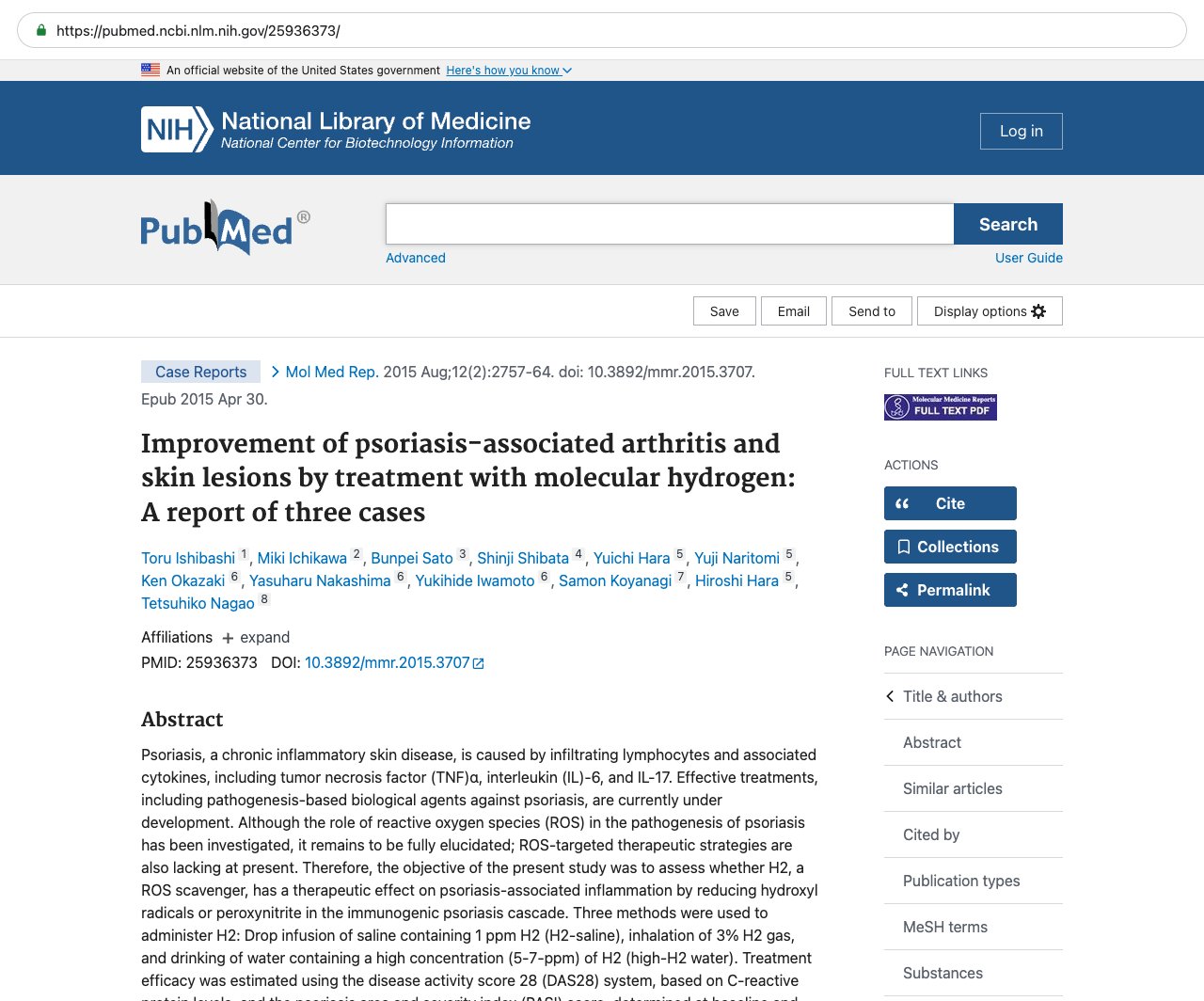
This page mirrors the published abstract (© the authors / publisher) for reference and citation. The canonical source is the PubMed record linked above. This is not medical advice.