2026 · Chen et al. — A Randomized Controlled Double-Blind Study on the Brain Protection of Infantile Patients With Epileptic Spasm Syndrome Through Atomized Inhalation of Hydrogen-Oxygen Gas
Super-Abstract
In 53 children with infantile epileptic spasms syndrome, adding nebulised hydrogen-oxygen gas to standard treatment for 14 days showed no statistically significant difference in spasm relief rate or effective rate compared with medical air (p = 0.705 and p = 0.950). Secondary efficacy endpoints, including disappearance of hypsarrhythmia on the EEG, Kramer and BASED scores and abnormal IL-6, also showed no statistically significant difference. No serious adverse events occurred in either group, but raised myocardial enzymes (28.3% compared with 10.9%), gastrointestinal dysfunction (43.5% compared with 23.9%) and abnormal liver function (8.7% compared with 0%) were significantly more frequent with hydrogen-oxygen (all p < 0.05). (Frontiers in Neurology, 2026.)
Commentary
The authors start from the premise that nebulised hydrogen-oxygen gas protects the brain, and they tested it as an add-on treatment for infantile epileptic spasms syndrome (IESS). In this prospective, randomised, double-blind controlled trial, 53 children with IESS were enrolled between November 2021 and November 2023 and allocated by random number table. The hydrogen-oxygen group (27 children) inhaled a nebulised mixture of 66.6% H₂ and 33.3% O₂. The air group (26 children) inhaled nebulised medical air. Both groups received standard treatment plus four 1-hour sessions a day for 14 consecutive days. The primary endpoints were the spasm relief rate and the effective rate. Secondary endpoints were improvement of the high-amplitude abnormal EEG, IL-6 levels, the respiratory tract infection rate and adverse reactions. The results also report the disappearance of hypsarrhythmia and changes in Kramer and BASED scores. The abstract does not describe the standard treatment, the number of centres or the length of follow-up.
Key quotes
- „The primary efficacy endpoints (spasm relief rate p = 0.705, effective rate p = 0.950) and secondary efficacy endpoints (disappearance rate of electroencephalogram hypsarrhythmia p = 0.576, change in Kramer score p = 0.140, change in BASED score p = 0.168, abnormal IL-6 rate p = 0.081) of the two groups of children were compared. There was no statistically significant difference.“ — primary and secondary efficacy endpoints: no statistically significant difference between groups
- „However, the incidences of elevated myocardial enzymes (28.3% vs. 10.9%), gastrointestinal dysfunction (43.5% vs. 23.9%), and abnormal liver function (8.7% vs. 0%) in the hydrogen-oxygen inhalation group were significantly higher than those in the air inhalation group (all p < 0.05).“ — a safety signal: three abnormalities were more frequent with hydrogen-oxygen than with air
- „Short-term hydrogen-oxygen nebulization inhalation failed to significantly improve the clinical efficacy of standard treatment for children with IESS. Although it is generally safe and feasible, its potential effects on myocardial, liver and gastrointestinal functions of children need to be closely monitored.“ — the authors' conclusion, which pairs the null result with a call for monitoring
Our assessment
This is a randomised, double-blind trial with a medical air comparator. Both primary endpoints and all reported secondary efficacy endpoints showed no statistically significant difference. The authors call the treatment generally safe and feasible. Yet raised myocardial enzymes, gastrointestinal dysfunction and abnormal liver function were significantly more frequent in the hydrogen-oxygen group, and the authors ask for close monitoring of these functions in children. Limitations: 53 children is a small sample, and the abstract does not say whether the trial was powered to detect a difference. Treatment lasted 14 days, and the abstract does not state the length of follow-up. The standard treatment is not described. The adverse-event percentages are given without the number of children analysed per group. Many endpoints were compared, and the number of centres is not stated. The authors call for larger, longer multicentre studies.
Study design
- Type: prospective, randomised, double-blind controlled trial (November 2021 to November 2023), allocation by random number table · n: 53 children (27 hydrogen-oxygen, 26 air) · H₂ delivery: nebulised 66.6% H₂ / 33.3% O₂, four 1-hour sessions a day for 14 days, added to standard treatment
- Comparator: nebulised medical air on the same schedule, also added to standard treatment
- Result: primary endpoints not significant: spasm relief rate p = 0.705, effective rate p = 0.950. Secondary efficacy endpoints also not significant: hypsarrhythmia disappearance p = 0.576, Kramer score p = 0.140, BASED score p = 0.168, abnormal IL-6 p = 0.081. No serious adverse events. Raised myocardial enzymes 28.3% vs. 10.9%, gastrointestinal dysfunction 43.5% vs. 23.9%, abnormal liver function 8.7% vs. 0% (all p < 0.05)
Abstract
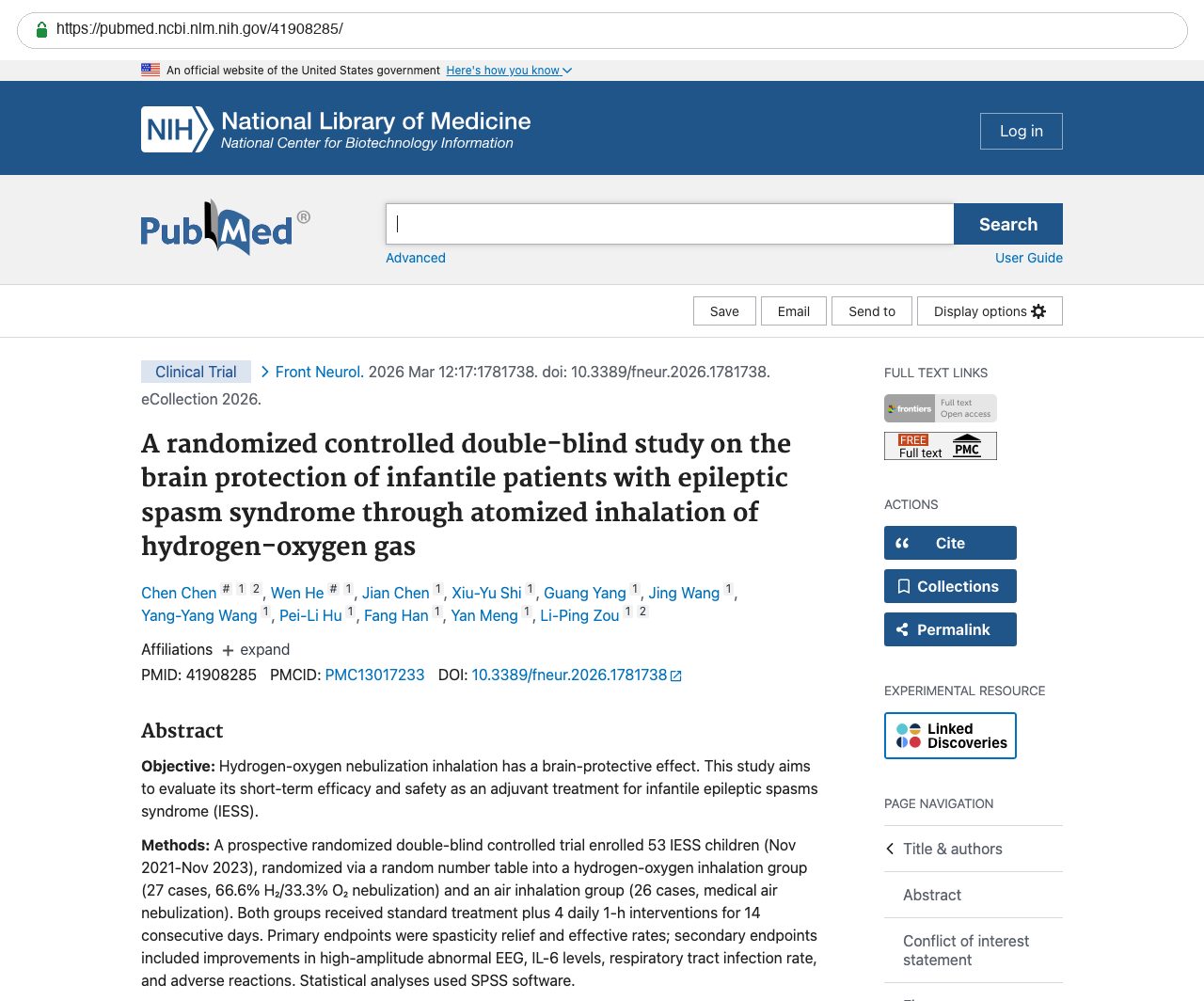
OBJECTIVE: Hydrogen-oxygen nebulization inhalation has a brain-protective effect. This study aims to evaluate its short-term efficacy and safety as an adjuvant treatment for infantile epileptic spasms syndrome (IESS). METHODS: A prospective randomized double-blind controlled trial enrolled 53 IESS children (Nov 2021-Nov 2023), randomized via a random number table into a hydrogen-oxygen inhalation group (27 cases, 66.6% H₂/33.3% O₂ nebulization) and an air inhalation group (26 cases, medical air nebulization). Both groups received standard treatment plus 4 daily 1-h interventions for 14 consecutive days. Primary endpoints were spasticity relief and effective rates; secondary endpoints included improvements in high-amplitude abnormal EEG, IL-6 levels, respiratory tract infection rate, and adverse reactions. Statistical analyses used SPSS software. RESULTS: The primary efficacy endpoints (spasm relief rate p = 0.705, effective rate p = 0.950) and secondary efficacy endpoints (disappearance rate of electroencephalogram hypsarrhythmia p = 0.576, change in Kramer score p = 0.140, change in BASED score p = 0.168, abnormal IL-6 rate p = 0.081) of the two groups of children were compared. There was no statistically significant difference. The overall incidence of adverse reactions in the two groups was comparable, and no serious adverse events occurred in either group. However, the incidences of elevated myocardial enzymes (28.3% vs. 10.9%), gastrointestinal dysfunction (43.5% vs. 23.9%), and abnormal liver function (8.7% vs. 0%) in the hydrogen-oxygen inhalation group were significantly higher than those in the air inhalation group (all p < 0.05). CONCLUSION: Short-term hydrogen-oxygen nebulization inhalation failed to significantly improve the clinical efficacy of standard treatment for children with IESS. Although it is generally safe and feasible, its potential effects on myocardial, liver and gastrointestinal functions of children need to be closely monitored. In the future, large-sample, long-term follow-up multi-center studies need to be carried out to comprehensively evaluate its clinical value. CLINICAL TRIAL REGISTRATION: http://www.chictr.org.cn/bin/home, identifier (ChiCTR2100047479).
Source & links
Screenshot of the PubMed page
This page mirrors the published abstract (© the authors / publisher) for reference and citation. The canonical source is the PubMed record linked above. This is not medical advice.