2017 · Tamura — Efficacy of Inhaled Hydrogen on Neurological Outcome Following Brain Ischemia During Post-Cardiac Arrest Care (HYBRID II Trial): Study Protocol for a Randomized Controlled Trial
Super-Abstract
This is the published protocol for the HYBRID II trial — a multicenter, randomized, double-blind, placebo-controlled trial designed to enroll 360 comatose cardiac arrest survivors and evaluate whether 18 hours of 2% hydrogen inhalation improves 90-day neurological outcome. The trial represents the highest-quality evidence infrastructure for H₂ in post-cardiac arrest care. (Trials, 2017.)
Commentary
Brain injury following cardiac arrest is the primary cause of death and long-term disability in survivors. Hydrogen gas inhalation (HI) showed strong neuroprotective effects in animal models of post-cardiac arrest syndrome (PCAS), and a small pilot study confirmed its safety in humans. The HYBRID II protocol represents the logical next step: a properly powered multicenter RCT. The design is rigorous: 360 adult comatose patients (Glasgow Coma Scale < 8) after out-of-hospital cardiac arrest of presumed cardiac cause, randomized 1:1 to either 2% H₂ + 24–50% oxygen or 24–50% oxygen alone for 18 hours, alongside full standard post-arrest care including targeted temperature management (TTM). The primary outcome is the 90-day neurological result on the Cerebral Performance Categories (CPC) scale. The study is powered to detect a 15% absolute improvement in good neurological outcomes (from 50% to 65%) with 80% power. Note: this publication is the trial protocol, not results — as of the data available here, outcome results are not yet included.
Key quotes
- „The patients will be randomized (1:1) to either the HI or control group. Patients in the HI group will inhale 2% hydrogen with 24% to 50% oxygen, and those in the control group will inhale 24% to 50% oxygen for 18 h after admission via mechanical ventilation.“ — the trial's intervention: precisely defined H₂ dose and delivery, distinguishing this from vague earlier protocols
- „This study will provide 80% power to detect a 15% change in the proportion of patients with good neurological outcomes (CPCs of 1 and 2), from 50% to 65%, with an overall significance level of 0.05.“ — the power calculation: a meaningful and clinically realistic effect size target
- „Our study has the potential to address HI as an appealing and innovative therapeutic strategy for PCAS in combination with TTM.“ — the clinical positioning: H₂ as a complement to standard targeted temperature management
Our assessment
This publication is a study protocol, not results — its value lies in confirming that a properly powered, well-designed RCT for H₂ in cardiac arrest was initiated. The protocol design is exemplary: multicenter, randomized, double-blinded, pre-registered, adequately powered, clinically meaningful primary outcome. Limitations of the protocol paper: no efficacy data is available from this publication; the feasibility of blinding H₂ vs. oxygen inhalation in an intensive care setting is challenging (though feasible with identical-appearing gas mixtures); 18 hours of H₂ inhalation during mechanical ventilation is logistically complex and limits applicability to well-equipped centers. The actual trial results from HYBRID II should be sought in subsequent publications for a complete picture of H₂ in post-cardiac arrest neuroprotection.
Study design
- Type: published RCT protocol (not results) · Target n: 360 comatose out-of-hospital cardiac arrest survivors · H₂ delivery: 2% hydrogen inhalation via mechanical ventilation for 18 hours
- Primary outcome: 90-day neurological outcome (Cerebral Performance Categories 1–2 = good) · Registration: UMIN 000019820
- Design features: multicenter, randomized 1:1, double-blind, placebo-controlled; combined with targeted temperature management (TTM 33–36°C); 80% power to detect 15% absolute improvement in good neurological outcome
Abstract
BACKGROUND: Hydrogen gas inhalation (HI) improved survival and neurological outcomes in an animal model of post-cardiac arrest syndrome (PCAS). The feasibility and safety of HI for patients with PCAS was confirmed in a pilot study. The objective of this study is to evaluate the efficacy of HI for patients with PCAS. METHODS/DESIGN: The efficacy of inhaled HYdrogen on neurological outcome following BRain Ischemia During post-cardiac arrest care (HYBRID II) trial is an investigator-initiated, randomized, double-blind, placebo-controlled trial designed to enroll 360 adult comatose (Glasgow Coma Scale score < 8) patients who will be resuscitated following an out-of-hospital cardiac arrest of a presumed cardiac cause. The patients will be randomized (1:1) to either the HI or control group. Patients in the HI group will inhale 2% hydrogen with 24% to 50% oxygen, and those in the control group will inhale 24% to 50% oxygen for 18 h after admission via mechanical ventilation. Multidisciplinary post-arrest care, including targeted temperature management (TTM) between 33 °C and 36 °C, will be provided in accordance with the latest guidelines. The primary outcome of interest is the 90-day neurological outcome, as evaluated using the Cerebral Performance Categories scale (CPC). The secondary outcomes of interest are the 90-day survival rate and other neurological outcomes. This study will provide 80% power to detect a 15% change in the proportion of patients with good neurological outcomes (CPCs of 1 and 2), from 50% to 65%, with an overall significance level of 0.05. DISCUSSION: The first multicenter randomized trial is underway to confirm the efficacy of HI on neurological outcomes in comatose out-of-hospital cardiac arrest survivors. Our study has the potential to address HI as an appealing and innovative therapeutic strategy for PCAS in combination with TTM. TRIALS REGISTRATION: University Hospital Medical Information Network (UMIN), 000019820 . Registered on 17 November 2015.
Source & links
Screenshot of the PubMed page
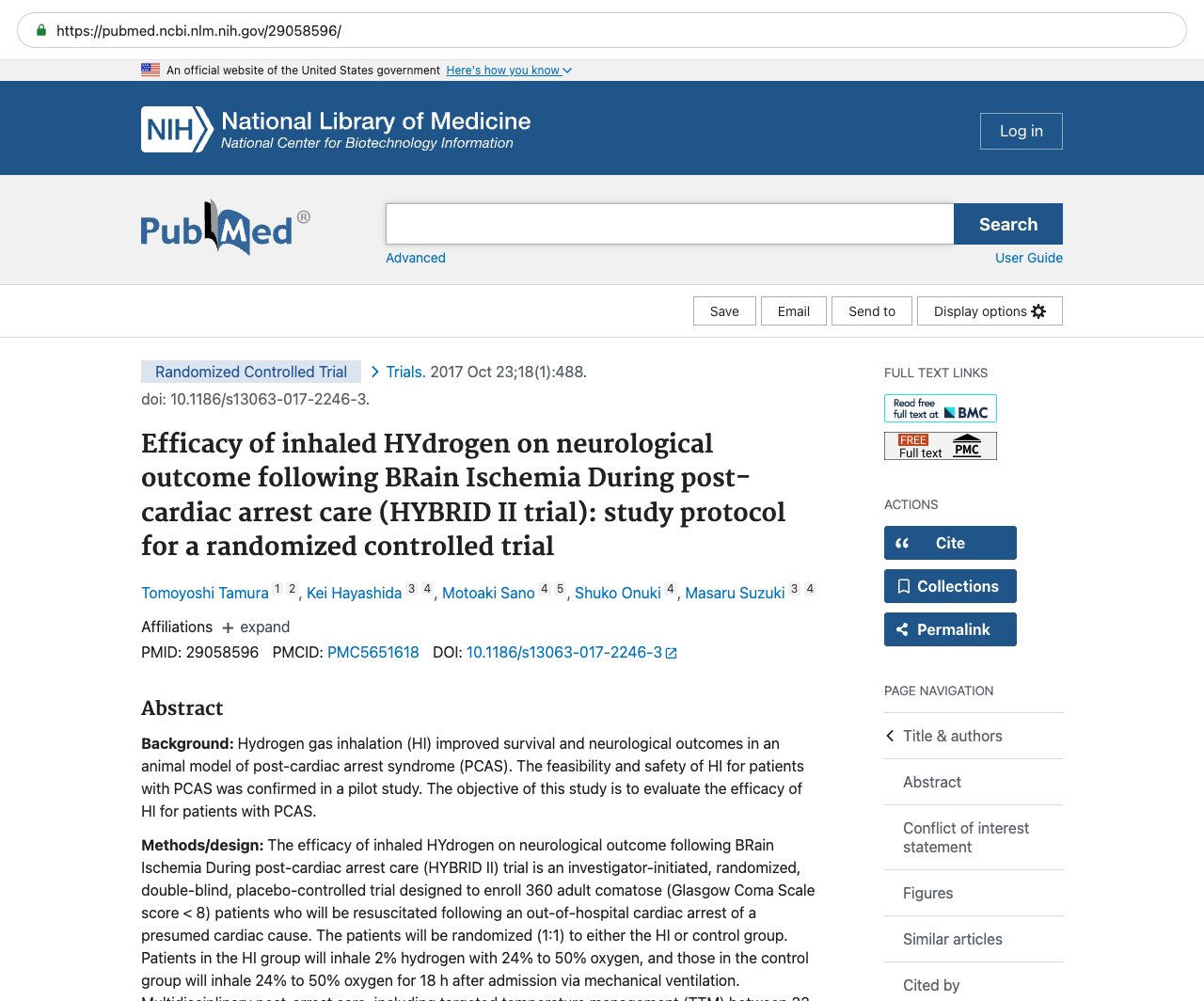
This page mirrors the published abstract (© the authors / publisher) for reference and citation. The canonical source is the PubMed record linked above. This is not medical advice.