2023 Antioxidants (Basel, Switzerland) Pilot / Observational Human H₂ therapy Inhalation NeurologyOxidative stressFundamentals / Safety
2023 · Rahman et al. — Effects of Hydrogen Gas Inhalation on Community-Dwelling Adults of Various Ages: A Single-Arm, Open-Label, Prospective Clinical Trial
Super-Abstract
In a single-arm, open-label study of 54 community-dwelling adults, 4 weeks of hydrogen gas inhalation showed no adverse change in white blood cell counts, and the oxidative stress markers reactive oxygen species and nitric oxide were lower afterwards. Several dementia-related blood markers also changed, which the authors describe as a significant improvement in cognitive condition, although the abstract reports no cognitive tests and no figures. With a single group and no control, the changes cannot be attributed to hydrogen. (Antioxidants, 2023.)
Commentary
The study asked how 4 weeks of hydrogen gas inhalation affects adults of various ages living in the community, with a focus on blood markers linked to Alzheimer's disease (AD) risk. Fifty-four participants were screened and enrolled, including about 5% who dropped out. Per full text, 51 participants met the inclusion criteria. All were treated as a single group without randomisation, and the title describes the trial as open-label. Per full text, participants inhaled 2% hydrogen in filtered air through a nasal cannula for 30 minutes a day for 4 weeks. Measurements before and after treatment covered total and differential white blood cell counts as a safety measure, the oxidative stress markers reactive oxygen species and nitric oxide, and dementia-related biomarkers: BACE-1, amyloid beta, BDNF, VEGF-A, total tau, MCP-1 and interleukin-6. The abstract does not name a primary endpoint, describe the participants' ages or report any figures or p-values.
Key quotes
- „The total and differential WBC counts were not adversely affected after H2 gas inhalation, indicating that it was safe and well tolerated.“ — the safety finding, based on blood counts over 4 weeks
- „Investigation of oxidative stress markers such as reactive oxygen species and nitric oxide showed that their levels decreased post-treatment.“ — oxidative stress markers, compared only with values before treatment
- „Collectively, our results indicate that H2 gas inhalation may be a good candidate for improving AD with cognitive dysfunction in community-dwelling adults of different ages.“ — the authors' conclusion, drawn from blood markers rather than cognitive tests
Our assessment
This single-arm, open-label study can describe changes in blood markers in one group over 4 weeks. It cannot show that hydrogen caused them, because there was no control group. The abstract gives no figures, effect sizes or p-values for any marker. Its statement that cognitive condition improved rests on blood biomarkers, and no cognitive testing is reported. Per full text, values before and after treatment were compared with unpaired t-tests, a method meant for independent groups rather than repeated measurements in the same people. Limitations: no randomisation, no blinding reported, no control group, only 4 weeks, many biomarkers tested, no primary endpoint named, and the abstract does not describe the participants' age or cognitive status. The safety finding rests on blood counts in a small group over 4 weeks.
Study design
- Type: single-arm, open-label, prospective clinical trial without randomisation · n: 54 enrolled including about 5% dropouts (51 included per full text) · H₂ delivery: hydrogen gas inhalation for 4 weeks; per full text 2% hydrogen in filtered air, 30 minutes a day by nasal cannula
- Comparator: none; values before treatment
- Result: no primary endpoint named. White blood cell counts not adversely affected. Reactive oxygen species and nitric oxide lower after treatment. Dementia-related markers (BACE-1, amyloid beta, BDNF, VEGF-A, total tau, MCP-1, interleukin-6) described as improved in most cases. No figures or p-values in the abstract
Abstract
Molecular hydrogen (H2) is a versatile therapeutic agent. H2 gas inhalation is reportedly safe and has a positive impact on a range of illnesses, including Alzheimer's disease (AD). Herein, we investigated the effects of 4 weeks of H2 gas inhalation on community-dwelling adults of various ages. Fifty-four participants, including those who dropped out (5%), were screened and enrolled. The selected participants were treated as a single group without randomization. We evaluated the association between total and differential white blood cell (WBC) counts and AD risk at individual levels after 4 weeks of H2 gas inhalation treatment. The total and differential WBC counts were not adversely affected after H2 gas inhalation, indicating that it was safe and well tolerated. Investigation of oxidative stress markers such as reactive oxygen species and nitric oxide showed that their levels decreased post-treatment. Furthermore, evaluation of dementia-related biomarkers, such as beta-site APP cleaving enzyme 1 (BACE-1), amyloid beta (Aβ), brain-derived neurotrophic factor (BDNF), vascular endothelial growth factor A (VEGF-A), T-tau, monocyte chemotactic protein-1 (MCP-1), and inflammatory cytokines (interleukin-6), showed that their cognitive condition significantly improved after treatment, in most cases. Collectively, our results indicate that H2 gas inhalation may be a good candidate for improving AD with cognitive dysfunction in community-dwelling adults of different ages.
Source & links
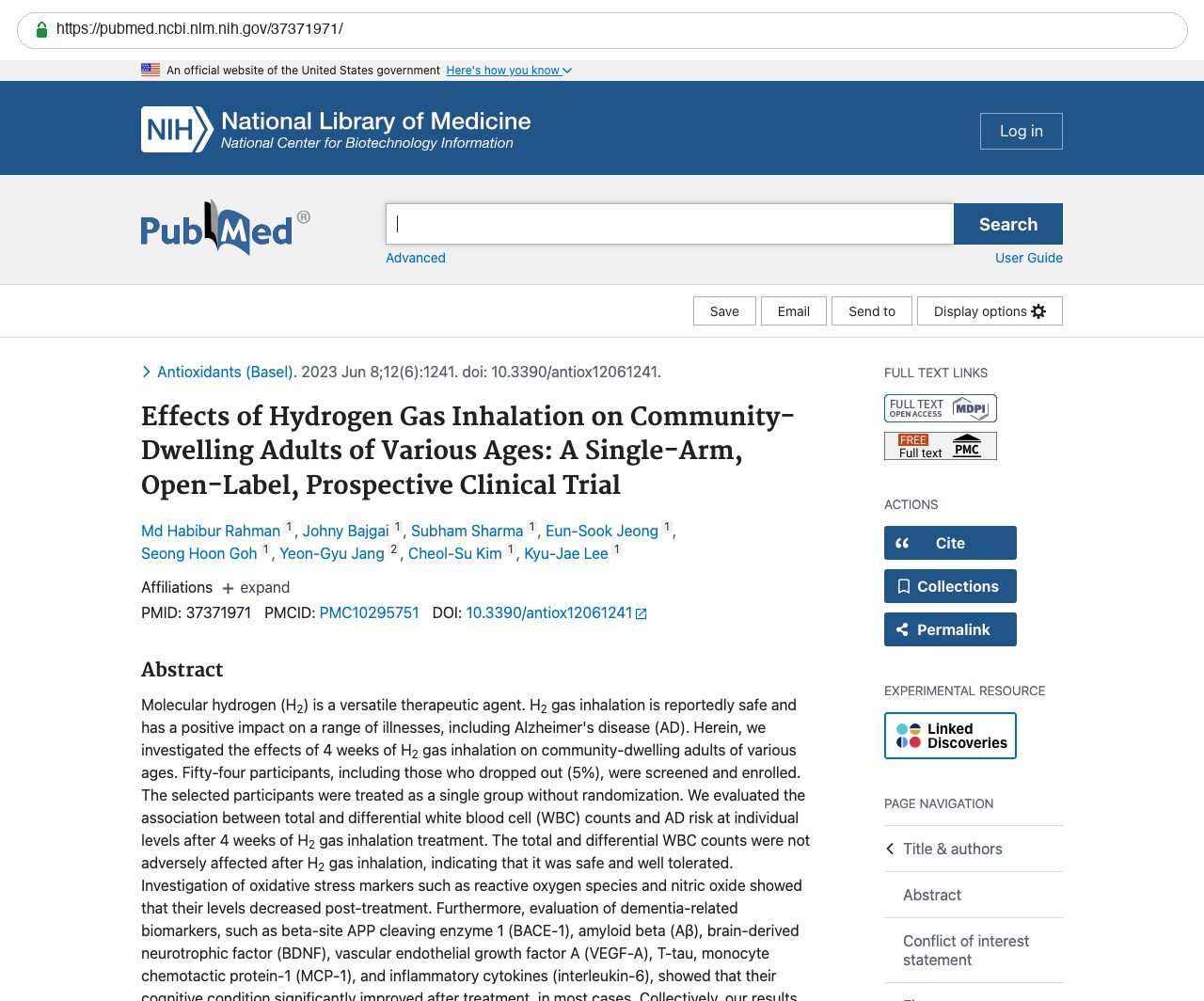
Screenshot of the PubMed page
This page mirrors the published abstract (© the authors / publisher) for reference and citation. The canonical source is the PubMed record linked above. This is not medical advice.