2021 · Chu — Mechanism of hydrogen on cervical cancer suppression revealed by high-throughput RNA sequencing
Super-Abstract
H₂ inhalation suppressed the growth of cervical cancer cells in the laboratory and in a mouse xenograft model, apparently by switching off two key cancer-promoting proteins — HIF-1α and NF-κB p65. RNA sequencing helped map the molecular pathway. These are cell-culture and animal findings; no human patients were involved.
Commentary
The study is technically well-rounded: it combines cytotoxicity assays, oxidative-stress markers, in-vivo xenograft tumour growth, and genome-wide RNA sequencing. The central observation — that H₂ selectively increased apoptosis and reduced proliferation in HeLa cervical cancer cells but not in normal HaCaT keratinocytes — is noteworthy and worth replicating. The proposed mechanism (downregulation of HIF-1α and NF-κB signalling) is biologically plausible and consistent with H₂'s established anti-inflammatory and antioxidative profile. However, the study remains entirely preclinical (in-vitro cells + mouse xenograft), and the authors themselves note that the exact mechanism „remains unclear.“ The leap from HeLa-cell culture to clinical application in cervical cancer patients is substantial and unproven.
Key quotes
- „The results revealed an increased apoptosis rate, and reduced cell proliferation and oxidative stress in H2-treated HeLa cells but not in HaCaT cells.“ — selective effect on cancer cells while sparing normal keratinocytes
- „RNA sequencing and GO analysis suggest that downregulated HIF1A (HIF-1α mRNA) and RelA (NF-κB p65) levels, and reduced NF-κB signaling were associated with the antitumor effect of H2.“ — proposed molecular mechanism identified via transcriptomics
- „the present study reveals a novel mechanism of H2 against cervical cancer, which may serve as a potential therapeutic target in clinical practice.“ — authors' cautious forward-looking conclusion
Our assessment
This is a preclinical study — HeLa cell culture plus a mouse xenograft model. The data are biologically interesting and the methodology is solid for its scope, but results cannot be extrapolated to human cancer therapy. HeLa cells are a highly artificial system (immortalised, heavily mutated), and xenograft models in immunocompromised mice routinely overestimate anti-tumour effects. Clinical trials in humans would be required to draw any therapeutic conclusions. The authors' own language — „may serve as a potential therapeutic target“ — correctly signals the preliminary nature of these findings.
Study design
- Type: in-vitro + animal (preclinical) · Model: HeLa cervical cancer cells; HaCaT keratinocytes; HeLa xenograft nude mice · H₂ delivery: H₂ gas inhalation (concentration not specified in abstract)
- Endpoints: apoptosis (TUNEL), proliferation (Ki67/CCK-8), oxidative stress (ROS, MDA, SOD), tumour volume; RNA-seq + GO enrichment analysis
- Key finding: H₂ increased apoptosis and reduced proliferation in HeLa but not HaCaT cells; HIF-1α and NF-κB p65 downregulated at mRNA and protein level in H₂-treated cells and tumours
Abstract
Cervical cancer is considered one of the diseases with the highest mortality among women and with limited treatment options. Hydrogen (H2) inhalation has been reported to have a variety of tumor‑suppressive effects, but the exact mechanism remains unclear. In the present study, HeLa cervical cancer cells and HaCaT keratinocytes treated with H2, and a HeLa xenograft mouse model subjected to H2 inhalation were established. TUNEL, Cell Counting Kit‑8 and Ki67 staining assays were used to detect cell apoptosis and proliferation. Oxidative stress was determined according to the levels of reactive oxygen species, malondialdehyde and superoxide dismutase. Tumor growth was recorded every 3 days, and the excised tumors were stained with hematoxylin and eosin. High‑throughput RNA sequencing and subsequent Gene Ontology (GO) enrichment analysis were performed in HeLa‑treated and un‑treated HeLa cells. The expression of hypoxia‑inducible factor (HIF)‑1α and NF‑κB p65 was verified by western blotting, immunohistochemistry and reverse transcription‑quantitative PCR. The results revealed an increased apoptosis rate, and reduced cell proliferation and oxidative stress in H2‑treated HeLa cells but not in HaCaT cells. Similarly, decreased tumor growth and cell proliferation, and enhanced cell apoptosis were observed in H2‑treated HeLa tumors. RNA sequencing and GO analysis suggest that downregulated HIF1A (HIF‑1α mRNA) and RelA (NF‑κB p65) levels, and reduced NF‑κB signaling were associated with the antitumor effect of H2. Finally, decreased HIF‑1α and NF‑κB p65 expression both at the transcriptional and translational levels were observed in H2‑treated HeLa cells and in HeLa‑derived tumors. In conclusion, the present study reveals a novel mechanism of H2 against cervical cancer, which may serve as a potential therapeutic target in clinical practice.
Source & links
Screenshot of the PubMed page
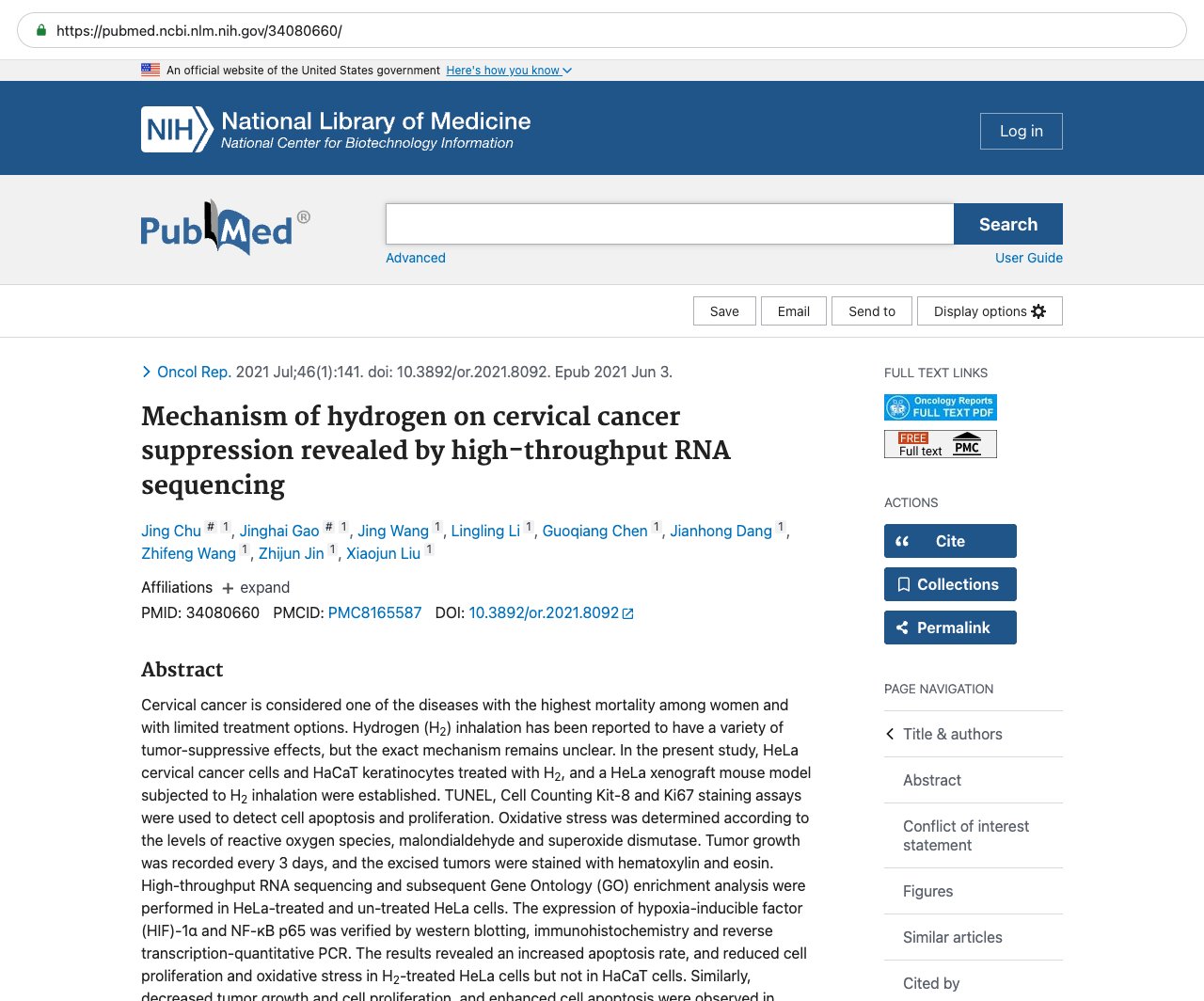
This page mirrors the published abstract (© the authors / publisher) for reference and citation. The canonical source is the PubMed record linked above. This is not medical advice.