2026 · Li — MXene-Engineered MgB₂ Nanoprodrugs with Acid-Responsive Hydrogen Evolution for Cooperative Photothermal Cancer Ablation
Super-Abstract
Researchers engineered a nanoparticle system (MgB₂-Ti₃C₂Tₓ@PEG) that releases hydrogen gas specifically within the acidic tumor microenvironment and simultaneously converts near-infrared laser light into heat — combining hydrogen gas therapy with photothermal tumor ablation. In cell culture experiments, this dual strategy disrupted mitochondrial function, increased reactive oxygen species, and suppressed heat-shock proteins that normally protect cancer cells from heat damage. The system also enabled real-time photoacoustic imaging. (ACS Applied Materials & Interfaces, 2026.)
Commentary
This is a materials-science paper at the intersection of nanomedicine and hydrogen gas therapy. The key innovation is the acid-responsive MgB₂ „prodrug“: in a slightly acidic tumor microenvironment, it hydrolyzes to release H₂ on demand, while the MXene (Ti₃C₂Tₓ) nanosheet scaffold converts laser energy into heat with 31 % efficiency. The authors argue that H₂ attacks a specific vulnerability of photothermal therapy — heat-shock protein (HSP) upregulation, which is the tumor's built-in resistance mechanism to heat. By downregulating HSPs, H₂ effectively lowers the temperature threshold at which heat kills cancer cells. All evidence is in-vitro (cell culture); no animal or human data are presented.
Key quotes
- „The liberated hydrogen gas then orchestrates a cascade of therapeutic effects; it triggers oxidative stress and a surge in reactive oxygen species within cancer cells, thus disrupting mitochondrial respiration function.“ — proposed mechanism: H₂ → ROS burst → mitochondrial disruption in cancer cells
- „the expression of HSPs is down-regulated, thereby eliminating thermotolerance and sensitizing tumor cells to PTT.“ — how H₂ overcomes the main resistance mechanism of photothermal therapy
- „This work pioneers the use of hydrogen molecules to dismantle cellular defense mechanisms against hyperthermia, offering a paradigm shift toward more precise, potent, and intelligently guided PTT.“ — authors' summary of the conceptual contribution
Our assessment
This is an early-stage, in-vitro proof-of-concept study. The nanosystem is chemically creative and the rationale for combining H₂ with photothermal therapy is mechanistically plausible. However, all data come from cell-culture experiments — there are no animal or human data. Translation to clinical use requires substantial further development: demonstrating tumor targeting in living organisms, ruling out off-target toxicity, and solving the engineering challenge of delivering precisely controlled laser doses to deep tumors. This is not a human therapeutic proof and does not constitute evidence for H₂ therapy as a standalone treatment.
Study design
- Type: in-vitro study · Model: cancer cell cultures · H₂ delivery: acid-responsive MgB₂ prodrug embedded in MXene nanosheet system (MgB₂-Ti₃C₂Tₓ@PEG)
- Result: increased ROS, mitochondrial disruption, HSP downregulation, enhanced photothermal killing in cancer cells; photothermal conversion efficiency 31.06 % at 808 nm laser excitation
Abstract
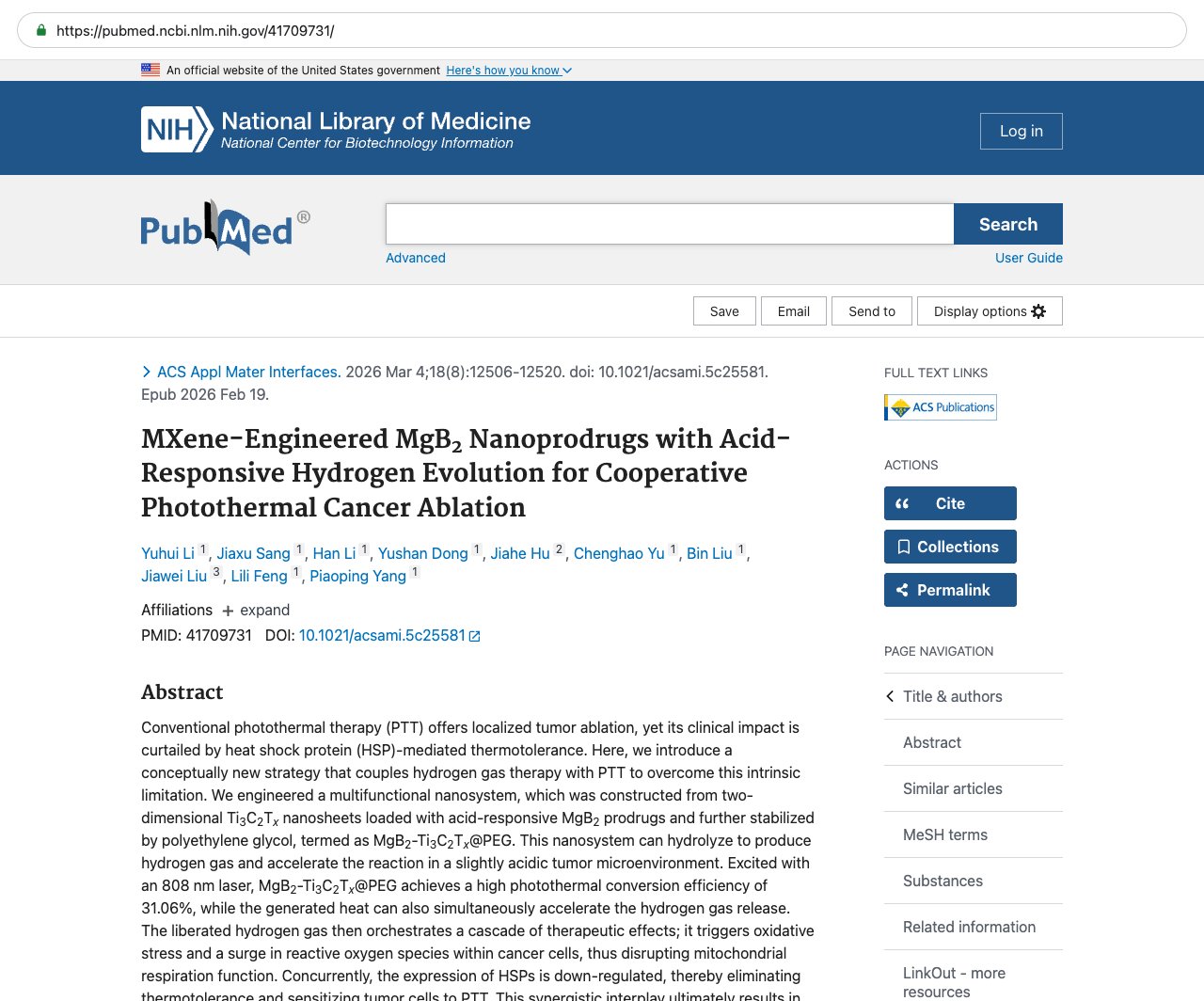
Conventional photothermal therapy (PTT) offers localized tumor ablation, yet its clinical impact is curtailed by heat shock protein (HSP)-mediated thermotolerance. Here, we introduce a conceptually new strategy that couples hydrogen gas therapy with PTT to overcome this intrinsic limitation. We engineered a multifunctional nanosystem, which was constructed from two-dimensional Ti3C2Tx nanosheets loaded with acid-responsive MgB2 prodrugs and further stabilized by polyethylene glycol, termed as MgB2-Ti3C2Tx@PEG. This nanosystem can hydrolyze to produce hydrogen gas and accelerate the reaction in a slightly acidic tumor microenvironment. Excited with an 808 nm laser, MgB2-Ti3C2Tx@PEG achieves a high photothermal conversion efficiency of 31.06%, while the generated heat can also simultaneously accelerate the hydrogen gas release. The liberated hydrogen gas then orchestrates a cascade of therapeutic effects; it triggers oxidative stress and a surge in reactive oxygen species within cancer cells, thus disrupting mitochondrial respiration function. Concurrently, the expression of HSPs is down-regulated, thereby eliminating thermotolerance and sensitizing tumor cells to PTT. This synergistic interplay ultimately results in robust tumor growth inhibition. Moreover, the strong near-infrared absorption and photoacoustic properties of Ti3C2Tx enable real-time imaging guidance, integrating therapy and diagnostics into a single nanoplatform. This work pioneers the use of hydrogen molecules to dismantle cellular defense mechanisms against hyperthermia, offering a paradigm shift toward more precise, potent, and intelligently guided PTT.
Source & links
Screenshot of the PubMed page
This page mirrors the published abstract (© the authors / publisher) for reference and citation. The canonical source is the PubMed record linked above. This is not medical advice.